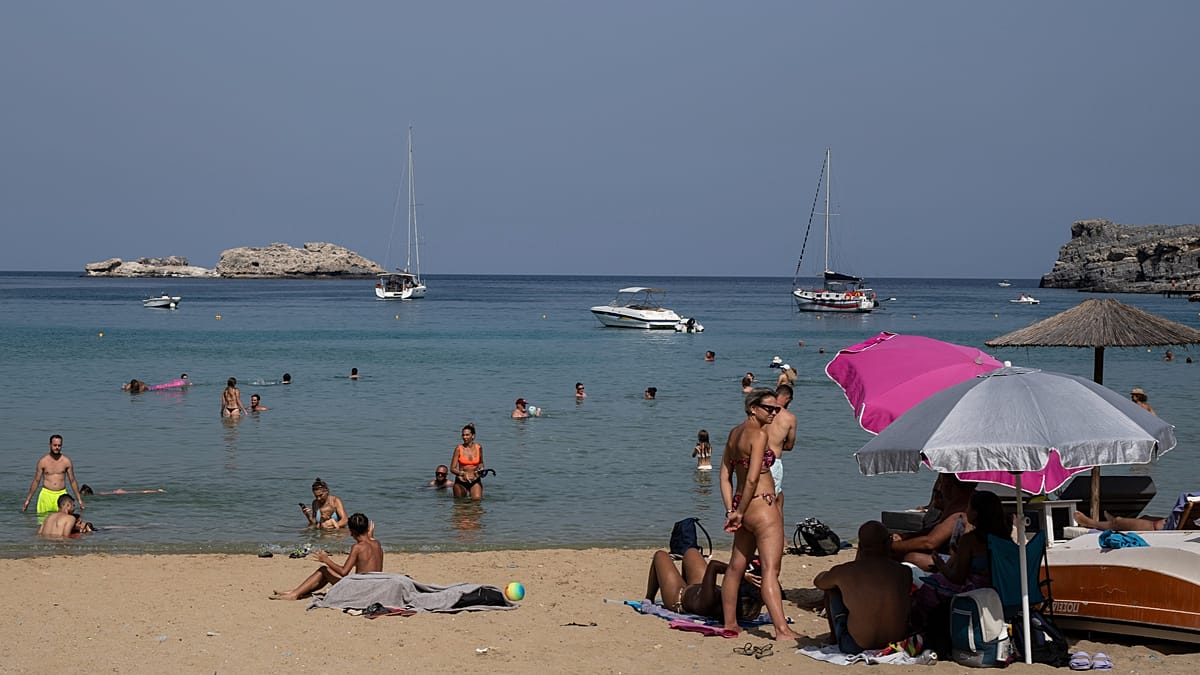
Greece's tourism sector continued its upward trajectory in July 2026, with provisional data from the Hellenic Statistical Authority (ELSTAT) showing arrivals at hotels, campsites and short-stay accommodation reaching 6.61 million and overnight stays climbing to 31.70 million. Compared with July 2025, arrivals rose by 2.5% and overnight stays by 2.0%, confirming the sector's steady post-pandemic recovery.
The headline figures, however, mask a stark divide between domestic and international demand. Foreign visitors accounted for approximately 5.30 million arrivals, or 80.3% of the total, while Greek travellers made up just 1.30 million arrivals, or 19.7%. The gap widens further when overnight stays are considered: foreigners recorded 27.78 million nights, representing 87.6% of the total, against 3.92 million nights (12.4%) for Greeks.
Foreign demand outpaces domestic growth
Both categories expanded year on year, but at markedly different rates. Arrivals of foreign visitors increased by 2.9%, and their overnight stays rose by 2.2%. Greek travellers, by contrast, posted a more modest gain of 0.8% in arrivals and 0.4% in overnight stays. The July expansion was therefore propelled overwhelmingly by demand from abroad, reinforcing the sector's reliance on international markets.
The divergence is even more pronounced when average length of stay is examined. Across all accommodation types, foreign visitors stayed an average of 5.2 days, compared with 3.0 days for Greeks. In hotels and campsites, foreigners averaged 5.2 days against 2.8 days for domestic travellers. In short-stay rentals, the figures were 5.4 days and 3.5 days respectively. Overall, the average stay for all visitors stood at 4.8 days, unchanged from July 2025.
Hotels, rentals and campsites
Foreign dominance is not confined to a single segment of the market. In hotel-type accommodation, international visitors represented around 81.1% of arrivals and 89.3% of overnight stays. In short-stay accommodation, they accounted for 79.6% of arrivals and 85.6% of nights. Campsites presented a more balanced picture, though foreigners still held the majority with 60.2% of arrivals and 55.9% of overnight stays, compared with 39.8% and 44.1% for Greeks.
In absolute terms, July 2026 recorded 6,608,128 arrivals and 31,701,467 overnight stays across the surveyed accommodation types. Year on year, that represents an additional 158,486 arrivals and 624,020 overnight stays. The figures underscore a tourism economy that depends heavily on international demand: four out of every five arrivals and nearly nine out of every ten overnight stays are attributable to foreign visitors, who also spend more days in accommodation than their Greek counterparts.
The data arrive amid broader debates about the sustainability of Greece's tourism model. A fatal dispute over sunbeds on an Athens beach has highlighted tensions between commercial tourism and public access to the coastline. At the same time, the sector faces structural challenges, including a youth exodus and product fraud threatening a protected Greek crop, which illustrate how tourism pressures intersect with rural economies and cultural heritage.
On a more positive note, Greece's capital markets have received a boost from the country's upgraded status, with Greece's stock market gaining developed status in the FTSE Russell index, a move that could improve financing conditions for tourism-related businesses and infrastructure projects.
ELSTAT cautions that the July 2026 figures are provisional, while the July 2025 data are final. The agency's survey covers hotels, campsites and short-stay accommodation, but does not capture other forms of lodging such as private homes rented informally or stays with friends and family. Nonetheless, the trend is clear: Greece's summer season remains buoyant, but its momentum is increasingly dependent on visitors from beyond its borders.