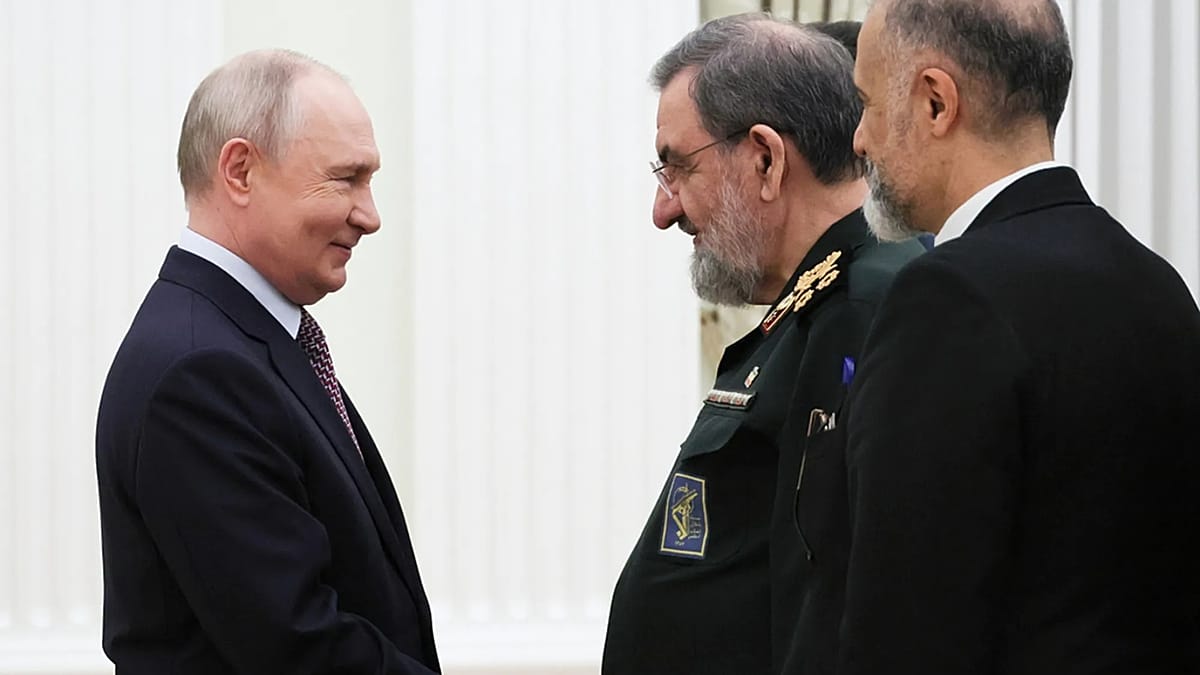
Iran's top security official, Mohsen Rezaei, met Russian President Vladimir Putin in Moscow on Thursday, delivering a personal message from Ayatollah Khamenei and discussing a proposed gas pipeline project. The unannounced meeting, reported by Iranian state media, focused on what both sides described as strengthening bilateral ties.
Rezaei, who serves as secretary of Iran's Supreme National Security Council, called the talks an "extremely important exchange of views" covering "the post-war situation and regional security." The content of Khamenei's message was not disclosed.
The visit follows a meeting between Putin and Iranian President Masoud Pezeshkian in Moscow last week during a summit of the Gas Exporting Countries Forum. Russia has long supported Iran, reportedly providing intelligence and equipment during the recent conflict, while Tehran has supplied Moscow with Shahed drone technology, which Russia has cloned into its own Geran UAVs for strikes on Ukrainian infrastructure.
Gas pipeline and regional security
Rezaei stated that "the construction of gas pipelines from Russia to Iran was discussed" during the meeting. He explained that the project aims to help Tehran "address its gas shortages, while also facilitating the sale of Russian gas to neighbouring countries."
Despite being a major gas producer, Iran has faced chronic shortages, exacerbated by the war that began in late February. Tehran claims that US and Israeli strikes targeted critical infrastructure, including gas processing plants, during the conflict's most intense phase. Iran retaliated against what it said were US military facilities, though regional governments and journalists reported civilian casualties as well. Both sides imposed blockades on the Strait of Hormuz, a vital waterway for global energy trade.
Putin has offered to mediate an end to the war, but Moscow has not acted as an intermediary; Pakistan and Qatar have taken that role. Rezaei noted Putin's emphasis on regional security mechanisms and his assertion that "any interference by external powers" in resolving Middle East issues is unacceptable. Meanwhile, Russia has continued to reject efforts to broker peace in its own war in Ukraine, now in its fifth year.
Infrastructure and loans
The meeting also addressed progress on the Rasht–Astara railway, a key infrastructure project. Rezaei said the Supreme National Security Council has approved the executive agreement for its construction with Russian participation, and Iran's Minister of Roads and Urban Development will sign the contract soon. The 160-kilometre railway is the final missing link in the International North-South Transport Corridor (INSTC), which would connect Russia to Iranian ports on the Persian Gulf.
According to Iranian media, Russia has prepared a $1 billion loan for Iran, the first instalment of a planned $20 billion package, but the transfer has been delayed. Some experts link the delay to stalled progress on the railway project. Putin, speaking at the Valdai Discussion Club on 1 October, said, "We are prepared to provide the necessary credit resources. The question is for our Iranian friends to complete their part of the work at this stage."
After the meeting, Russia's Foreign Ministry issued a travel advisory warning Russians to avoid Iran and the Middle East due to the risk of renewed conflict. This follows a similar advisory issued in February, which was lifted in June after a short-lived interim deal between Washington and Tehran collapsed.
The meeting underscores the deepening alignment between Moscow and Tehran, both isolated by Western sanctions and engaged in conflicts that have reshaped regional dynamics. For Europe, the prospect of a Russia-Iran gas pipeline could further complicate energy security and geopolitical stability, as the EU continues to reduce reliance on Russian energy. France has pushed for stronger European naval power amid such maritime threats, while Khamenei has warned of a global response if the US strikes Iran again. The situation remains fluid, with potential implications for the broader Middle East and beyond.