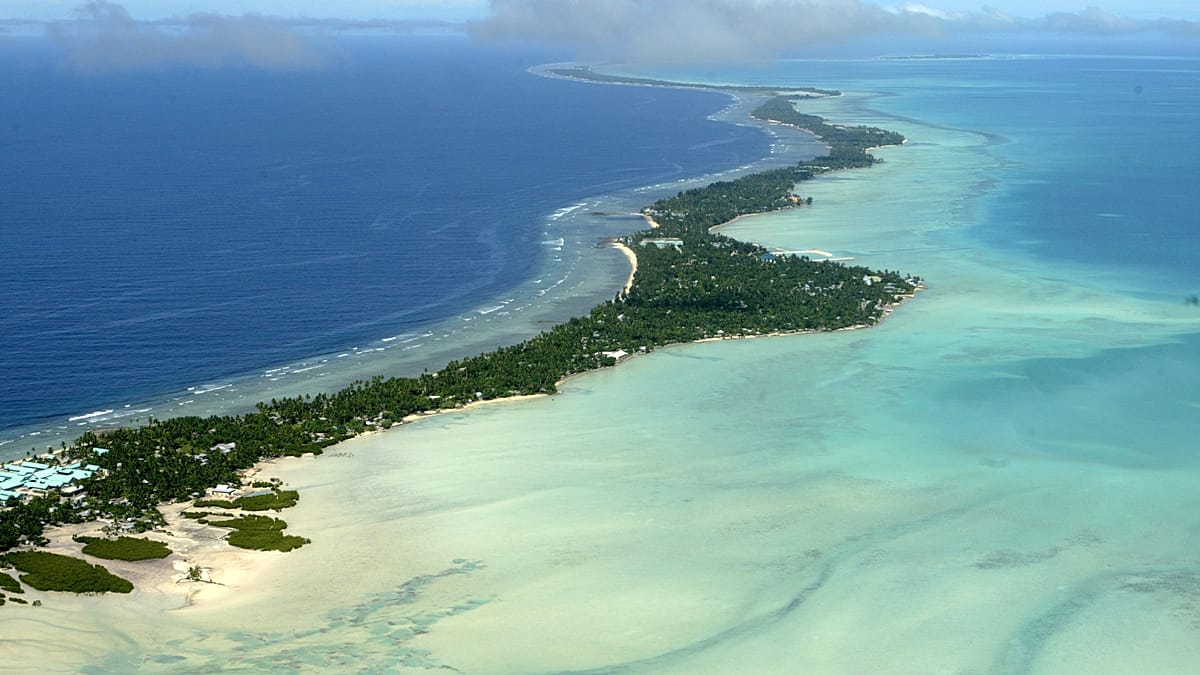
Five people, including two children, have been found alive on a remote Kiribati island after spending roughly three months adrift in the Pacific Ocean. The group, which had been missing since late July, was spotted by villagers on Fanning Island (Tabuaeran) on Sunday, according to the Australian Broadcasting Corporation.
The survivors had departed from Murilo Atoll in Micronesia's Chuuk State on July 30 aboard a 6-metre skiff, intending to travel to the nearby island of Ruo. A storm, however, pushed them far off course, and they drifted an estimated 5,400 kilometres eastward before reaching the shores of Fanning Island, part of the Republic of Kiribati.
The United States Coast Guard conducted a ten-day search covering more than 85,000 square kilometres after the vessel was reported missing, but found no trace. In a statement to The Associated Press, the USCG expressed relief at the discovery, saying: “Incredible and wonderful news these five folks were found and are receiving care.” The agency also extended condolences to the families of the four other passengers who were aboard the skiff and remain unaccounted for.
Kaotitaake Rakoroa, a local lawmaker in Chuuk, confirmed that the survivors have received medical treatment and are currently being cared for by a pastor on Fanning Island. The group's condition has not been fully detailed, but they are reported to be stable.
Repatriation efforts underway
Alexander Narruhn, the governor of Chuuk State, said on Sunday that he is in talks with the Kiribati government to arrange the survivors' return to Micronesia. “There were nine people aboard the boat that went missing. Thanks be to God for his love and mercy that five of the nine have been found,” Narruhn said in a statement.
The rescue highlights the perils of inter-island travel in the Pacific, where vast distances and unpredictable weather can turn short journeys into life-threatening ordeals. It also underscores the importance of regional cooperation in search-and-rescue operations, a challenge that resonates beyond the Pacific as climate change increases the frequency of extreme weather events.
While this incident occurred far from European shores, it serves as a reminder of the global nature of maritime safety and the need for continued investment in emergency response capabilities. European nations, many of which have overseas territories in the Pacific and Indian Oceans, have long been involved in similar rescue efforts, and the European Union has funded maritime safety programmes in the region.
The survivors' ordeal is a testament to human endurance, but it also raises questions about the adequacy of safety measures for small vessels in remote areas. As the Pacific community celebrates this rare happy ending, attention now turns to the families of the four who did not make it, and to the logistical challenge of bringing the five home.