As the olive harvest season unfolds across the occupied West Bank, Palestinian farmers are once again navigating a landscape shaped by Israeli military restrictions. This year, access to groves has been permitted only within narrow windows, and the experience has been marked by both damaged trees and the lingering threat of tear gas.
Restricted access and damaged groves
Under the current military orders, farmers in several villages near Nablus and Hebron have been allowed into their fields for limited hours, often requiring coordination with the Israeli Civil Administration. Many who reached their groves discovered that centuries-old olive trees had been cut or burned, likely during previous military operations or settler activity. The loss is not just economic but deeply symbolic, as olives are central to Palestinian identity and rural livelihoods.
In the village of Qusra, south of Nablus, farmer Mahmoud Awad described finding a dozen of his trees snapped at the base. "These trees have been in my family for generations," he told European Pulse. "We waited all year for this harvest, and now we are left with firewood." Similar reports have emerged from the Jordan Valley, where access is often the most restricted.
Tear gas and tension
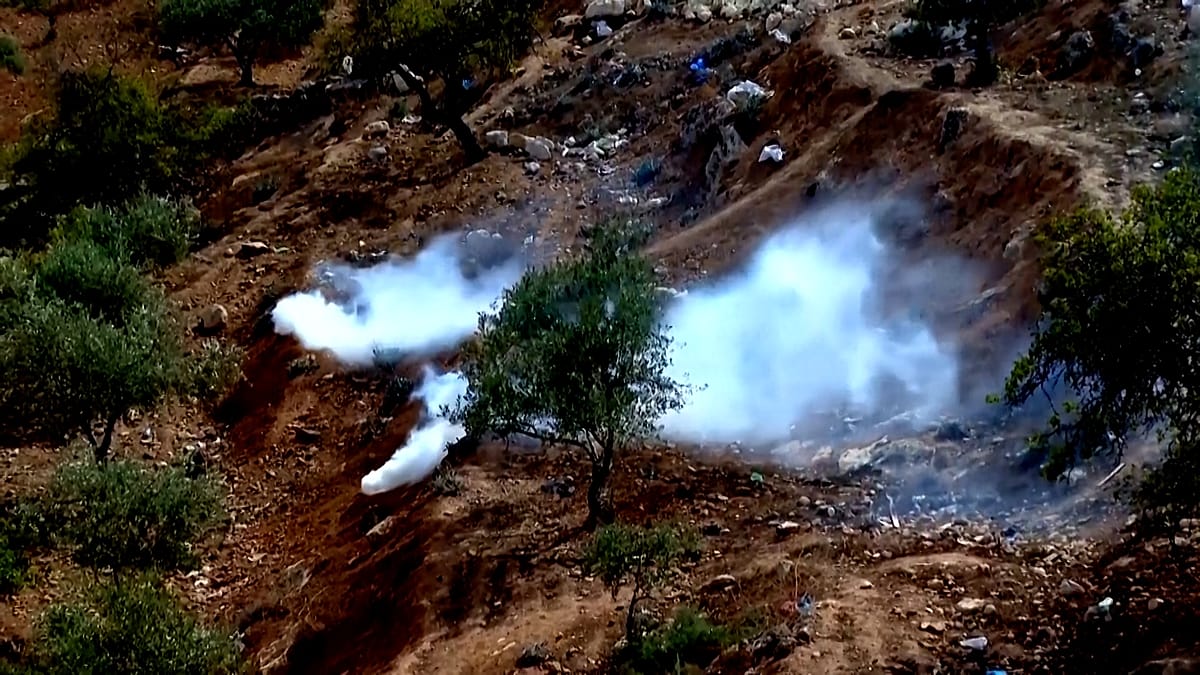
Witnesses reported that Israeli soldiers fired tear gas canisters near groups of harvesters, dispersing families and forcing them to abandon their work temporarily. The Israeli military said the measures were necessary to prevent clashes with settlers and to maintain security, but Palestinian officials and human rights groups argue that the restrictions are part of a broader pattern of displacement and land appropriation.
The olive harvest is a critical economic pillar for the West Bank, accounting for a significant share of agricultural income. According to the Palestinian Central Bureau of Statistics, olives and olive oil represent about 14% of the territory's agricultural output, supporting tens of thousands of families. When access is curtailed, the impact ripples through local markets and households.
European stakes
The situation resonates well beyond the region. The European Union has repeatedly called for the protection of Palestinian farmers and has funded projects to support olive cultivation. In 2023, the European Parliament passed a resolution condemning the expansion of settlements and the destruction of Palestinian agricultural land. Yet, as this year's harvest shows, little has changed on the ground.
European foreign policy has also been tested by the broader conflict. The EU's stance on the Israeli-Palestinian issue remains a delicate balancing act, with member states split on how to pressure Israel while maintaining diplomatic ties. The recent clearing of Israeli election fraud claims has done little to ease tensions, and the prospect of US military aid ending in 2027 could reshape the strategic calculus.
Human cost
For the farmers, the restrictions are not just an inconvenience but a daily struggle for survival. Many have resorted to harvesting at night or in small groups to avoid drawing attention. Others have given up entirely, leaving their groves untended. The psychological toll is evident in the words of a woman from the village of Burin, who asked not to be named: "We are not asking for much, just to pick what we planted. But even that is now a political act."
The international community, including European observers, has documented these practices for years. A 2022 report by the UN Office for the Coordination of Humanitarian Affairs found that settler violence and military restrictions had led to a 40% decline in olive production in some areas. This year's harvest appears to be following a similar trajectory.
Looking ahead
As the harvest season continues, the hope among Palestinian farmers is that international pressure, particularly from European capitals, will lead to a relaxation of restrictions. But with the political landscape in Israel remaining volatile and the broader conflict unresolved, the immediate outlook is bleak. For now, the olive trees stand as silent witnesses to a struggle that shows no sign of ending.
European Pulse will continue to monitor the situation, and we invite readers to explore related coverage on Europe's military readiness and undersea cable security, as these issues reflect the broader security challenges facing the continent.