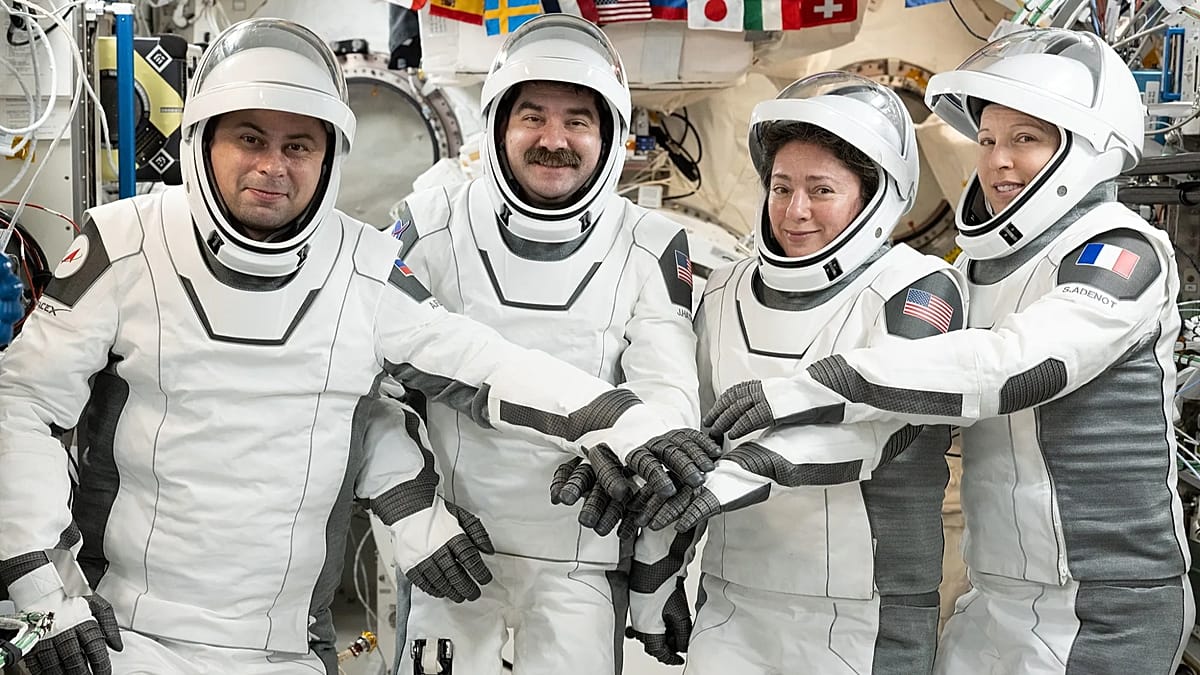
In a rare but established procedure, three NASA astronauts cast their ballots in Tuesday's US midterm elections from the International Space Station (ISS), using a secure electronic link that ensures their votes reach election officials on Earth.
Anil Menon, who arrived at the station in mid-July aboard a Russian Soyuz spacecraft, announced on X that he and colleagues Luke Delaney and Jessica Watkins had voted from orbit. In a 29-second video, Menon displayed an “I voted” sticker and gave a tour of his private cabin, which he jokingly called his “polling station.” He explained that he filled out the ballot on his computer and transmitted it to Harris County, Texas, where his vote was officially recorded.
Harris County is the customary electoral home for NASA astronauts because it hosts the Johnson Space Center in Houston, the agency's primary hub for human spaceflight missions. The voting process relies on the same infrastructure NASA uses daily to exchange data with the ISS through its Space Communications and Navigation program.
How votes travel from orbit
The procedure begins when an astronaut requests an absentee ballot using the Federal Post Card Application, a form also used by US military personnel stationed abroad. Once completed on board, the ballot is sent via NASA's Tracking and Data Relay Satellite System to a ground antenna at the agency's White Sands facility in Las Cruces, New Mexico. From there, it is forwarded to Mission Control at the Johnson Space Center and then to the relevant county election official for registration and counting.
NASA emphasizes that the process is protected by strict security measures. The ballot is encrypted, and only the astronaut and the authorized election official can view its contents, safeguarding the secrecy and integrity of the vote.
While voting from beyond Earth is highly unusual, it is not new. The practice began in 1997, when the Texas legislature passed a law allowing NASA astronauts to vote in US elections while in orbit. American astronaut David Wolf was the first to do so, casting his vote that same year from the Russian space station Mir, nearly three years before the ISS welcomed its first permanent crew in November 2000.
The three astronauts who voted this year arrived on two separate missions. Delaney and Watkins launched on 1 October last year as part of SpaceX's Crew-13 mission, while Menon arrived in mid-July aboard a Russian Soyuz spacecraft. They are living alongside four other crew members: Canadian astronaut Joshua Kutryk and Russian cosmonauts Anna Kikina, Pyotr Dubrov, and Sergei Teteriatnikov. Kutryk and Teteriatnikov are also part of Crew-13, while Dubrov and Kikina arrived with Menon on the Soyuz.
This orbital voting tradition underscores the lengths to which the United States goes to ensure its citizens can participate in democracy, even when they are hundreds of kilometres above the Earth. It also highlights the international cooperation that defines the ISS, where astronauts and cosmonauts from different nations work side by side. As European readers may note, the ISS is a joint project involving NASA, Roscosmos, ESA, JAXA, and CSA, and the ability to vote from space is a testament to the robust communication networks that support such missions.
For those interested in the broader context of electoral integrity, recent events such as Israel's election commission clearing a vote of fraud show that trust in electoral processes remains a global concern. Meanwhile, the US midterms have drawn attention worldwide, with results that could shape international policy. The astronauts' participation is a reminder that even in the most remote of workplaces, civic duties are not forgotten.