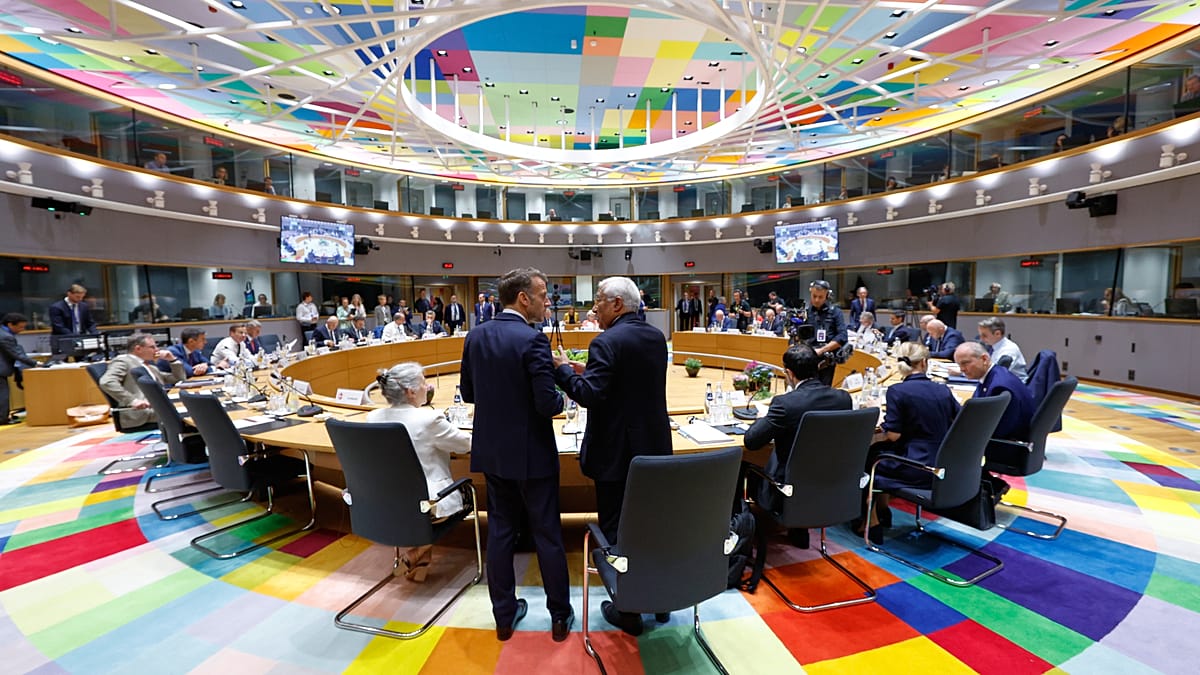
Brussels is dusting off an old idea with new urgency: a permanent European Security Council (ESC) that would keep defence and crisis management on the agenda all year round. The proposal, floated by European Commission President Ursula von der Leyen in September, comes as EU member states confront a wave of hybrid attacks and growing doubts about the reliability of US security guarantees under NATO.
The EU has already ramped up defence spending significantly. The European Defence Fund has received €8.8 billion, and military mobility projects another €1.7 billion. Between 2021 and 2026, member states' defence investment is projected to rise by 158.7%. Yet, as the European Commission itself acknowledges, Europe still lacks a rapid-response mechanism and a coherent way to coordinate defence efforts across the bloc.
What would the European Security Council do?
The proposed ESC would be the EU's first permanent forum for crisis management, bringing together heads of state and government, the High Representative for Foreign Affairs, and the European Commissioner for Defence. Its goal is to improve operational unity, speed up decision-making, and provide stronger strategic direction. It would also unify responses to crises that affect multiple member states simultaneously.
The council would operate under an emergency security protocol modelled on NATO's Article 4. That means any member state that believes its security, territorial integrity, or political independence is under threat could call for consultations and a coordinated response. The idea is to create a habit of joint action before a crisis escalates, rather than reacting ad hoc.
The ESC would not replace NATO. Instead, it would complement the alliance by giving the EU its own crisis-management tool, particularly for threats that fall below the threshold of collective defence. This is seen as increasingly important as Black Sea drone strikes expose gaps in EU maritime defence plans and as Russian hybrid attacks—ranging from airspace violations to cyberattacks and sabotage—continue to test European resilience.
Who would be at the table?
The Commission's proposal envisions a council that includes not only EU leaders but also key international partners: Ukraine, Canada, Norway, and the United Kingdom. This reflects the reality that European security cannot be managed by the EU alone. The inclusion of the UK, in particular, marks a pragmatic step beyond Brexit friction, acknowledging that London remains a vital European security actor.
The idea is not entirely new. In 2018, French President Emmanuel Macron and then-German Chancellor Angela Merkel proposed a similar body in the Meseberg Declaration, titled “Renewing Europe’s promises of security and prosperity.” That earlier initiative stalled, but the current security environment has given it new life.
Why now?
The push for greater strategic autonomy has gained momentum as US commitments to NATO have become less predictable. Washington's repeated threats to cut funding and its recent decision to withdraw B-1 bombers from RAF Fairford have underscored European dependence on American military assets. At the same time, US Secretary of State Marco Rubio has been pushing Europe to boost defence spending, a message that resonates in Athens and other capitals but also raises questions about the durability of the transatlantic bond.
Russia's 2027 budget, which slashes cancer funding while defence consumes 35% of spending, signals that Moscow intends to sustain its military posture for years to come. European leaders are increasingly convinced that they must prepare for a long-term security challenge, not a short-term crisis.
Challenges ahead
Creating a European Security Council is not without obstacles. Member states have differing threat perceptions and defence priorities. The Baltic states and Poland, for example, are more focused on direct Russian aggression, while southern members like Portugal and Italy worry more about migration and energy security. Portugal's 2027 budget allocates 2.15% of GDP to defence, but the political debate there is as much about housing as about tanks.
There is also the question of how the ESC would interact with existing EU structures. The Foreign Affairs Council, the Political and Security Committee, and the European Defence Agency all have roles in security policy. Adding a new body risks duplication and bureaucratic turf wars unless its mandate is clearly defined.
Despite these hurdles, the proposal has a certain logic. The EU has spent heavily on defence but lacks the institutional machinery to use that spending effectively. A permanent council could provide the political oversight needed to turn investment into capability. It could also send a signal to both Moscow and Washington that Europe is serious about taking responsibility for its own security.
The coming months will show whether member states can agree on the details. The ESC is not a panacea, but it could be a step toward a more coherent European defence posture. As the Commission puts it, the goal is to ensure that Europe can respond to crises “with one voice and one purpose.” Whether that voice can be found remains to be seen.



