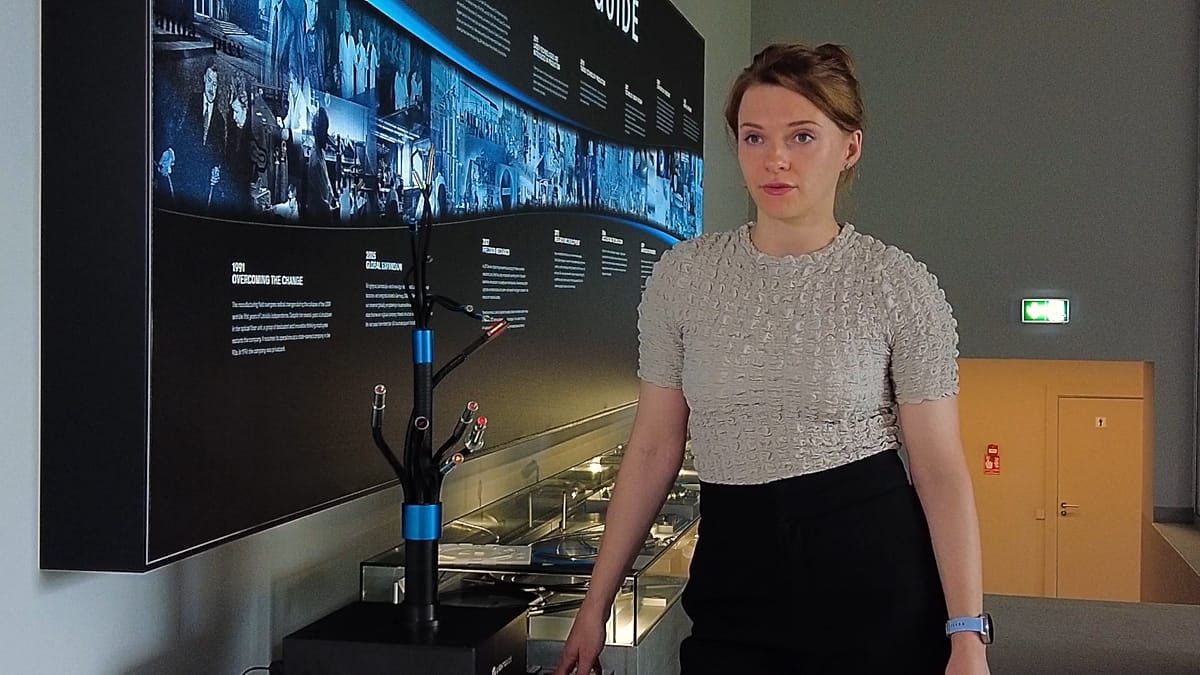
In the quiet town of Līvāni, tucked into Latvia's eastern Latgale region near the Russian border, a remarkable industrial thread runs from the Soviet past to the European present. This is the cradle of Latvia's fibre-optic sector, a story that begins not with imported know-how but with a local glass factory that once supplied cups and vases across the entire Soviet Union.
“It all began in Līvāni, near Latvia’s eastern border,” says Santa Vucina, quality manager at Lightguide, one of the country's leading fibre-optic companies. “This small town has a long industrial tradition, and the glass factory was its heart.”
A secret start with military roots
In the early 1980s, the factory's management established what was then known as the “secret department,” dedicated exclusively to developing optical fibres. As Vucina explains, “All scientific advances start somewhere, and here it began with fibres for military and space applications.” The founders of today's Lightguide were part of that original team, which managed to safeguard the technology through the collapse of the Soviet Union and the turbulent transition to a market economy.
“Despite the economic changes and the new world order, they sustained this specialisation in this small town,” Vucina notes. “This knowledge and expertise were not imported from anywhere else. They’re local. They were born and raised here from the very beginning.”
The survival of this niche industry is all the more striking given the region's geopolitical context. Latgale borders Russia, and the area has been a focal point for NATO's eastern flank, with recent incidents such as drones intercepted over neighbouring Lithuania underscoring the security dimension. Yet Līvāni's engineers have kept their heads down, focusing on precision manufacturing rather than geopolitics.
Local expertise in a global market
Today, Lightguide produces specialty optical fibres used in telecommunications, medical devices, and industrial sensing. The company exports worldwide, competing with much larger players from the United States and Asia. Its edge, Vucina argues, lies in the accumulated know-how of a workforce that has been perfecting the craft for over four decades.
“We have people here who have spent their entire careers in this field,” she says. “That continuity is rare in any industry, let alone one as technically demanding as fibre optics.”
The Latvian government has taken notice, promoting the sector as a high-tech success story in a region often associated with emigration and economic decline. For the European Union, the existence of such specialised manufacturing in a border state carries strategic weight, especially as Brussels pushes for greater technological autonomy in critical supply chains.
Still, challenges remain. The industry faces stiff competition, and retaining skilled workers in a small town is not always easy. But Vucina remains optimistic: “We have the expertise, we have the tradition, and we have the commitment. That’s what keeps us going.”
As Europe debates the future of its industrial policy, the story of Līvāni offers a reminder that innovation can flourish far from capital cities, rooted in local history and resilience. It also highlights how a Soviet-era legacy can be transformed into a modern European asset, one fibre at a time.