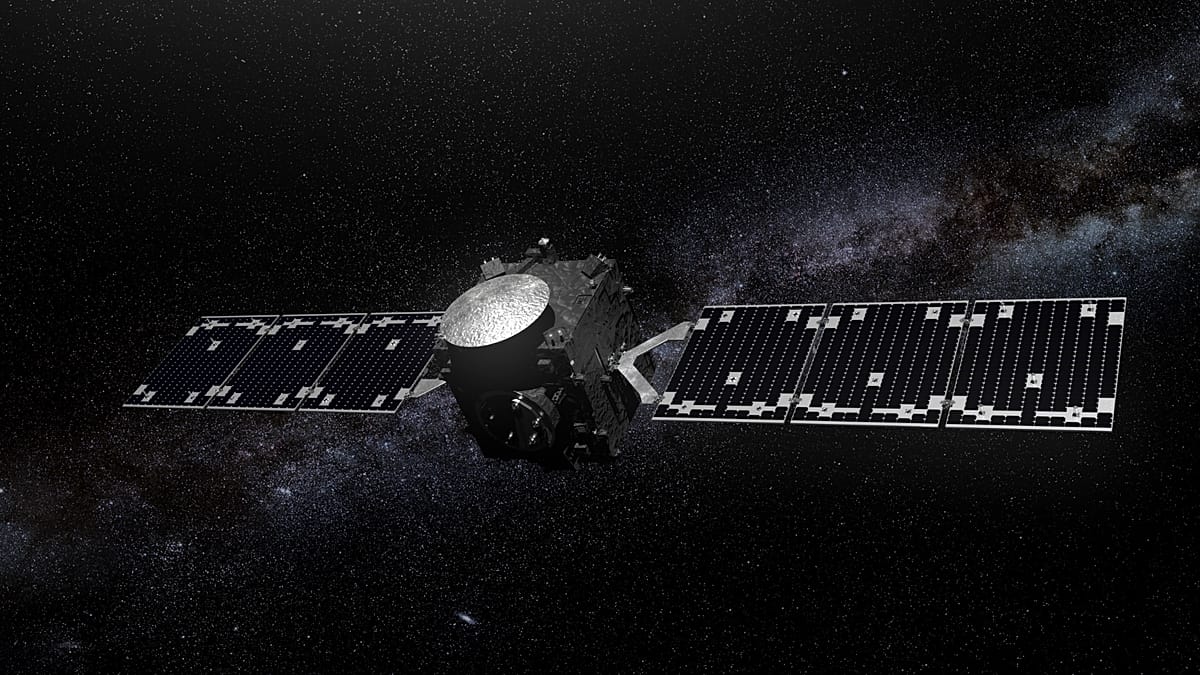
The European Space Agency's Hera spacecraft has begun its close-up investigation of the asteroid system that NASA deliberately rammed four years ago, marking a new phase in humanity's efforts to protect Earth from potential cosmic threats.
On Wednesday, ESA confirmed that Hera is now operating at a distance of just 25 to 30 kilometres from Didymos and its small moonlet, Dimorphos. The spacecraft, launched in 2024, is conducting a detailed survey of the aftermath of NASA's Double Asteroid Redirection Test (DART), which in 2022 slammed a probe into Dimorphos to test whether such a kinetic impact could alter an asteroid's trajectory.
The DART impact succeeded in shortening Dimorphos's orbit around Didymos by about 30 minutes, and more significantly, it nudged the moonlet into a slightly different path around the Sun. Scientists are now eager to understand the full consequences of that collision, including the amount of debris ejected and the structural changes to the asteroid's surface.
A 'crash site investigation' with robotic detectives
ESA officials have described the Hera mission as a "crash site investigation" worthy of the agency's finest robotic detective work. The car-sized spacecraft is equipped with 25 scientific instruments, along with two shoebox-sized CubeSats that will venture even closer to Dimorphos, attempting to land on its surface and gather data from within the debris field.
Next month, Hera will move to within 20 kilometres of the asteroid, allowing for even higher-resolution imaging and measurements. The mission is a cornerstone of Europe's growing role in planetary defence, complementing NASA's earlier efforts and providing critical data for future asteroid deflection strategies.
According to scientists, the DART impact sent rubble and boulders flying off Dimorphos, creating a debris trail that extended more than 10,000 kilometres into space and persisted for months. Some of that debris may still be lingering in the vicinity, offering a unique opportunity to study the long-term evolution of an asteroid after a high-velocity collision.
The Hera mission is a collaborative effort involving ESA member states, with significant contributions from German, French, and Italian space agencies. It underscores the importance of international cooperation in addressing global threats, a theme that resonates across Europe's broader security discussions, including deepening defence ties with partners like Qatar.
As Hera continues its investigations, the data it returns will help refine models of asteroid behaviour, informing future missions that might one day deflect a dangerous object on a collision course with Earth. The mission also highlights the growing synergy between European and American space programmes, which have been collaborating closely since the DART impact.
While the immediate focus is on scientific discovery, the implications for planetary defence are profound. The ability to alter an asteroid's path could one day save millions of lives, making investments in such missions a prudent use of public funds. As ESA's Director General noted, "Hera is not just a mission to an asteroid; it is a mission to safeguard our planet."
The Hera spacecraft is expected to continue its observations for several months, with the CubeSats attempting their landings in the coming weeks. The mission's findings will be presented at major scientific conferences later this year, and they are likely to shape the next generation of asteroid deflection technologies.
For now, the spacecraft's close-up views of Dimorphos are already providing unprecedented insights into the aftermath of a cosmic collision, and they serve as a reminder of Europe's commitment to advancing space science and protecting our world.