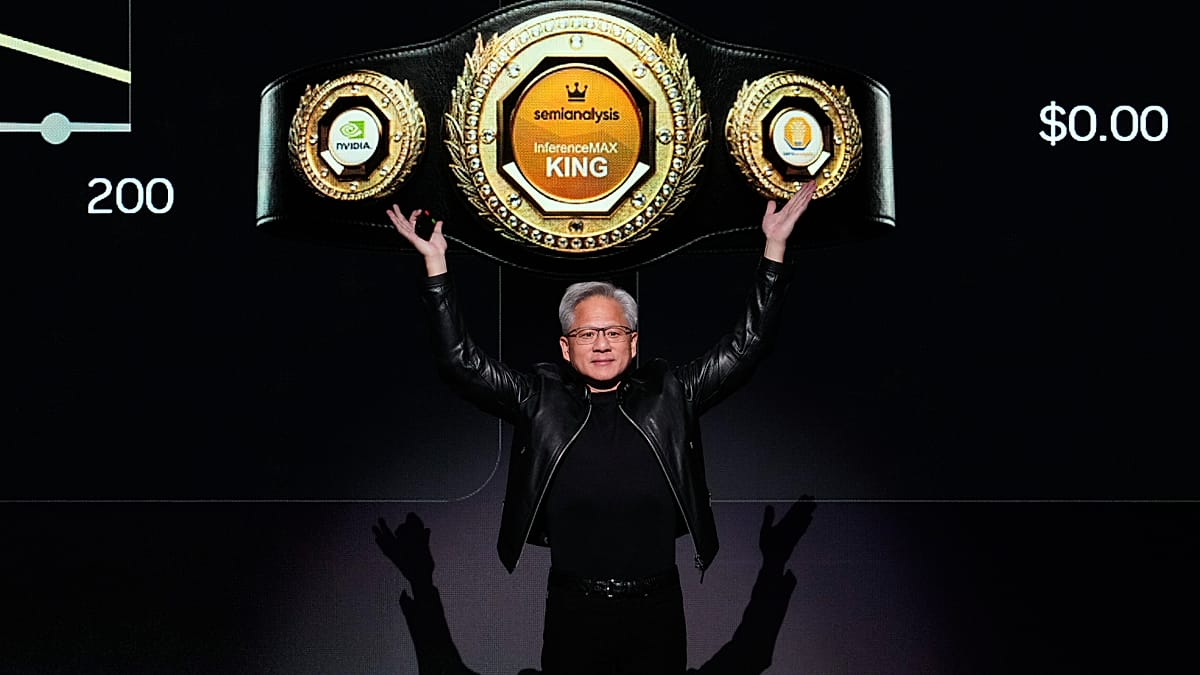
When Jensen Huang walked back into Nvidia's headquarters in Santa Clara on Monday, he was greeted like a returning champion. Employees cheered, applauded, and chanted his name. "Thank you all for the second chance," he told them, in footage shared online. The market's response was even more emphatic: Nvidia's shares closed 31.5% higher, adding roughly $950bn (€871bn) to the company's market value—the largest one-day gain for any company in history.
Huang's personal fortune swelled by about $34bn (€31bn), according to Forbes' real-time billionaires list. But the windfall extended far beyond the executive suite. US President Donald Trump, who had lobbied for Huang's reinstatement, saw his own Nvidia holdings gain between $1.3m (€1.2m) and $15m (€14m) in a single day, based on an analysis of his financial disclosures by the Financial Times. The White House says Trump's portfolio is managed independently by third-party institutions.
The rally rippled across global markets. On Wall Street, the Nasdaq Composite closed 6.5% higher and the S&P 500 gained 4.7%, their strongest sessions since April 2025. The S&P 500 recaptured about $3trn (€2.7trn) in market value. In Asia, Taiwan's Taiex surged 9%, South Korea's Kospi jumped 6.3%, and Japan's Nikkei 225—closed Monday for a holiday—added 3.9% on Tuesday.
Europe's muted response
European markets, however, felt only a fraction of the enthusiasm. The pan-European Stoxx 600 rose 1.8% on Monday, Germany's DAX added 2.2%, and the UK's FTSE 100 gained about 1.3%. Chip stocks like ASML jumped, but by Tuesday morning the main European indices were slightly down.
The tepid reaction reflects a structural reality: Europe's stock markets are far less tech-heavy than their US counterparts. Technology accounts for just 9.5% of the Stoxx 600, while banks are the largest sector at 16.2%. As one analyst put it, Europe's investors are more exposed to interest rates and commodity prices than to the fortunes of a single chipmaker.
Still, the event underscores the outsized influence of a handful of American tech giants on global wealth. Nvidia's workforce, many of whom have become millionaires through share-based pay, has particular reason to celebrate. In a 2024 poll on Blind, an anonymous forum for tech workers, 76% of Nvidia employees who participated said they were millionaires, and more than four in ten reported a net worth of $10m (€9.2m) or more.
Share-based compensation cost Nvidia $6.4bn (€5.9bn) in the financial year to January, according to its annual report. Employees can also buy a limited amount of company stock at a discount of at least 15%. With turnover at just 3.7% among its roughly 42,000 staff, many employees have accumulated significant holdings—holdings that Monday's surge made considerably more valuable.
The decision to reinstate Huang came after intense pressure from the White House. Trump told CNBC that he had "convinced" Nvidia's board, boasting, "I made the deal." The company acknowledged receiving "input from senior levels of the United States government." More than 10,000 people claiming to work at Nvidia reportedly signed a petition calling for Huang's return, a sign of the loyalty he commands.
For Europe, the episode is a reminder of its relative position in the global tech economy. While the continent hosts world-class semiconductor equipment makers like ASML, it lacks the scale of US platform companies. The earlier decision to rule out Huang's return had already sparked debate about corporate governance and political influence. Now that he is back, the question is whether Nvidia's momentum—and the wealth it creates—will continue to flow primarily across the Atlantic and Pacific, leaving Europe to watch from the sidelines.
As Huang settles back into the CEO's chair, the broader implications for global markets remain unclear. But one thing is certain: the world's richest chipmaker just got a whole lot richer, and its influence shows no signs of waning.