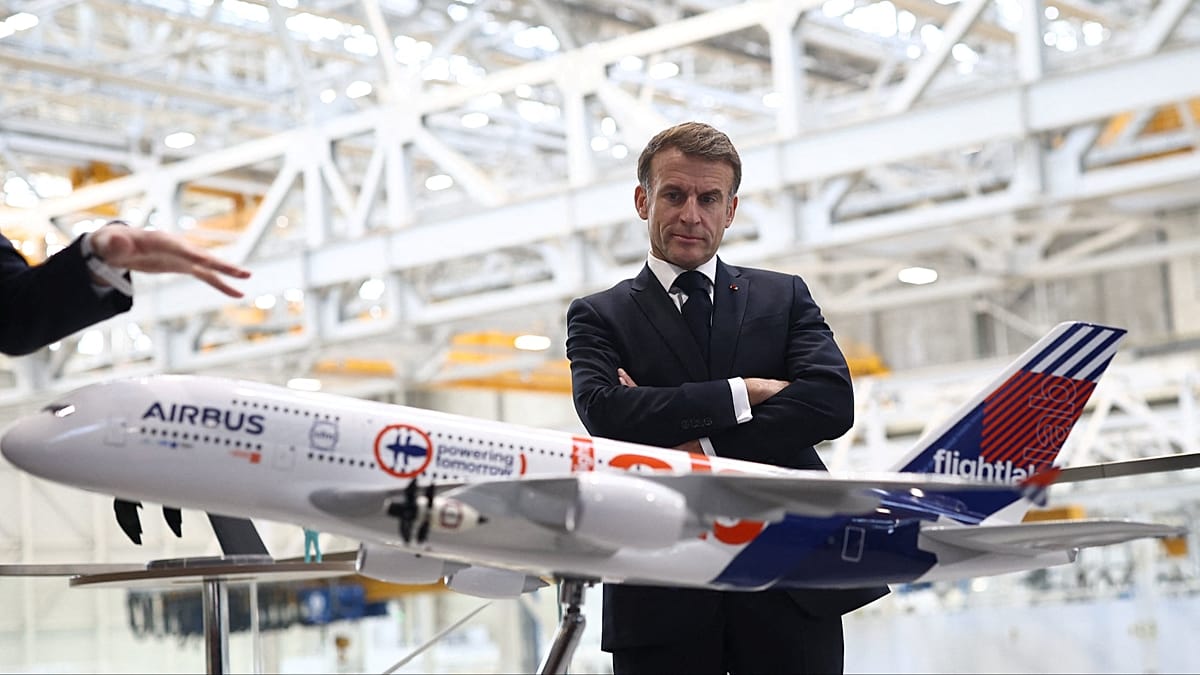
French President Emmanuel Macron used a visit to the Airbus site in Blagnac, near Toulouse, to unveil a €350 million package for aeronautics research and innovation. The announcement, made on Monday, is intended to support the development of new technologies and sharpen the competitiveness of a sector that remains a cornerstone of France's industrial base.
Speaking to workers and executives at the plant, Macron confirmed the funding for CORAC, the Council for Civil Aeronautics Research, a public-private body that coordinates research priorities for the French aerospace industry. "350 million euros for CORAC, that is what we will do," he said. "It was very important to be able to confirm it to you. We are providing visibility."
The president also announced the creation of so-called "high-potential" industrial zones, where administrative procedures will be streamlined to accelerate the establishment of new factories. The goal is to make France more attractive for industrial investment and to encourage companies to expand production on French soil.
The visit came on the same day as the Choose France summit in Paris, an annual event designed to lure foreign investors. This year's edition highlighted nearly 300 industrial projects led by French companies, underscoring the government's push to reindustrialise the country.
Airbus expansion plans
Airbus, Europe's largest aerospace group, is preparing to adapt a second assembly line at its Toulouse facility to produce the A321 and A32XLR models. The move is expected to increase production rates and create new jobs, a development Macron welcomed as a sign of confidence in the region's engineering workforce.
The A321XLR, a long-range narrowbody, has been a commercial success for Airbus, and the company has been investing heavily to meet demand. The expansion in Toulouse is part of a broader strategy to ramp up output across its European production network, which also includes sites in Germany, Spain, and the UK.
For the French president, the visit was an opportunity to link industrial policy with broader economic goals. "We are providing visibility," he said, referring to the multi-year funding for CORAC, which gives companies a clearer picture of future state support for research and development.
The announcement also fits into a wider European context, where governments are competing to secure investment in high-tech manufacturing. France has been particularly active in courting aerospace and defence companies, and Macron has made industrial sovereignty a recurring theme of his presidency.
However, the sector faces challenges, including supply chain disruptions and rising energy costs, which have affected production across Europe. The new funding is partly aimed at helping companies develop more efficient and sustainable technologies, such as hydrogen propulsion and electric hybrid systems.
Macron's visit to Blagnac also served as a reminder of the political importance of the aerospace industry, which employs tens of thousands of people in the Occitanie region. The president's commitment to the sector is likely to be a talking point in the run-up to the 2027 presidential election, with Dominique de Villepin having already declared his candidacy.
While the €350 million is a significant sum, it is part of a larger pattern of state support for strategic industries across Europe. Germany, for example, has also invested heavily in its aviation sector, and the EU has launched initiatives to boost research in clean aviation.
The announcement was met with cautious optimism by industry representatives, who welcomed the long-term visibility but stressed the need for continued investment in skills and infrastructure. The creation of streamlined industrial zones is seen as a practical step to reduce red tape, though its impact will depend on implementation.
As France seeks to position itself as a leader in the next generation of aviation, the combination of research funding and regulatory reform could prove decisive. Whether it will be enough to counter global competition from the US and China remains to be seen, but for now, the message from Toulouse is one of confidence.