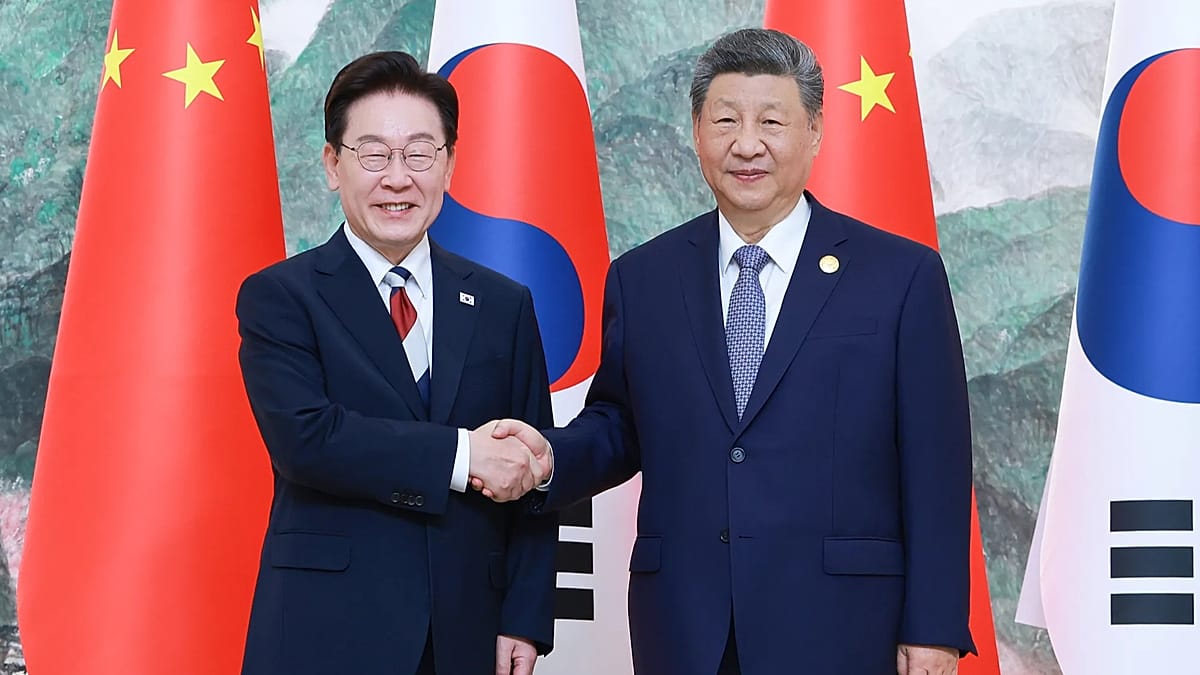
South Korea and China have moved closer to expanding their bilateral free trade agreement, with new commitments that would cover entertainment, tourism, and financial services. The announcement followed talks between President Lee Jae Myung and President Xi Jinping on the sidelines of the Asia-Pacific Economic Cooperation summit in Shenzhen.
China's commerce ministry said that technical details, translations, and legal reviews still need to be completed before the expanded pact can be formally signed. Once in force, the agreement would mark a significant step in easing the informal barriers that have hampered South Korean cultural exports since 2016.
Entertainment sector gains
Under the proposed terms, China has agreed to treat South Korean film and video game companies on an equal footing with those from other countries. It has also pledged not to discriminate against Korean films and online games during approval reviews, according to Seoul's trade ministry.
The deal would broaden joint production arrangements beyond films to include television dramas, animation, entertainment programmes, and documentaries. Productions officially recognised under these arrangements would qualify as Chinese content, exempting them from foreign content quotas.
However, a South Korean official told The Korea Herald that films would still have to pass China's content review process before being released in cinemas. This means that while the regulatory environment may become more predictable, censorship remains a hurdle.
K-pop concerts, which have been effectively banned since the deployment of a US missile defence system in 2016, are not guaranteed to return. A senior South Korean presidential official said the agreement does not oblige either country to approve concerts, but it has opened more channels for discussion with Beijing.
Industry representatives remain cautious. "We will have to see whether practical measures that affect the content industry follow," an official at a South Korean drama production company told Yonhap News Agency.
Wider market access
Beyond entertainment, the expanded agreement would allow South Korean tour operators in 23 designated Chinese cities, including Beijing and Shanghai, to arrange overseas trips for Chinese citizens and foreign residents. Retailers would be able to operate chains of 30 stores or more without forming joint ventures with Chinese companies.
Financial services firms would automatically benefit from any future access China grants to other countries through trade deals. In return, South Korea has agreed to expand access for Chinese companies in legal, retail, and audiovisual services. Both countries have also committed not to require technology transfers as a condition of investment.
China's commerce ministry framed the agreement as a joint effort to oppose protectionism and support international trade. The original free trade agreement took effect in December 2015, and negotiations on expanding services and investment began in March 2018, spanning 17 formal rounds.
The development comes as Europe watches closely, given the EU's own trade negotiations with China and its interest in protecting cultural industries. The EU recently finalised a free trade pact with Indonesia after a decade of talks, and this new Sino-Korean deal could set a precedent for how cultural goods are treated in trade agreements.