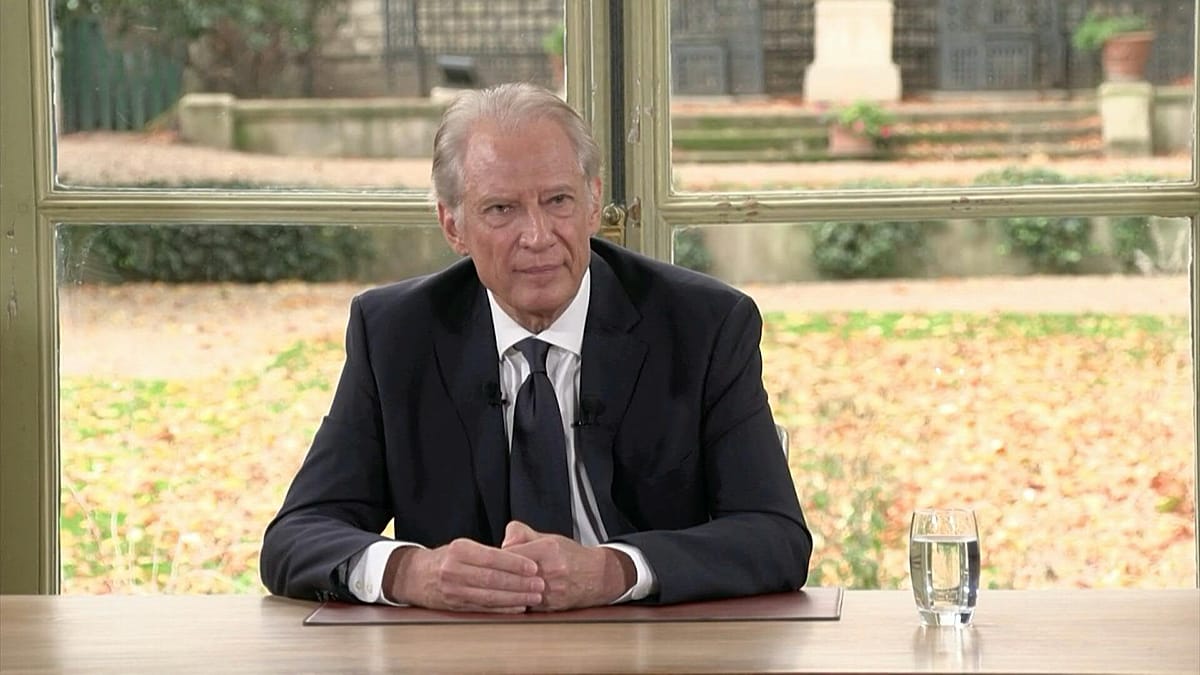
Dominique de Villepin, the former French prime minister known for his fiery opposition to the 2003 Iraq War, has formally entered the race for the Élysée Palace. At a press conference in Paris on Friday, the 73-year-old declared his candidacy for the 2027 presidential election, warning that France is succumbing to a sense of decay and defeat.
“This decay of France, this instinct for defeat, this spirit of death that is taking hold of us, these are all reasons that lead me to stand before you today and say: I am a candidate in the 2027 presidential election,” he said, his voice carrying the same oratorical weight that made his UN Security Council speech two decades ago a defining moment in French diplomacy.
De Villepin, who served as prime minister under Jacques Chirac from 2005 to 2007, is now running under the banner of his own movement, La France humaniste. His entry adds a new layer of complexity to an already fragmented political landscape, as the centre-right struggles to find a unifying figure ahead of the vote.
A return to the frontline
De Villepin has been largely absent from the frontlines of French politics since his time in government, but he has remained a vocal commentator on international affairs. His 2003 speech at the United Nations, where he passionately argued against the US-led invasion of Iraq, earned him global recognition and a reputation as a defender of multilateralism.
His announcement comes at a time when the French centre-right is fragmenting, with multiple figures vying for influence. De Villepin, who has often positioned himself as a Gaullist with a social conscience, may appeal to voters disillusioned with the traditional parties.
Political analysts note that his candidacy could draw support from both the right and the left, given his emphasis on national sovereignty and social justice. However, his path to the second round remains uncertain, as he faces competition from a crowded field that includes current and former ministers, as well as far-right and far-left contenders.
France's decline and the European dimension
De Villepin's rhetoric about decline is not new; it echoes a broader anxiety that has permeated French political discourse in recent years. His critique of the country's “instinct for defeat” resonates with a public that has seen repeated protests, from the gilets jaunes to the recent cost-of-living demonstrations, which have also had economic repercussions, with insurance costs from unrest estimated at €207 million.
For Europe, a de Villepin candidacy could signal a shift in French foreign policy. He has long advocated for a more independent European defence and a stronger role for the EU on the global stage. His vision of France as a balancing power between the US and Russia, though controversial, may appeal to those who feel Europe has become too reliant on Washington.
Yet his campaign faces practical hurdles. He must gather the 500 signatures from elected officials required to appear on the ballot, a challenge that has tripped up many would-be candidates. His movement, La France humaniste, is still nascent, and he will need to build a national organisation quickly.
De Villepin's entry also complicates the calculations of other candidates. For the centre-right, he could siphon off votes from those who admire his statesmanship but find the current leadership uninspiring. For the left, his social policies might attract those who see him as a principled alternative to the more technocratic options.
As the 2027 campaign begins to take shape, de Villepin's presence adds a dose of drama and intellectual heft. Whether he can translate his eloquence into electoral success remains to be seen, but his announcement has already injected new energy into a race that was in danger of becoming predictable.