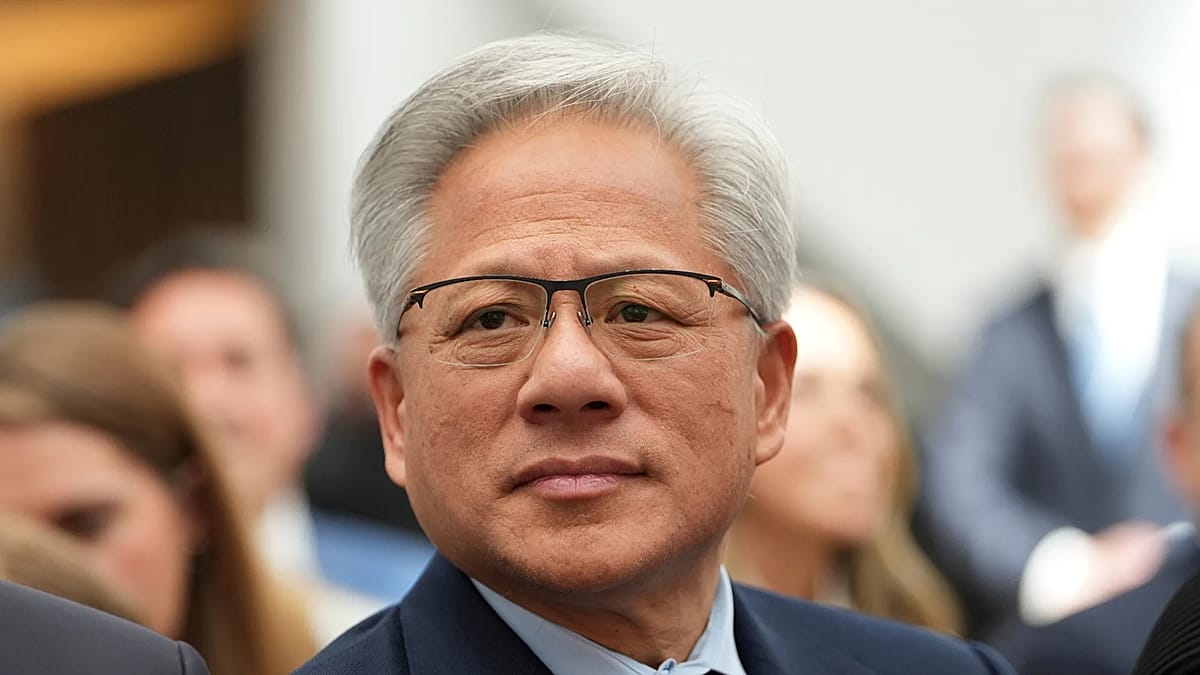
Nvidia chief executive Jensen Huang has warned that Germany is losing ground in the global artificial intelligence race, arguing that Europe's largest economy has the talent and industrial base to compete but is being held back by too much hesitation and analysis. Speaking to journalists in London, Huang urged policymakers to move faster from deliberation to deployment.
His remarks land in Berlin at an awkward moment. The German government has spent months trying to answer mounting concerns about the country's technological competitiveness, and it has settled on a closer partnership with the US chip designer as part of its response.
A pact to be unveiled in Berlin
At the Invest in Germany summit in Berlin this week, Chancellor Friedrich Merz and Huang are expected to present a joint AI pact designed to accelerate the uptake of AI products across German industry. The federal government is preparing to commit hundreds of millions of euros to the initiative, according to officials familiar with the plans.
The partnership is expected to involve around ten established German companies, among them Siemens and Audi, alongside the Freiburg-based start-up Black Forest Labs. The arrangement builds on the Sovereign Open Source Foundation Models initiative, an alliance focused on developing capable open-source AI systems that European firms and public bodies can use without depending entirely on US or Chinese providers.
Much of the funding is earmarked for computing capacity on Deutsche Telekom's Industrial AI Cloud, which runs on Nvidia's latest Blackwell hardware. Berlin hopes the investment will make Germany a more attractive location for innovation and technological development, and will give domestic manufacturers faster access to the processing power that modern AI models require.
Industrial base meets compute gap
Germany's pitch rests on a familiar strength: its Mittelstand, its automotive and engineering champions, and a dense research landscape. What it has lacked is the large-scale compute infrastructure and the willingness to deploy AI tools quickly across factories, hospitals and public administration.
Huang's criticism echoes a broader frustration in Silicon Valley and among European start-ups alike. Brussels and national capitals have produced a steady stream of strategies, white papers and consultation exercises, but the translation into commercial products has often been slow. For a country whose export model depends on industrial leadership, that gap carries particular weight.
The timing is also politically sensitive. Merz's coalition has made economic revival a central promise, and AI is increasingly framed as a question of sovereignty rather than mere industrial policy. The government's willingness to channel public money into Nvidia-powered infrastructure reflects a pragmatic turn: rather than trying to build every layer of the stack at home, Berlin is buying access to the compute it needs now.
Questions over dependence
Not everyone in Germany is comfortable with the approach. Critics argue that deepening ties with a single US supplier risks swapping one form of dependency for another, and that public funds should do more to nurture European chipmakers and cloud providers. The open-source component of the initiative is partly intended to answer that concern, giving German firms models they can adapt and host on their own terms.
The summit in Berlin will be watched closely in Paris, Amsterdam and Stockholm, where similar debates are underway. Nvidia has already expanded its European footprint, including a Stockholm AI hub for climate and health startups, and the company is positioning itself as a partner to European governments rather than simply a vendor.
For Berlin, the stakes are straightforward. If the pact delivers faster adoption across industry, it could become a template for how European states combine public money, private hardware and open models. If it does not, Huang's warning will read less like a nudge and more like a verdict.