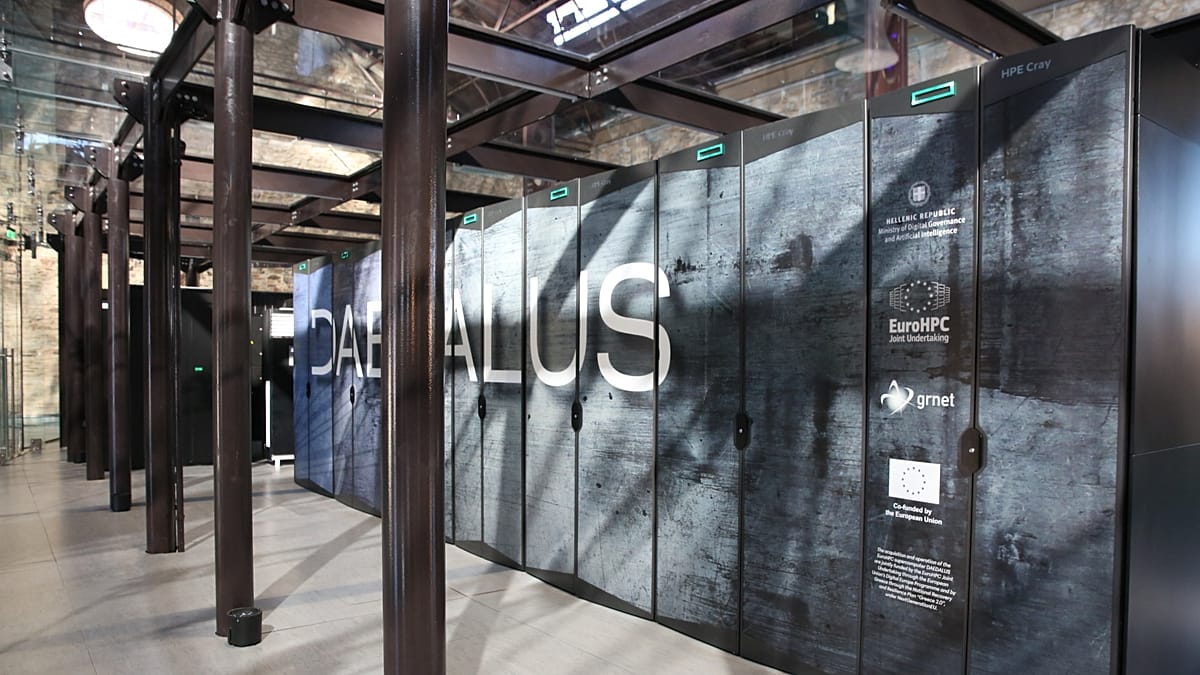
Greece has taken a significant step in its technological development with the official launch of Daedalus, the most powerful supercomputer ever installed in the country. The system, inaugurated at the Lavrio Technology and Cultural Park near Athens, marks a shift toward domestic high-performance computing and a reduced dependence on foreign infrastructure.
With a measured performance of 85.69 petaflops—roughly 85.69 quadrillion floating-point operations per second—Daedalus ranks 31st globally, according to available data. The €58.9 million investment, funded through the Recovery and Resilience Facility and the European High-Performance Computing Joint Undertaking (EuroHPC), is designed to give Greek universities, research centres, businesses, and public bodies the capacity to develop and train advanced artificial intelligence models on home soil.
The ability to process sensitive or confidential data within Greece is a key advantage. Under strict security and personal data protection safeguards, Daedalus opens possibilities for applications in medical research, public administration, and other sectors where data handling is tightly regulated. This local processing capability could prove crucial for projects that cannot rely on cloud services abroad.
Position in Europe's computing landscape
Daedalus is not intended to compete with Europe's largest exascale-class supercomputers, which exceed one exaflop—1,000 petaflops—in power. Instead, its value lies in providing Greece with substantial computing resources for specialised applications and integrating into the broader European AI infrastructure ecosystem. For the domestic research and business community, this lowers barriers to accessing high-performance computing, facilitates the development of technology products, and strengthens collaboration with European research networks.
Energy efficiency is also a priority. According to the Green500 ranking of June 2026, Daedalus placed 23rd worldwide for energy performance. The system uses liquid cooling to manage the thermal loads generated by its Nvidia Grace Hopper GH200 processors, a design choice that reduces environmental impact while maintaining high output.
The supercomputer is housed in the historic former power station of the Lavrio Technology and Cultural Park, operated by the National Technical University of Athens. The National Infrastructures for Research and Technology (EDYTE – GRNET) manages the system, while Hewlett Packard Enterprise supplied and installed the computing equipment under a €41 million contract. Mainsys carried out the electromechanical installations and data centre configuration for €17.9 million, both figures including VAT.
Pharos AI Factory: bridging research and market
A central element of the project is the Pharos AI Factory, one of the first seven AI factories selected by the European Union. This initiative aims to bring Daedalus's capabilities to the business community, offering computing resources alongside advisory support and services that help move from research to commercial exploitation. Start-ups and small and medium-sized enterprises are expected to access computing power free of charge, within the limits of European state aid rules, while larger companies may be charged based on usage time.
The service package includes guidance on adopting AI, support for commercialising applications, access to collaboration networks and business acceleration programmes, secure testing environments, and infrastructure for deploying applications in production. It also provides access to AI models, selected datasets, and open data.
According to current planning, broader service provision to businesses is scheduled to begin in March 2027, after a period of technical testing and system configuration. The final access conditions, detailed services, and pricing policy have not yet been finalised.
For the commercial exploitation of the initiative, the company Hellenic AI Factory S.A. has been established. This move reflects Greece's ambition to play a more active role in Europe's AI race, leveraging its new infrastructure to attract investment and foster innovation. As the continent builds its digital sovereignty, projects like Daedalus are essential for ensuring that smaller member states can participate fully in the AI-driven economy.
The launch comes at a time when Europe is grappling with shifting debt dynamics and economic pressures, but also with opportunities for technological leapfrogging. Greece's investment in high-performance computing is a bet on its future as a regional tech hub, one that could pay dividends in research, entrepreneurship, and public services.