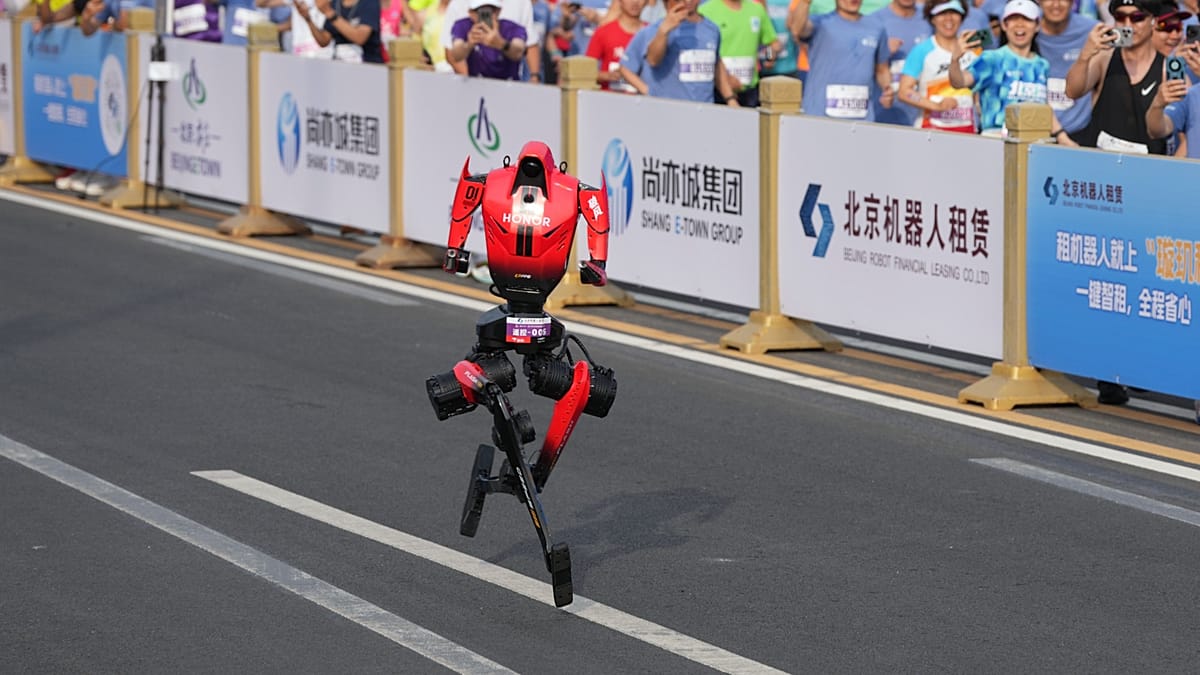
In a milestone for robotics, a humanoid machine has outpaced the fastest human half-marathon runner. At the Beijing E-Town Humanoid Robot Half-Marathon on Sunday, a robot developed by Chinese smartphone company Honor completed the 21-kilometre course in 50 minutes and 26 seconds — nearly seven minutes faster than the human world record of 57 minutes set by Uganda's Jacob Kiplimo earlier this year.
The race, held alongside 12,000 human participants on parallel tracks, was designed to test machines under real-world conditions. More than 100 robots took part, following large-scale trial runs involving over 70 teams navigating the full course overnight in Beijing’s E-Town development zone.
Design Inspired by Elite Athletes
Honor engineer Du Xiaodi explained that the winning robot's design was modelled on top human runners. “From the very beginning of the design, our robot was modeled on outstanding human athletes, achieving long legs of about 0.95 meters,” he said. “In addition, we’ve equipped it with a very powerful liquid-cooling system, which is also largely developed in-house.”
Around 40% of the robots ran using fully autonomous navigation — a key challenge organisers deliberately built into the competition — while others were remotely controlled. A separate, remote-controlled Honor robot crossed the finish line first in 48 minutes and 19 seconds, but the autonomous model secured overall victory under the event’s scoring system. Two more Honor robots, also autonomous, completed the podium.
Performance improved dramatically from last year’s inaugural event, where only six out of 21 robots finished. Still, the competition exposed technical limits: some robots fell at the start, others collided with barriers, and teams continued to struggle with overheating motors and battery constraints.
Du noted that the technology developed for the race could extend beyond competitive events. “Some of these technologies might be transferred to other areas. For example, structural reliability and liquid-cooling technology could be applied in future industrial scenarios.”
The race comes amid growing global interest in humanoid robotics. In Europe, companies like Siemens and Nvidia have tested humanoid robots in German factories, aiming to integrate AI-driven production. Meanwhile, Tesla has pivoted toward robots and robotaxis, though growth fears persist as the company shifts focus.
For European observers, the Beijing race underscores the rapid pace of Chinese innovation in robotics — a field where the EU has also invested heavily. The European Commission’s Horizon Europe programme funds robotics research, and countries like Germany, France, and Sweden are home to leading robotics labs. Yet the gap between laboratory prototypes and real-world performance remains wide, as the race’s mishaps illustrate.
As humanoid robots edge closer to practical applications, the half-marathon record may be just the beginning. Whether in factories, hospitals, or disaster zones, the ability to navigate complex environments autonomously will be critical. For now, the Honor robot’s feat offers a glimpse of what is possible — and a benchmark for future competitors.