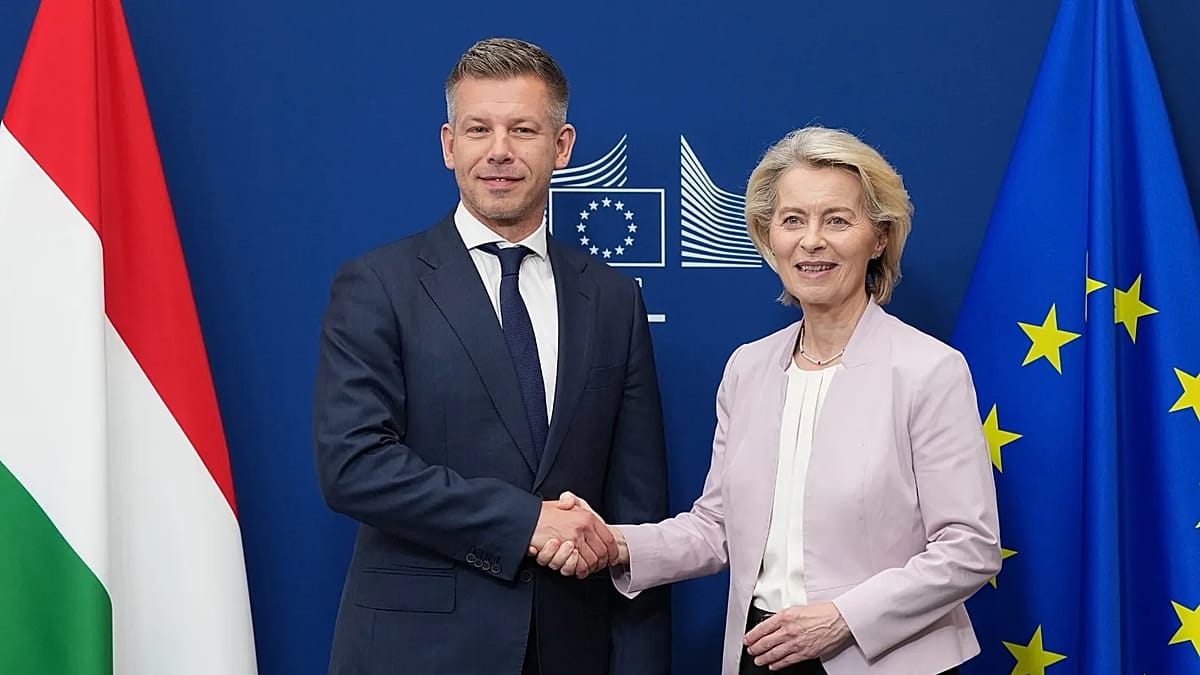
Hungary is on course to satisfy all European Commission requirements by the end of August, paving the way for the release of €10 billion in frozen recovery funds, according to officials in both Budapest and Brussels. The development marks a significant political victory for Prime Minister Péter Magyar, who took office after a landslide election victory in April, ending Viktor Orbán's 16-year rule.
The funds are part of the EU's post-pandemic Recovery and Resilience Facility (RRF), which expires later this year. In May, Magyar and Commission President Ursula von der Leyen agreed to unlock €16.4 billion in total, including €6.4 billion from Cohesion Funds, which have no immediate deadline.
Progress on reforms
A Commission source told European Pulse that the process is advancing well, with every chance Hungary can meet all criteria on time and withdraw the recovery money by autumn. A spokesperson for Hungary's Ministry of Transport and Investment, which oversees the EU funds process, confirmed that two-thirds of the required commitments have been fulfilled, with the remaining cases in their final stage.
“We are making good progress in meeting the milestones related to recovery funds: we have already fulfilled two-thirds of our commitments, and the settlement of the remaining cases is in its final stage,” the ministry said. The government expects to provide more precise details after its next cabinet meeting, but stressed that “there is no milestone where we do not see fulfilment as realistic.”
Hungary must deliver on 27 so-called super milestones set by the Commission. Of these, 21 concern corruption and transparency, four relate to judicial independence, and two involve audits of fund spending. The four judicial reform milestones have already been met, but parliament had to push through a series of complex measures over the summer to address the rest.
In June, lawmakers adopted a sweeping anti-corruption package, including stricter asset-declaration rules for politicians, greater transparency in public tenders, and the nationalisation of public-interest asset-management foundations (KEKVA), which had been used to transfer state assets, including universities, into private-style control. In July, the tax code was amended in line with RRF milestones, and related legislation covering the energy sector was passed.
Hungary has also established a new anti-corruption body, the National Asset Recovery and Protection Office, tasked with recovering state assets linked to suspected Orbán-era corruption. Prime Minister Magyar has launched the process for Hungary to join the European Public Prosecutor's Office, a step that would strengthen oversight of EU funds.
At the same time, Hungary amended its National Recovery Plan to ensure it can draw on the funds in time. The revised plan includes measures to modernise the country's energy grid, railways, and rental housing stock.
While the political focus is on meeting the deadline, the broader context includes Hungary's ongoing challenges, such as record-low water levels in lakes and rivers due to severe drought, which could affect the implementation of some infrastructure projects. Nevertheless, the government remains committed to bringing home every euro cent due to Hungary.
If successful, the unlocking of funds would provide a substantial boost to Hungary's economy and a clear endorsement of the new government's reform agenda. It would also signal a reset in relations between Budapest and Brussels, which had deteriorated under Orbán over rule-of-law and corruption concerns.