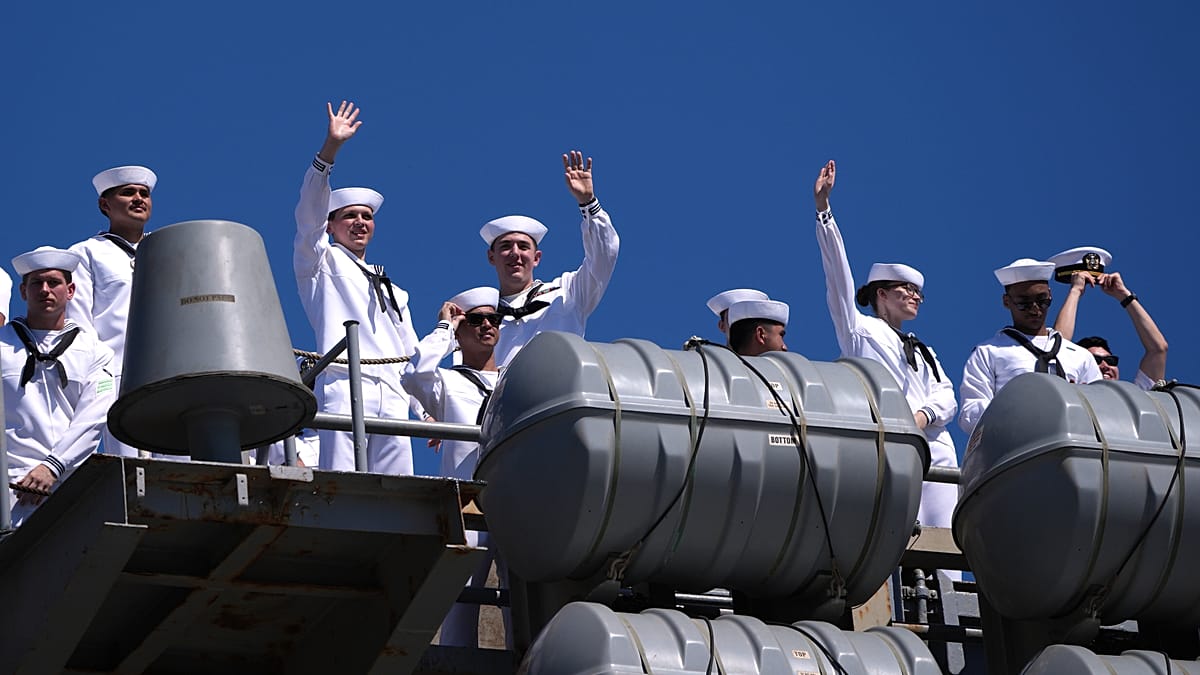
The USS Abraham Lincoln pulled into San Diego on Thursday, ending a deployment that stretched a record 265 consecutive days at sea. The carrier had been supporting US operations against Iran, after being rerouted from an initial assignment in the South China Sea. Its return marks the longest continuous at-sea period for a US aircraft carrier in modern history, a milestone that has drawn both praise and scrutiny.
US Defence Secretary Pete Hegseth visited the ship on Wednesday to present the crew with the Presidential Unit Citation, the highest honour awarded to a military unit. In remarks on board, he rejected suggestions that the Lincoln had become "a symbol of dysfunction or a symbol of low morale or a symbol of a failed mission." His comments came after weeks of media reports describing difficult conditions for the roughly 6,000 sailors and airmen on board.
Crew welfare under the spotlight
During the deployment, reports emerged of stress, mental health concerns, and shortages of food and hygiene products. The Navy initially downplayed the problems, but later acknowledged that reduced meal options had been caused by limited opportunities for resupply. Officials also confirmed to lawmakers that eight sailors had attempted suicide during the ten-month mission. Experts noted that this figure was relatively low for a strike group of that size over such a long period, though they stressed that any such incident is a cause for concern.
The Lincoln left California in November 2025 for a planned deployment to the South China Sea, but was redirected to the Middle East ahead of the US-Israeli strikes on Iran that began in February 2026. The extended time at sea, far from home ports and with limited port calls, put unusual strain on the crew. The ship made a stop in Thailand last month on its way back, its first significant break from operations.
The return to San Diego was marked by emotional reunions on the pier at Naval Air Station North Island in Coronado, as families and friends waited for hours to greet loved ones. For many on board, the deployment was among the longest of their careers, and the Navy has said it will review lessons learned from the experience.
The episode has reignited debates in Washington about the sustainability of extended carrier deployments, which have become more frequent as the US Navy faces global commitments. Some analysts argue that the record-setting patrol reflects the strain on a fleet that is smaller than it was during the Cold War, even as demand for its presence grows in both the Pacific and the Middle East.
For European observers, the Lincoln's deployment is a reminder of the extent to which US military power still underpins security in regions that directly affect European interests, from the Strait of Hormuz to the South China Sea. European navies, including those of France and the UK, have occasionally operated alongside US carriers in recent years, but none can match the scale or endurance of a US carrier strike group.
The Navy has announced no immediate changes to deployment schedules, but the Lincoln's experience is likely to inform future planning. As one senior officer put it, the goal is to ensure that "the next record is not one we have to set."