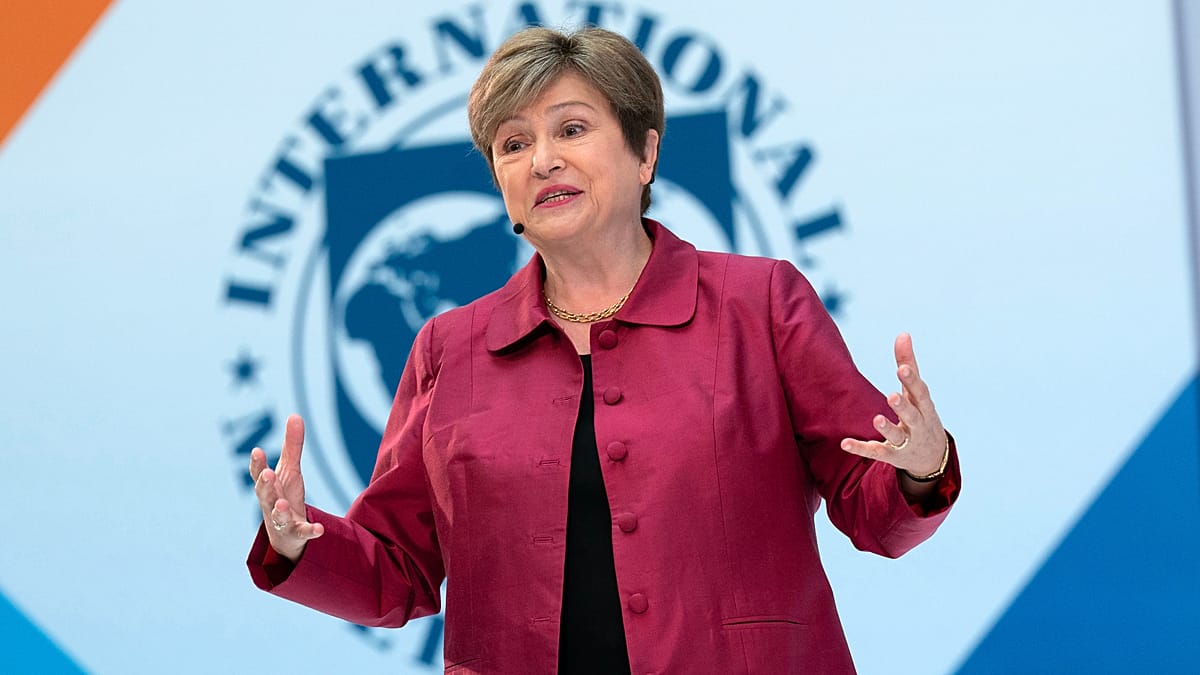
The era of cheap money and growth-driven debt management is over, according to the head of the International Monetary Fund. Speaking in Singapore ahead of the IMF and World Bank annual meetings in Bangkok, Kristalina Georgieva urged governments to rein in spending and central banks to maintain a hawkish posture.
“Policymakers can no longer rely on higher growth rates alone to solve fiscal problems,” Georgieva said, pointing to global public debt levels not seen since the aftermath of World War II. She warned that worldwide debt could surpass 100% of GDP before 2030, with advanced economies being the “worst offenders.”
Fiscal consolidation needed
Georgieva stressed that high-debt advanced economies have yet to take decisive action. “The need of the hour is for credible medium-term fiscal consolidation plans,” she said, adding that “fiscal space is crying out for replenishment.” Borrowing costs are already climbing, with 10-year government bond yields in the United States, Germany, and Japan at their highest levels since 2007, 2009, and 1996 respectively.
The IMF chief described recent rate hikes by the US Federal Reserve, the European Central Bank, and the Bank of Japan as “highly appropriate” and suggested that “now may be a good time for a prudently hawkish bias in many countries' monetary policy.”
Energy shock and AI boom
Georgieva noted that the global economy is being pulled in opposite directions: a negative energy supply shock from the Iran war and a positive demand shock from artificial intelligence. Oil prices remain around $100 a barrel, well above the $89 the IMF assumed in its July forecasts, which projected global growth of 3% in 2026 and 3.4% in 2027. “Even if the war in the Gulf were to end soon, the problem of high energy prices will likely persist for some time,” she said.
The AI boom, while promising, carries risks. “Love it, hate it, or fear it, AI is here,” Georgieva said, describing it as “rapidly becoming a key driver of countries' relative fortunes in the world economy.” If managed well, AI could add half a percentage point to global growth annually—equivalent to adding “an economy the size of ASEAN to the world economy” over a decade.
However, she cautioned that “the AI building boom is inflationary,” with spending on the technology relative to GDP likely to outstrip past investment waves in railways, power grids, and telecoms. A letdown for investors could become “a far-reaching shock,” she warned, also flagging dangers from job losses, cyberattacks, and the possibility that cutting-edge models could “escape human control and run amok.”
For Europe, the message is particularly pertinent. With Germany's bond yields at their highest in over a decade and the ECB having raised rates, the continent faces a delicate balancing act between fiscal discipline and supporting growth. The IMF's call for consolidation echoes the austerity debates that followed the 2008 financial crisis, but this time the backdrop is different: an energy crisis exacerbated by geopolitical tensions and a technology-driven investment surge that could reshape economies.
As European leaders prepare for the annual meetings in Bangkok, they will have to weigh Georgieva's warnings against domestic pressures. France, Italy, and other high-debt members of the eurozone are already under scrutiny from markets, and the IMF's push for credible plans may add to the pressure. The question is whether governments can deliver the fiscal consolidation the IMF demands without stoking social unrest, as seen in recent protests over pension reforms in France and housing crises in Spain.
Georgieva's remarks also carry implications for the European Central Bank's future path. With inflation still above target in many eurozone countries, the ECB may need to maintain its hawkish stance even as growth slows. The IMF chief's endorsement of recent rate hikes suggests that the era of ultra-loose monetary policy is firmly behind us, and that central banks must remain vigilant against inflationary pressures.
For now, the IMF's message is clear: the post-pandemic fiscal expansion is over, and governments must adapt to a new reality of higher debt, higher interest rates, and slower growth. Whether they can do so without undermining the recovery remains to be seen.