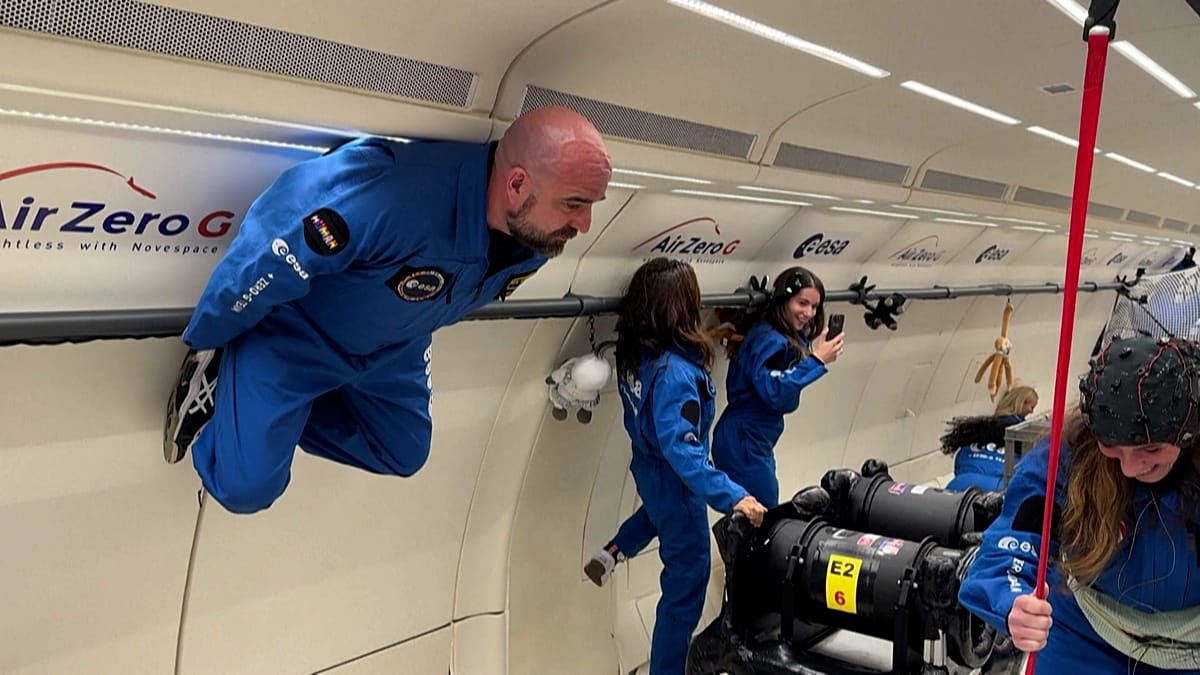
Just outside Bordeaux, a modified Airbus A310 climbs steeply, then arcs into a freefall, creating up to 22 seconds of weightlessness. This is Europe's flying laboratory, operated by the French space agency CNES and Novespace, where scientists from across the continent gather to probe the mysteries of zero gravity.
Parabolic flights, as they are known, offer a cost-effective alternative to the International Space Station for testing how the human body and various materials behave without the pull of Earth's gravity. The aircraft flies a series of parabolas—each a roller-coaster-like maneuver—producing brief but intense periods of microgravity. Researchers from universities and institutes in France, Germany, Italy, and other EU member states use these flights to run experiments that would be impossible on the ground.
What Scientists Are Learning in Zero G
One key area of study is human balance. In weightlessness, the inner ear's vestibular system, which governs equilibrium, sends confusing signals to the brain. By monitoring volunteers during the flights, scientists hope to understand how astronauts adapt—and how to help elderly people on Earth who suffer from balance disorders. Another experiment tracks fluid shifts: in microgravity, blood and other fluids move toward the head, causing facial puffiness and potentially affecting vision. Understanding these changes is critical for long-duration space missions, such as those planned for the Moon and Mars.
Beyond human physiology, the flying lab hosts experiments in physics and materials science. Researchers observe how flames behave without convection, how fluids mix, and how crystals form—insights that could improve industrial processes on Earth. The flights also serve as a training ground for future astronauts, who experience weightlessness for the first time before heading to space.
Europe's investment in parabolic flights reflects a broader commitment to space research, complementing missions on the International Space Station and satellite-based projects. The facility near Bordeaux is one of only a few in the world, alongside similar programs in the United States and Russia. For European scientists, it offers a flexible and relatively accessible way to test hypotheses before committing to more expensive orbital experiments.
In a related development, astronomers recently discovered 27 potential planets orbiting twin stars using a novel technique, highlighting the continent's growing role in space exploration. Meanwhile, a Spanish study found that the Mediterranean diet improves vaginal microbiome and fertility outcomes, showing how European research spans from the cosmos to human health.
The zero-gravity flights are not just about space; they have practical applications on Earth. Insights into bone density loss, muscle atrophy, and immune system changes in microgravity could lead to new treatments for osteoporosis, muscle wasting diseases, and chronic inflammation. As Europe's population ages, these findings may become increasingly valuable.
For now, the flying lab continues its regular campaigns, with scientists queuing up for a chance to float in the cabin and collect data. Each parabola brings them closer to understanding how life—and the human body—works beyond our planet's pull.