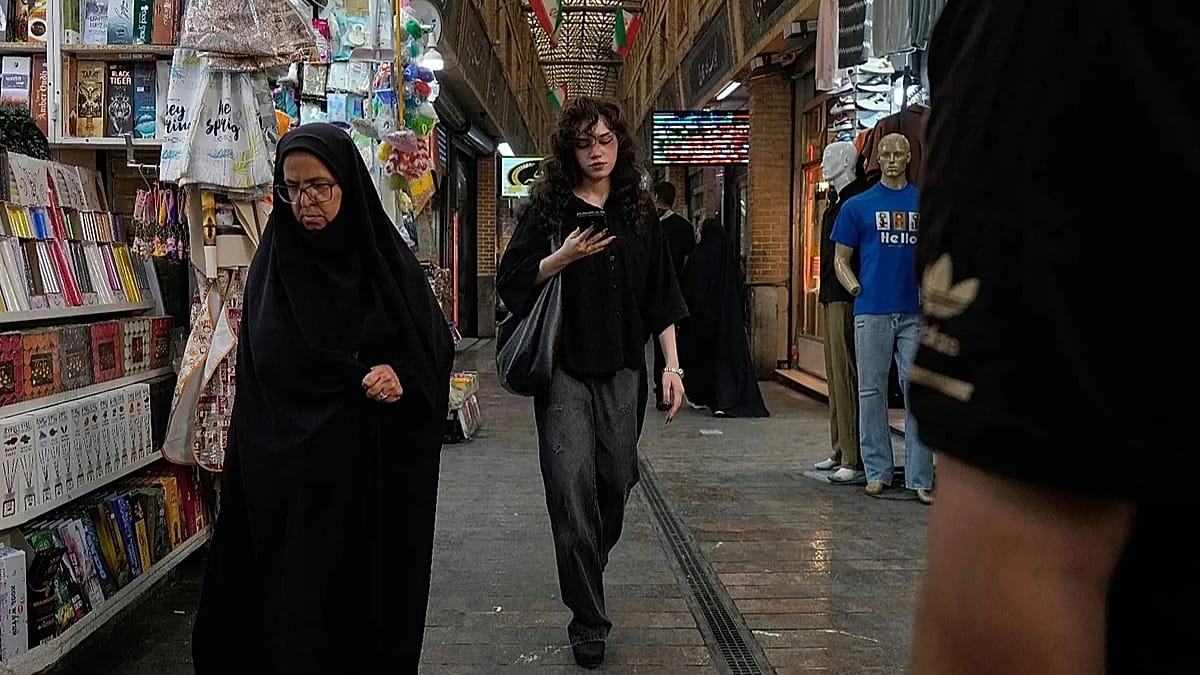
Six months after the outbreak of war between the United States and the Islamic Republic of Iran, the economic damage inside the country has reached a severity that even decades of sanctions never produced. The combination of active conflict and a reinstated US naval blockade has paralysed daily life, sent the national currency into a historic tailspin, and forced millions of families into drastic austerity.
On Wednesday, US President Donald Trump reiterated Washington's position while boarding Air Force One for a trip to Dallas. "They're in very bad shape. Their country is destroyed now," Trump told reporters. "As you probably saw by the numbers, they have 300% inflation."
According to Iran's free currency market data, the rial has continued its sharp decline, falling from around 1.45 million rials per US dollar in March 2026 to over 2.1 million rials by early September. By Thursday, the free-market exchange rate for the dollar had breached 234,000 tomans (2.34 million rials), while the euro soared to an all-time high of 273,000 tomans (2.73 million rials). Iran's official currency is the rial, but most Iranians conduct everyday transactions in tomans — a colloquial unit equal to 10 rials. Shops, restaurants and property listings quote prices almost exclusively in tomans.
The latest decline marks a further slide since early September, when the rial had already lost over 63% of its value against the dollar since March, when Iran's Central Bank Governor pledged a $2 billion liquidity injection while conceding that spiralling inflation was placing "heavy pressure on people's livelihoods."
Domestic corruption and a doubling of fuel prices
While Tehran frequently attributes the economic crisis entirely to external pressure, some domestic political figures acknowledge structural failures at home. Hassan Ghashghavi, spokesman for the Iranian Parliament's National Security and Foreign Policy Commission, admitted that internal mismanagement remains the primary driver of the crisis.
"Regarding the economy, we must look inward. Injustice — especially in distribution and the concentration of wealth within a tiny elite compared to the vast majority — alongside widespread financial corruption and factional self-interest, impacts our economy far more than the United States does," Ghashghavi said.
"Surveys conducted before and after the 12-day conflict (with Israel in June 2025) show that while severe blockades exist, roughly 35% to 65% of our national economic problems stem from domestic issues," he added. "Lack of planning, failure of the three branches of government to perform their duties properly, and internal missteps account for a significant share. Only about 35% of the problems are rooted in foreign policy and US sanctions."
Compounding the hardship, the government implemented a sudden 100% increase in fuel prices on Tuesday. Under the new rationing framework, vehicle owners receive a monthly allowance of 60 litres at 1,500 tomans per litre, and an additional non-subsidised tier of 50 litres at 3,000 tomans per litre. Any consumption beyond that quota jumps to 10,000 tomans per litre. Fuel cards are strictly tied to individuals, meaning households owning more than one vehicle receive only a single monthly allowance.
Eyewitnesses across several major Iranian cities reported a heavy security presence at gas stations to preempt potential civil unrest following the price hike. Although the new price of 10,000 tomans per litre — which comes out to a fraction of a euro — may still seem relatively low compared with other essential goods, the increase is particularly sensitive in Iran because fuel prices have historically been closely linked to protests and social unrest.
In practical terms, when your monthly income is around €100, even 4 euro cents a litre can feel expensive, especially in a country with vast oil reserves. One telling comparison is the price of bottled water: a 1.5-litre bottle of mineral water currently sells for around 20,000 tomans or more — leading Iranians to joke online that it would actually be cheaper to drink petrol than water.
Drivers squeezed by inflation and fixed fares
The surge in fuel costs and operating expenses has crippled Iran's gig economy, particularly ride-hailing services like Snapp and Tap30 — Iran's local equivalent of Uber. Mehdi, a full-time Snapp driver in Tehran, told Euronews Farsi that driving eight hours a day covers roughly 200 kilometres and generates about 65 million tomans (€236) per month on paper. However, company commissions, fuel, oil, and heavy vehicle depreciation immediately wipe out nearly 30 million tomans (€109), leaving him with a net monthly income of just 35 million tomans (€127).
"With the fuel price increase, fares should logically rise by 30%, but Snapp refuses to adjust them because passengers simply can't afford it and would revert to traditional taxi agencies," Mehdi explained. "The number of active drivers on Snapp is shrinking fast because the rates no longer cover costs. Some drivers ask passengers to transfer payments directly via card-to-card to bypass the app's rates, but most passengers report these requests to the company."
For drivers like Mahmoud, who worked for Tapsi, the outbreak of active military conflict effectively halted business altogether. During the 40 days of active war and for weeks following the ceasefire, passenger requests plummeted. "Fares picked up slightly by early summer — a trip from Aryashahr to Sattarkhan ran about 120,000 tomans (€0.43), and a cross-town trip from Dowlat Street to Sepah Square fetched 300,000 tomans (€1.09)," Mahmoud told Euronews Farsi. "But food..."
The economic collapse is not just a matter of statistics; it is reshaping daily survival strategies across the country. As the rial continues to slide and fuel prices climb, the gap between official rhetoric and lived reality grows wider. For many Iranians, the question is no longer when the war will end, but how they will make it to the end of the month.