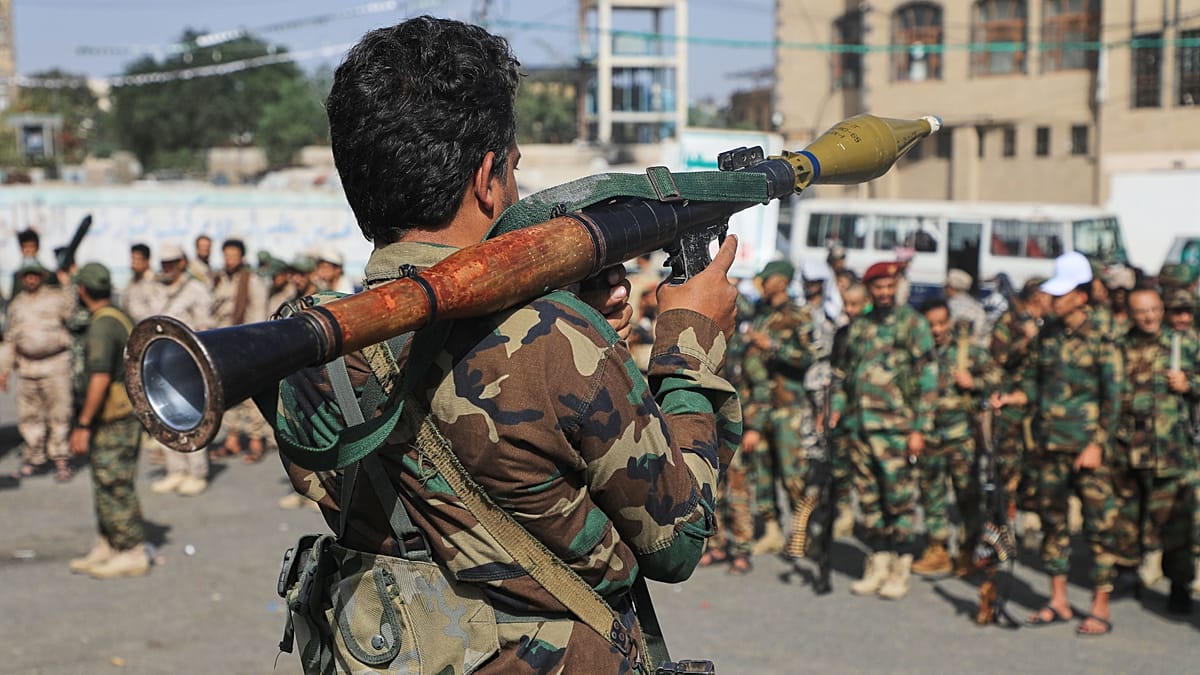
Yemen's Houthi rebels have taken control of the Red Sea port city of Mokha, a key stronghold of the internationally recognised government, and are pushing toward the Bab el-Mandeb strait, according to a Yemeni military source. Witnesses reported Houthi fighters entering the city on Thursday chanting slogans against the United States and Israel.
Mokha, which had been held by government forces, has come under sustained attack since early August, when more than two dozen missiles struck the city in a matter of days, halting port operations. The Yemeni government has not yet officially confirmed the city's fall.
The Houthis, who control roughly a third of Yemen's territory—including the most densely populated areas—are seeking to gain a foothold along the Bab el-Mandeb, a narrow waterway that links the Red Sea to the Gulf of Aden and, ultimately, to the Suez Canal. Together with the Strait of Hormuz, this route carries about a quarter of the world's daily petroleum and crude shipments and nearly a third of global maritime trade.
Reports indicate that the Houthis have consulted with Tehran about imposing a toll for safe passage through the strait, a move that could further strain global economies. The Yemeni government has repeatedly warned of such plans, noting that the strait's Arabic name, "Bab el-Mandeb," translates to "Gate of Tears."
Strategic push toward the strait
Major-General Sadeq Duwaid, spokesman for the government-affiliated National Resistance Forces controlling areas adjacent to the strait, said the Houthi siege of Mokha is a key manoeuvre to build operational capacity along the Red Sea coast. "Through their continued attacks on Mokha and its port, the Houthi militia seeks to establish a presence along the shores of the Bab el-Mandeb Strait and transform the area into a situation resembling that of the Strait of Hormuz," he said in mid-August.
The coastal town of Dhubab and Perim Island—a rocky volcanic island that sits in the middle of the strait and divides it into two shipping channels—are now considered the Houthis' central military objectives.
The Houthis, formally known as Ansar Allah, launched a large-scale offensive last week against Saudi-backed government forces. They have also fired ballistic missiles and drones at several cities in southern Saudi Arabia, prompting Riyadh to respond with daily airstrikes on Houthi-held territory. On Thursday, the Houthi news agency Saba reported around 40 Saudi airstrikes in the governorates of Taiz, Hodeida, Al-Jawf, and Marib.
The Saudi-led coalition, which has been fighting the Houthis on behalf of the internationally recognised government since 2015, said it would "take all necessary measures and actions to respond to the sources of the threat and neutralise its danger."
The renewed fighting has left more than 500 people dead, mostly combatants, according to an AFP tally. The conflict has also contributed to a spike in oil prices, which surpassed $100 a barrel on Thursday, and has raised concerns about energy security in Europe, which relies heavily on the Suez Canal route for imports of oil and liquefied natural gas.
The Houthis are part of Tehran's so-called Axis of Resistance, a network of militant groups backed by Iran's Islamic Revolutionary Guard Corps, including Hezbollah in Lebanon, Hamas in Gaza, and militias in Iraq. Their previous campaign against Israel-linked shipping during the Gaza war severely disrupted cargo traffic through the Bab el-Mandeb, a reminder of the strait's vulnerability.
For European policymakers, the instability in the Red Sea is a stark reminder of the fragility of global supply chains. The Black Sea blockade has already shown how regional conflicts can trigger food crises and migration surges. Now, the Bab el-Mandeb is emerging as another potential flashpoint that could have far-reaching consequences for the continent's economy and security.