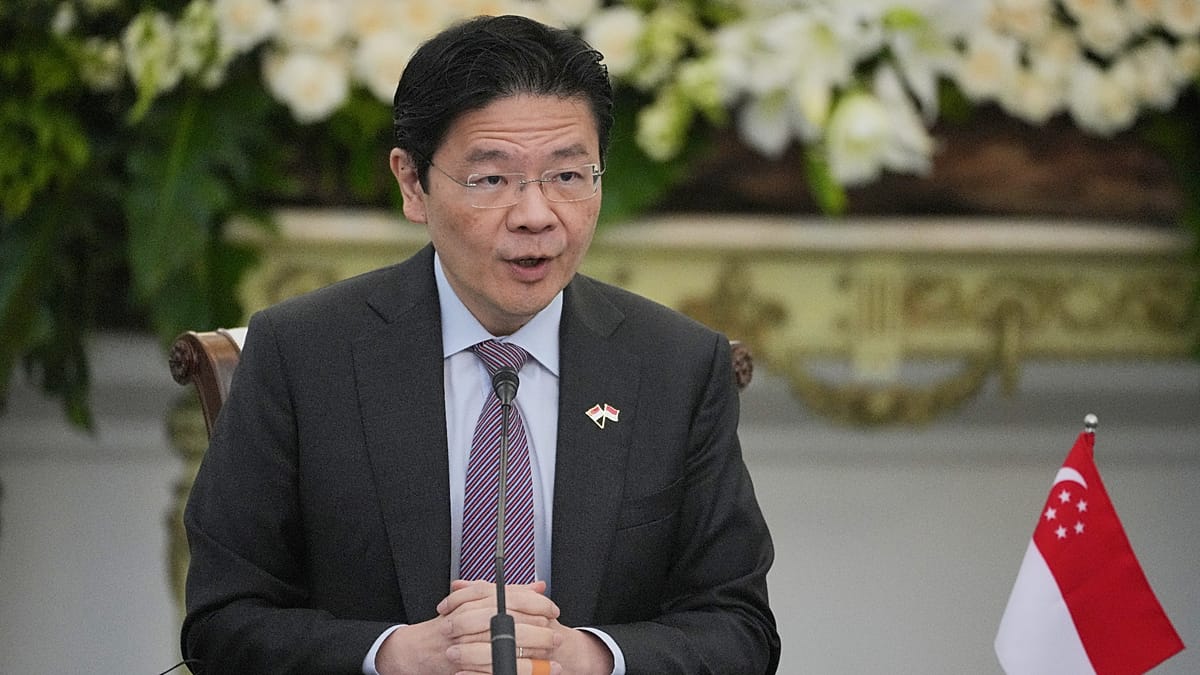
Singapore's political leaders are set to receive their first salary increase in 15 years, a decision that has reignited debate about public-sector pay in the city-state. Prime Minister Lawrence Wong announced the revised framework in Parliament on Tuesday, saying the government must remain competitive to attract capable individuals into politics.
Under the new structure, the benchmark annual salary for a minister at the lowest grade will rise from S$1.1 million (€747,000) to S$1.8 million (€1.2 million). The prime minister's own benchmark pay will jump from S$2.2 million (€1.5 million) to S$3.6 million (€2.4 million), an increase of 64 percent.
The adjustments follow recommendations from an independent committee, which reviewed the salary framework for the first time since 2012. Wong stressed that the full increases will not be applied immediately; instead, ministers will receive a one-off adjustment of up to 9 percent from October 15, depending on individual performance and circumstances.
In a gesture aimed at softening public criticism, Wong announced he would donate his entire salary increase to charity for the next five years. However, the move has not fully assuaged concerns among Singaporeans, many of whom are grappling with rising living costs.
Public reactions: support and skepticism
On the streets of Singapore, reactions were divided. May Goh, a 69-year-old retiree from the semiconductor industry, voiced support for the raises. "I think their responsibilities are very high. They are doing a good job so far compared to other countries," she said.
A 32-year-old cybersecurity professional working in the central business district echoed that sentiment, describing ministers as "basically the CEOs of the political world." She said she "honestly" believed the increases were fair.
Others were less convinced. A 26-year-old IT consultant called the raises "very steep," noting that the figures put the scale of compensation into perspective. "When you see such a huge salary increase, it puts into perspective, like 'wow that's quite a lot'. We don't even spend that much," he said.
A 69-year-old retiree, while expressing support for the principle, called for greater transparency in how the numbers are calculated and justified.
The pay debate is particularly sensitive given Singapore's median gross monthly income of S$5,775 (€3,924) for fully employed residents in 2025, according to government data. The prime minister's new benchmark salary is more than 600 times that figure.
Singapore's ministerial pay has long been among the highest in the world, a deliberate policy to counter corruption and attract talent from the private sector. Yet the gap between political salaries and ordinary incomes has fueled periodic public discontent, especially during periods of economic uncertainty.
The announcement comes as Singapore's ruling People's Action Party faces a more competitive political landscape, with opposition parties gaining ground in recent elections. The pay raise could become a campaign issue, though the government argues that competitive compensation is essential for effective governance.
For now, the revised framework takes effect in stages, with the full increases expected to be phased in over the coming years. The independent committee's report, which has not been fully published, is expected to provide further details on the rationale behind the changes.