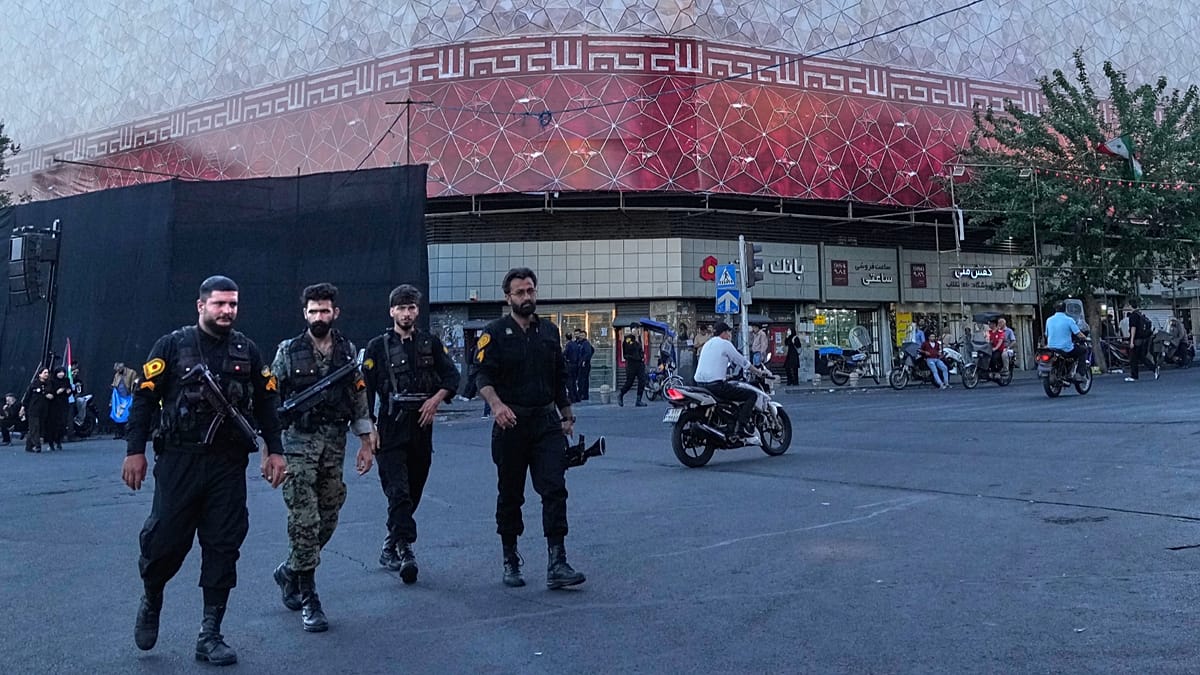
Iran's hardline establishment is framing the US-Iran framework deal as evidence that Tehran outlasted Washington, rather than as a concession. Yet questions remain over how much control the Islamic Revolutionary Guard Corps (IRGC) exercised over its terms.
IRGC Quds Force commander Esmail Qaani made his first public appearance in months on Monday night to discuss the deal. Speaking on Iranian state television, Qaani claimed that the Bab al-Mandeb Strait—linking the Red Sea to the Gulf of Aden—"is fully in the hands of the guys in Hezbollah, the (Houthis) in Yemen, and even some of the comrades and children of resistance who are not Yemeni." This remark signals that Tehran's regional network retains leverage over a separate global shipping route, even as the Hormuz blockade is lifted.
The Quds Force, the IRGC's intelligence and asymmetrical warfare branch, is the main architect of the Axis of Resistance—a network of armed groups across the Middle East, including Hamas in Gaza, Houthis in Yemen, and Shia militias in Iraq, which Tehran finances, arms, and directs.
Internal Divisions Over the Deal
For Iran's hardliners, the memorandum is likely to be presented domestically as a strategic victory—evidence that the Islamic Republic survived the war and forced Washington to negotiate. However, this narrative is not shared evenly across Iran's political spectrum.
Ebrahim Rezaei, spokesperson for the Iranian parliament's National Security and Foreign Policy Committee, called the memorandum "unbalanced" and said Iran's red lines had not all been respected. "We are in a full-scale hybrid war, and we must use this opportunity to become stronger," he said in a televised interview.
The reaction comes at a sensitive moment, as Iran prepares official funeral ceremonies for late Ayatollah Ali Khamenei, who was killed in US-Israeli airstrikes on 28 February. State-run media are expected to emphasise that the document contains no provisions on regime change, political reform, or Iran's domestic governance, instead focusing on clauses requiring both sides to respect each other's sovereignty.
Sanctions relief, the resumption of oil exports, the release of frozen assets, and the reopening of maritime traffic are likely to be presented as proof that Iran extracted major economic concessions without conceding its political structure. Iranian state media have already reported that three Iranian oil tankers carrying a combined 5 million barrels of crude transited the Strait of Hormuz after Trump announced the lifting of the US naval blockade.
Hardliner Skepticism and Exiled Opposition
Even among hardliners, support for the deal has not translated into trust in Washington. Hossein Shariatmadari, editor of the hardline Kayhan newspaper, criticised Iranian negotiators for failing to publish the memorandum themselves, forcing Iranians to learn its contents from US media. He called for parliamentary review before it proceeds.
The agreement also complicates the position of exiled opposition figures who had hoped sustained pressure might weaken or topple the Islamic Republic. US Vice President JD Vance moved to dispel that expectation directly. "Trump never said that his goal was to install Reza Pahlavi to become the new leader of Iran," he said. "What we want is a cessation of their nuclear program."
Pahlavi, the most prominent opposition figure abroad, rejected the deal outright. "Any deal with this regime will ultimately fail," he told ITV News. "It can never be trusted. It will continue to blackmail the world, brave, innocent Iranians, and spread terror and instability in the region and internationally."
Trump's Mixed Signals and European Implications
US President Donald Trump has stressed that the framework deal—meant to be followed by 60 days of further negotiations for a final agreement—remains only a memorandum of understanding. "And if I don't like it, we'll go back to shooting at them, dropping bombs on their head," Trump said. The agreement is now expected to be signed not in Geneva but at Switzerland's Bürgenstock Hotel, a venue often used for high-level diplomacy.
Trump has sent further mixed signals. Speaking alongside Egyptian President Abdel Fattah el-Sisi, he dismissed reports that the deal included a $300 billion reconstruction fund for Iran. "That's false," he said. "We are not investing 10 cents," repeating that the arrangement remained conditional. "If they don't behave, we'll go right back to dropping bombs right smack in the middle of their head," Trump added.
Israeli officials have been openly critical of the deal's rushed nature, warning that it could strengthen Tehran's position—a stance likely to weigh heavily on the agreement's survival of the 60-day negotiating window that follows.
For European observers, the deal's implications are significant. The reopening of the Strait of Hormuz could ease global energy markets, but the IRGC's continued control over the Bab al-Mandeb Strait threatens shipping routes vital to European trade. The agreement also comes amid broader geopolitical tensions, as seen in Albanian protests against a Kushner-linked resort and ongoing Ukraine-Russia strikes as EU accession talks advance.