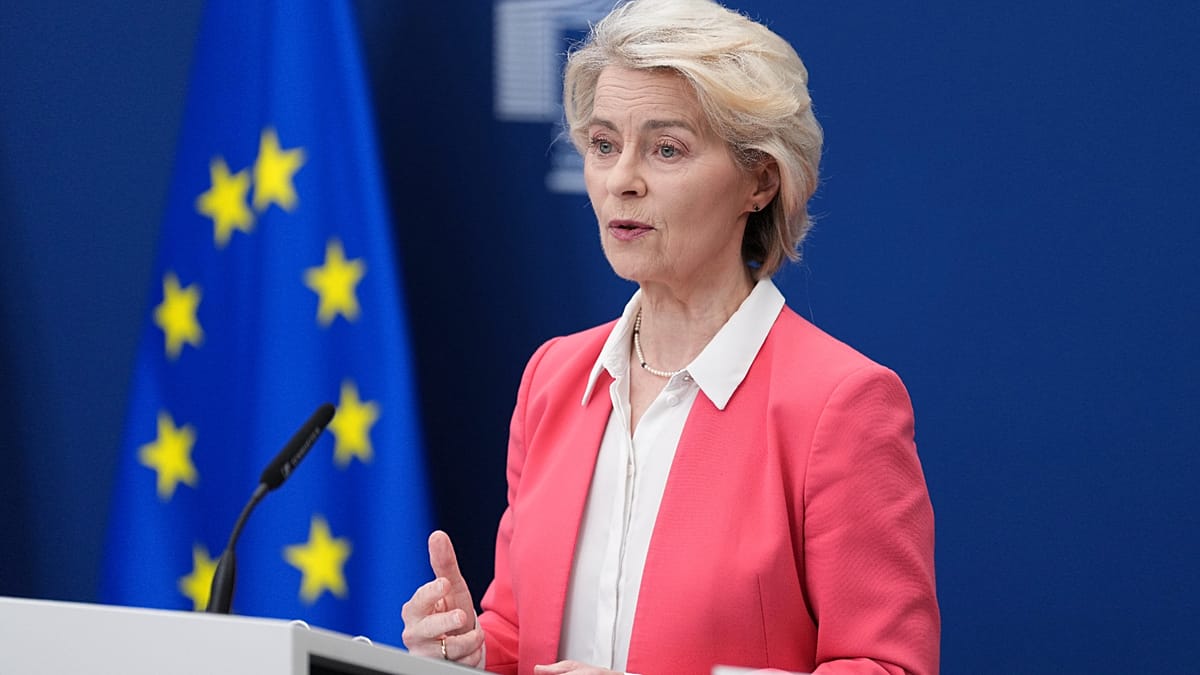
European Commission President Ursula von der Leyen said on Saturday that despite the massive influx of irregular migrants into the Spanish enclave of Ceuta, none managed to reach mainland Spain or other parts of the European Union. Speaking after a conference call with EU Commissioner for Internal Affairs and Migration Magnus Brunner and Dubravka Šuica, who oversees Mediterranean affairs, she credited the swift response of Spanish and Moroccan authorities.
“Due to the effective work of Spanish and Moroccan law enforcement, not a single person reached mainland Spain or the rest of the EU,” von der Leyen said. The statement came after an estimated 60,000 people crossed into Ceuta, a Spanish territory on the North African coast, in a matter of days, overwhelming local infrastructure and prompting a diplomatic crisis between Madrid and Rabat.
The episode has reignited debates about border management and solidarity within the bloc. While the immediate crisis appears to have been contained, the political fallout is far from over. A majority of EU member states have now called for emergency discussions at the ministerial level to coordinate a common response and prevent similar incidents in the future.
22 member states demand urgent action
In an open letter, leaders from 22 of the EU’s 27 member states urged the bloc’s interior ministers to hold a video conference “as a matter of urgency.” The letter, reported by several European media outlets, calls for a coordinated and rapid response to what it describes as “uncontrolled crossings” and stresses the need to reinforce the EU’s external borders.
Von der Leyen welcomed the initiative, saying the bloc needed “a lessons learned process to improve our European resilience.” She also emphasised the importance of cooperation with countries of origin and transit, a recurring theme in EU migration policy.
The situation in Ceuta has also exposed legal and political tensions within Spain. The government of Prime Minister Pedro Sánchez has faced criticism from opposition parties and regional leaders over its handling of the crisis. Some have questioned whether Spain’s migration laws are adequate to deal with such large-scale arrivals, a topic explored in this analysis of Spain’s legal deadlock on returns.
Meanwhile, the European Commission has reiterated that migrants who entered Ceuta irregularly cannot simply move to the mainland, as Schengen rules and EU asylum procedures apply. This has added to the pressure on Spanish authorities to process claims and returns efficiently.
The crisis has also fuelled criticism from right-wing parties across Europe, who argue that the EU’s migration policies are too lenient. In Spain, the far-right Vox party has called for the military to be deployed to protect the borders, while some conservative leaders in other member states have used the incident to push for stricter controls. Right-wing criticism of Spain’s approach has intensified, complicating efforts to find a unified European stance.
At the same time, humanitarian organisations have warned against framing the crisis solely in security terms. They point to the dire conditions in Morocco and the desperation of those who attempt the crossing. The UN’s migration agency has called for a humane and orderly management of the situation, respecting the rights of asylum seekers.
As the EU debates its next steps, the immediate priority for Spanish authorities remains the return of the remaining migrants to Morocco. According to Spanish officials, the vast majority of those who entered have already been sent back, but several thousand remain in temporary facilities in Ceuta. The Spanish government has said it will continue to work with Moroccan authorities to resolve the situation.
The Ceuta episode is being described by some experts as the EU’s largest single irregular border crossing in recent history, a claim that underscores the scale of the challenge. This analysis looks at the numbers and their implications for European border policy.
For now, the EU’s focus is on preventing a repeat. The proposed emergency meeting of interior ministers is expected to take place in the coming days, with discussions likely to centre on burden-sharing, returns agreements, and the role of Frontex, the EU’s border agency. Von der Leyen’s call for a “lessons learned” process suggests that Brussels is aware of the need for structural improvements, not just a reactive response.
The crisis has also raised questions about Spain’s position within the Schengen area. Some have speculated whether Spain could face suspension from the border-free zone, a scenario that this piece examines. While such a move is unlikely, the debate reflects the broader anxiety about the EU’s ability to manage its external frontiers.
As the situation evolves, European Pulse will continue to monitor developments and provide in-depth coverage of the political and human dimensions of this story.