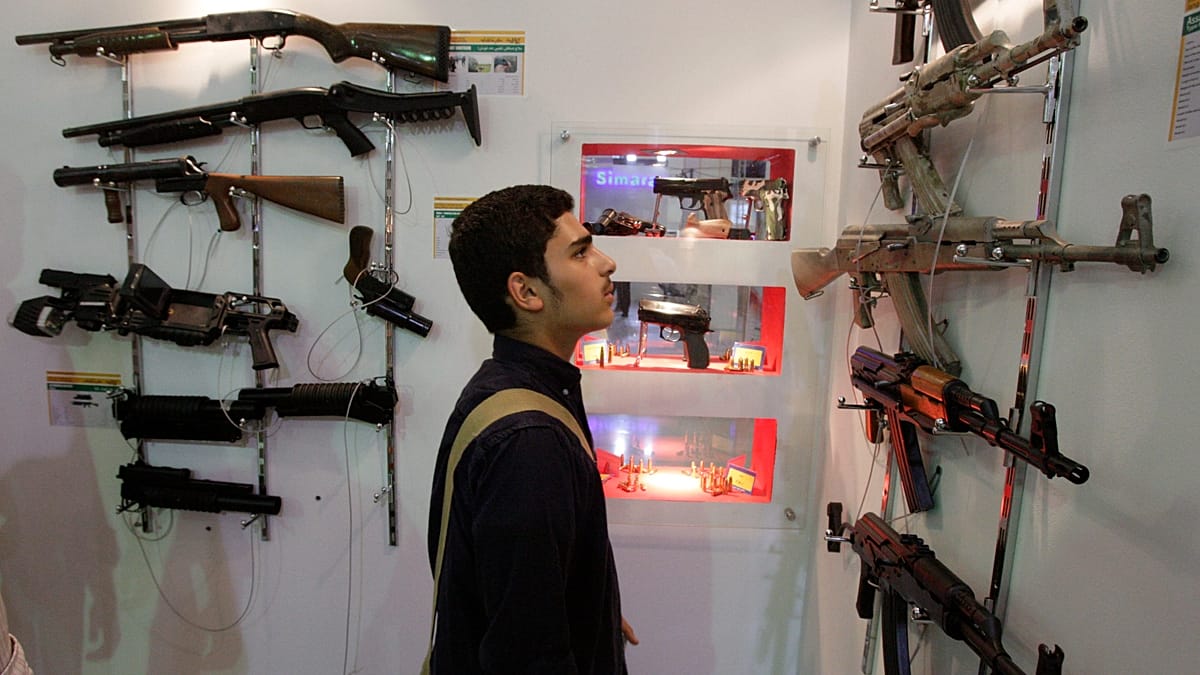
Iranian state television IRIB has broadcast live weapons training programmes that include simulated attacks on US President Donald Trump and Israeli Prime Minister Benjamin Netanyahu, as well as a host firing at the flag of the United Arab Emirates. The broadcasts, aired across multiple IRIB channels, show studio instruction on assembling and firing Kalashnikov rifles, PK machine guns, Dragunov sniper rifles and RPG-7 launchers.
Footage has also emerged from mosques in Ahvaz, Kerman, Shiraz and Zahedan, where men, women and children are presented as voluntarily learning to fight against the US and Israel. Mohsen Barmahani, IRIB's deputy head, defended the programming to Tasnim News Agency, stating: "In a wartime situation, and in a country that is simultaneously engaged in a struggle against all world powers and oppressions, it is only natural for the national media to adopt a war footing." He added that hosts appearing with weapons serve as a reminder of these teachings to the public.
Child Recruitment and a Fatal Checkpoint
The broadcasts coincide with reports from Iranian human rights organisations that an 11-year-old boy, Alireza Jafari, was killed by an Israeli drone strike while manning an IRGC checkpoint in Tehran last Sunday. Hengaw and HRANA identified the child and said his father was present at the time. Both organisations stated he had been assigned to the checkpoint by Iran's security forces. Euronews could not independently verify the claims, but reports from a Tehran municipality-affiliated outlet and Basij units described his death in the context of checkpoint service.
The boy's mother was quoted as saying his father had taken him there due to a personnel shortage, and that teenagers aged 15 and 16 — or younger — were regularly present at checkpoints. The Basij Teachers Organisation, an ideological training branch linked to the IRGC, was cited by multiple Iranian media outlets abroad as having confirmed the death.
The IRGC formally announced a civilian recruitment campaign on 26 March, setting the minimum enlistment age at 12. Rahim Nadali, deputy of the Mohammad Rasulullah IRGC unit in Tehran, said in a television appearance that children of 12 and 13 had expressed interest in intelligence patrols and checkpoint operations. An IRGC advertising poster published by Defa Press News Agency showed two children alongside adults in military uniform.
Human Rights Watch warned this month that the recruitment campaign constitutes "a grave violation of children's rights and a war crime when the children are under 15." The organisation confirmed that IRGC representative Nadali stated recruits would be used for checkpoint staffing, operational and intelligence patrols, vehicle convoys and other security activities. Basij checkpoints have proliferated across Tehran since the war began and have been repeatedly targeted by Israeli strikes.
The use of minors in Iran's military structures is not new. During the Iran-Iraq war in the 1980s, authorities recruited hundreds of thousands of children into the Basij for high-risk operations, with tens of thousands killed, according to HRW estimates based on Iranian official figures. Reports of child recruitment have also emerged in regional conflicts and domestic crackdowns in subsequent years.
Under the Rome Statute of the International Criminal Court, conscripting or enlisting children under 15 into armed forces or using them to participate actively in hostilities constitutes a war crime. The European Union has previously taken action against Iranian entities involved in human rights abuses, including a recent Europol takedown of 14,200 IRGC-linked accounts across 19 EU states.