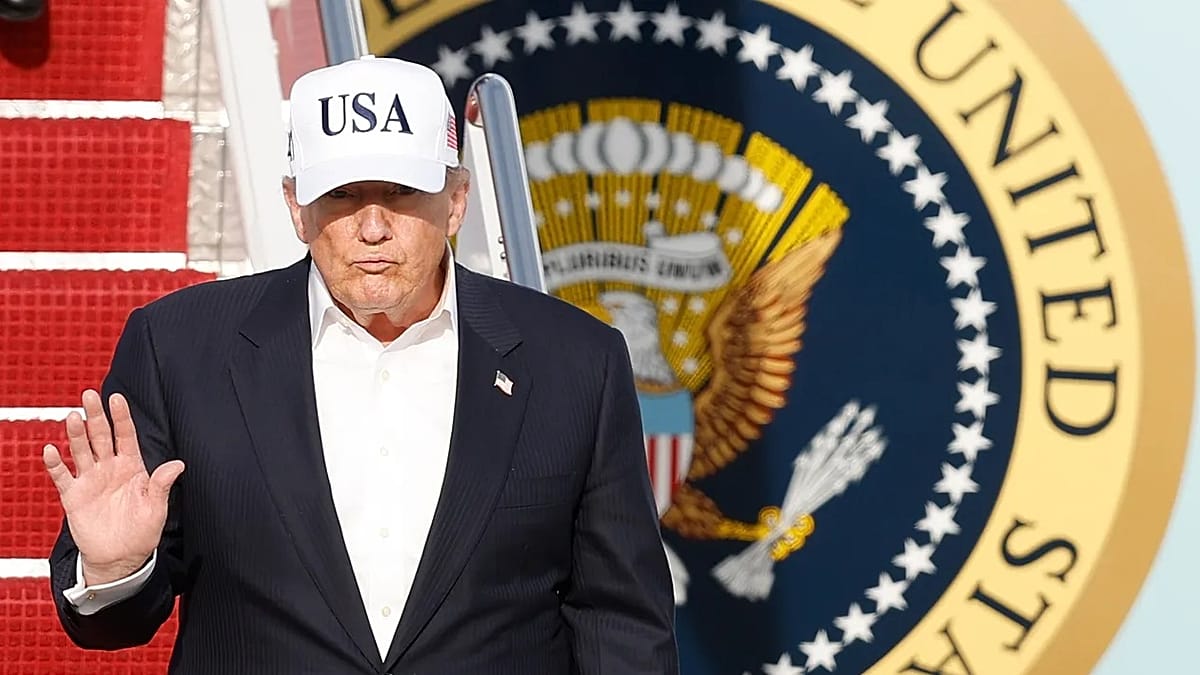
During a state visit to Beijing this week, US President Donald Trump warned Taiwan against formally declaring independence from China, prompting a swift response from Taipei. In an interview with Fox News, Trump stated he was not looking for Taiwan to declare independence and questioned the rationale of US military intervention in such a scenario. 'I'm not looking to have somebody go independent and, you know, we're supposed to travel 9,500 miles to fight a war. I'm not looking for that,' he said. He added that he wanted both sides to 'cool down.'
Taiwan's foreign ministry responded on Saturday, thanking Trump for his support for regional peace but firmly reasserting the island's status as a 'sovereign democratic country.' The statement declared that 'Beijing has no right to claim jurisdiction over Taiwan' and pledged to 'continue to deepen cooperation with the United States, maintain peace through strength, and ensure that the security and stability of the Taiwan Strait are not threatened or undermined.'
European Implications of the Taiwan Strait Tensions
For European capitals, the Trump-Xi summit in Beijing — and the accompanying rhetoric on Taiwan — carries significant weight. The European Union, which maintains a policy of 'One China' while engaging economically with Taiwan, watches closely as the world's two largest economies navigate a relationship that affects global trade, technology standards, and security. The Trump-Xi summit in Beijing has already prompted Brussels to brace for potential fallout in trade and technology sectors, where European firms are deeply intertwined with both US and Chinese supply chains.
China views Taiwan, which has its own democratically elected government, as a breakaway province that must eventually be reunified with the mainland. President Xi Jinping has not ruled out the use of force to achieve this goal. A spokesperson for Xi described Taiwan as the 'most important issue in China-U.S. relations' and key to future dealings between the two nations. This stance was echoed during the summit, where China warned the US on Taiwan while also offering to mediate other global crises.
The European Union's member states, from Berlin to Paris to Warsaw, have diverse approaches to the Taiwan issue. Germany, under Chancellor Olaf Merz — who recently criticized US policy before holding a call with Trump — must balance economic ties with China against security commitments to the US-led alliance. France, with its own strategic autonomy doctrine, has maintained a nuanced position, while Central and Eastern European states often align more closely with Washington on security matters.
Trump's comments also raise questions about the reliability of US security guarantees in the Indo-Pacific, a region where European navies occasionally patrol. The EU's 2021 strategy for the Indo-Pacific emphasizes a rules-based order and freedom of navigation, principles that could be undermined if the US appears to waver on Taiwan. European diplomats in Brussels and national capitals are likely to scrutinize the fine print of the summit's outcomes, particularly any joint statements or back-channel assurances.
Economically, the stakes are high. Taiwan is a global leader in semiconductor manufacturing, producing chips essential for European automotive, industrial, and defense sectors. Any disruption in the Taiwan Strait could cripple supply chains across the continent. The global markets rallied on hopes of stability from the summit, but the underlying tension remains.
Taiwan's foreign ministry statement underscores the island's determination to maintain its democratic institutions and international partnerships. 'Beijing has no right to claim jurisdiction over Taiwan,' it insisted, a position that resonates with many European democracies that value self-determination. However, the EU's official policy of non-recognition of Taiwan as a sovereign state complicates any overt support.
As the dust settles on Trump's Beijing visit, European policymakers must navigate a delicate balance: maintaining economic engagement with China, supporting democratic allies like Taiwan, and ensuring that the US remains a credible security partner. The coming weeks will reveal whether the summit's rhetoric translates into concrete actions — or leaves Europe to manage the consequences of great-power rivalry.