The son of Myanmar's ousted civilian leader Aung San Suu Kyi has turned to French President Emmanuel Macron for assistance in securing independently verified proof of his mother's life, after the country's junta claimed she had been moved from detention to house arrest.
Kim Aris, who lives in the United Kingdom, handed a letter to France's Foreign Minister Jean-Noël Barrot during a meeting in Paris on Tuesday, according to Suu Kyi's lawyer, François Zimeray. In the letter, Aris implores France to join his call for proof of life, warning that without it, there is no way to confirm the 80-year-old Nobel Peace Prize winner's condition or whereabouts.
“I implore France to join my call so that we may obtain independently verified proof of life, and so that her fundamental rights are guaranteed: appropriate medical care, access to her lawyers and to her family,” Aris wrote.
The junta chief, Min Aung Hlaing, ordered Suu Kyi's transfer on Thursday, five years after she was first detained following the military coup of February 2021. The regime later released an undated photograph showing Suu Kyi seated between two uniformed men, but her legal team has cast doubt on its authenticity. “We don't know if it's real or if it's AI,” Zimeray told AFP.
Lawyer Catalina de la Sota, who also represents Suu Kyi, expressed growing concern over the lack of transparency. “We cannot imagine that she is no longer alive, but why is she being kept in total secrecy, in violation of all international conventions? We are worried about her health,” she said.
In response to the appeal, Barrot stated that France would continue to work for the immediate and unconditional release of Aung San Suu Kyi, according to the French foreign ministry. The request comes as European leaders grapple with shifting global alliances and security challenges, including discussions on a new security order as US disengagement looms.
Myanmar's Civil War and Humanitarian Toll
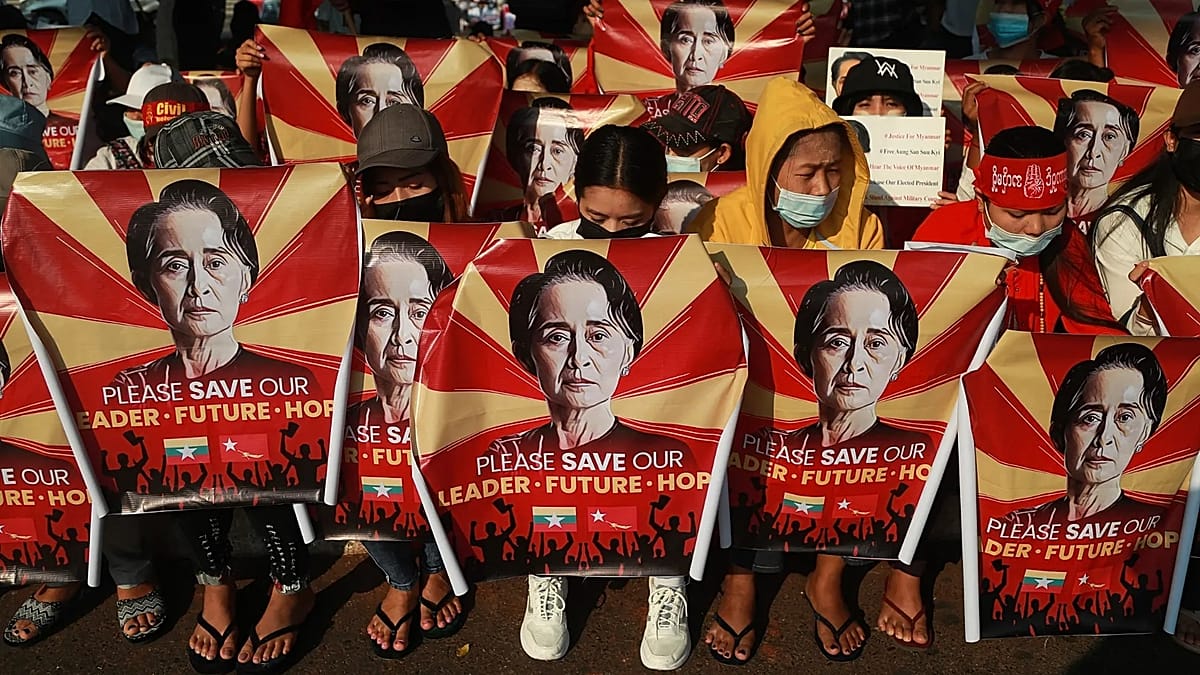
The military's 2021 takeover sparked massive public protests, which were violently suppressed by security forces. That crackdown triggered an armed resistance that has since escalated into a full-blown civil war. Ethnic minority militias and People's Defence Forces aligned with the opposition now control large swaths of the country, while the junta holds much of central Myanmar and major cities such as the capital, Naypyidaw.
The United Nations Human Rights Office reported that the military intensified violence against civilians in 2024 to unprecedented levels, inflicting the heaviest civilian death toll since the coup as its grip on power weakened. The Assistance Association for Political Prisoners, which tracks arrests and casualties, documented at least 6,239 deaths and 28,444 arrests linked to the junta's repression. The actual toll is believed to be significantly higher, as the group cannot verify cases in remote areas or count military casualties.
Suu Kyi, who led Myanmar's civilian government from 2016 until the coup, remains a powerful symbol of resistance despite her long isolation. Her son's appeal to Macron underscores the international dimension of the crisis, as European nations weigh their response to the junta's continued defiance of global norms.