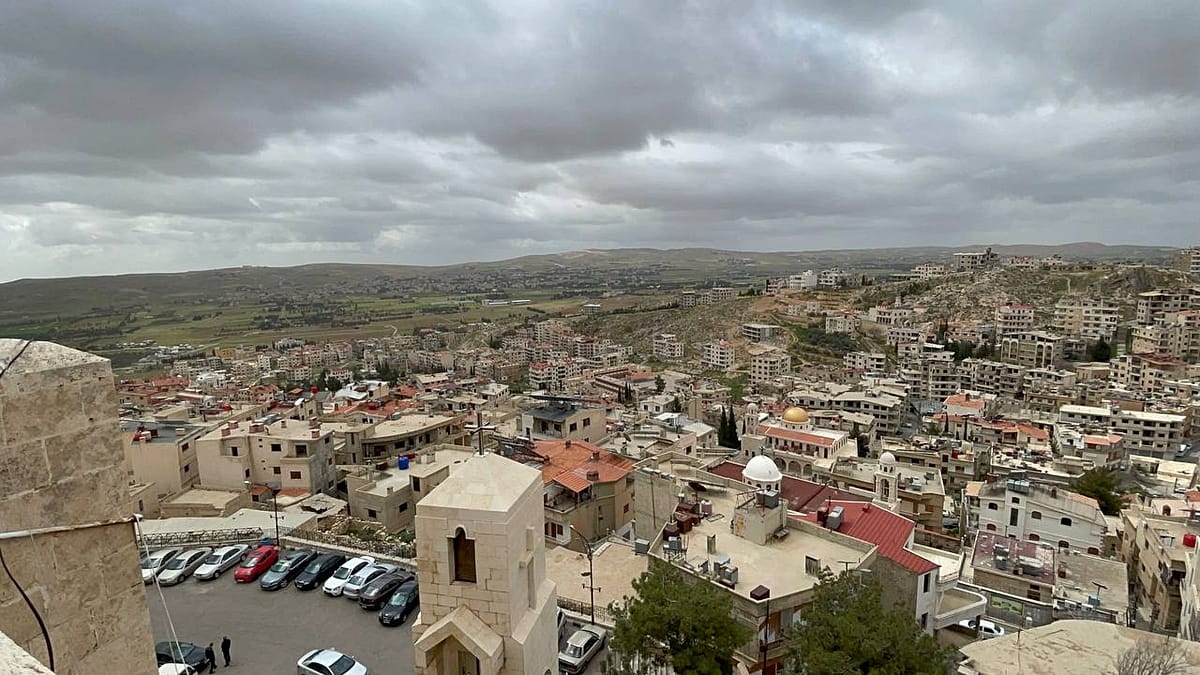
For centuries, the hilltop city of Saydnaya, perched more than 1,400 metres above sea level in Syria's Qalamoun Mountains, has been known as one of Christianity's most important pilgrimage destinations. Its Monastery of Our Lady of Saydnaya, founded at the dawn of the 7th century, draws believers from across the region and is considered second only to Jerusalem in significance. But since the fall of Bashar al-Assad's regime in December 2024, residents have been fighting a different kind of battle — one over the name of a notorious prison that sits on the road to their city.
The facility in question is the First Military Prison, a Syrian Ministry of Defence compound located 30 kilometres north of Damascus, outside Saydnaya's administrative boundaries. Built under Hafez al-Assad and expanded under his son, it held between 10,000 and 20,000 prisoners at its peak and became internationally infamous for systematic torture and cruel treatment. When opposition forces entered the prison after the regime's collapse, global media coverage universally referred to it as 'Saydnaya Prison' — a label residents say is geographically wrong and deeply damaging.
A 'blatant injustice'
"Many media outlets removed the word 'prison' and just said 'Saydnaya', as if the town itself is a prison. This is completely false," Bassam Habib Andraos, mayor of the city's first neighbourhood, told Euronews. "The First Military Prison is a site of terror, and linking it to the name of Saydnaya is a blatant injustice — just as the city of Palmyra was wronged when its name was linked to another prison."
Resident Mahmoud Pasmana echoed the complaint. "The so-called 'Saydnaya Prison' is not administratively located within the city of Saydnaya, but on the road leading to it," he said. "Ascribing it to us is an injustice."
The city's mixed Christian and Muslim population has long prided itself on peaceful coexistence. "Saydnaya has a long history. There are no sects here — we are all from one place, and this is deeply rooted in us since our ancestors. We look after one another," Jamil Daher, a local resident, told Euronews. He explained that the town traditionally relies on small-scale agriculture — vineyards and almond farming — alongside a relatively high number of educated professionals. But the naming dispute compounds already difficult living conditions. "Saydnaya has been wronged because of a single issue — the prison. The media should make it clear that the prison is not on Saydnaya's land and has no connection to it," Daher said.
George Murad, head of the Saydnaya municipal council, noted that the town's churches, mosque and schools affiliated with the monastery serve residents of all faiths, including displaced people from surrounding villages. Religious tourism, once a mainstay of the local economy, has declined sharply since the war began, though Murad expressed hope for recovery.
Samaan Maamar, head of the parish council at the Church of Our Lady of the Assumption, said believers still visit the monastery to see what he described as a miraculous icon attributed to John the Baptist. "Saydnaya is known globally, not just in Syria," he said. "We are made up of Christians and Muslims living together as one family in all our contexts."
The city's leaders have raised the issue with Syria's transitional authorities. Andraos said a delegation met the new governor of Rural Damascus, Amer al-Sheikh, to discuss the prison's name and its future use. The dispute echoes broader challenges across the region, where place names carry heavy symbolic weight. In a similar vein, former French hostage Louis Arnaud recalled Evin Prison as a 'den of evil', highlighting how prisons become synonymous with terror.
For now, residents of Saydnaya are determined to reclaim their city's identity. As Daher put it: "Saydnaya has a deep history and a civilisation that has nothing to do with this place. Everything nearby gets named after it because of its fame, but this prison is far from us and unjustly associated with us. It is a prison of terror, pure and simple."