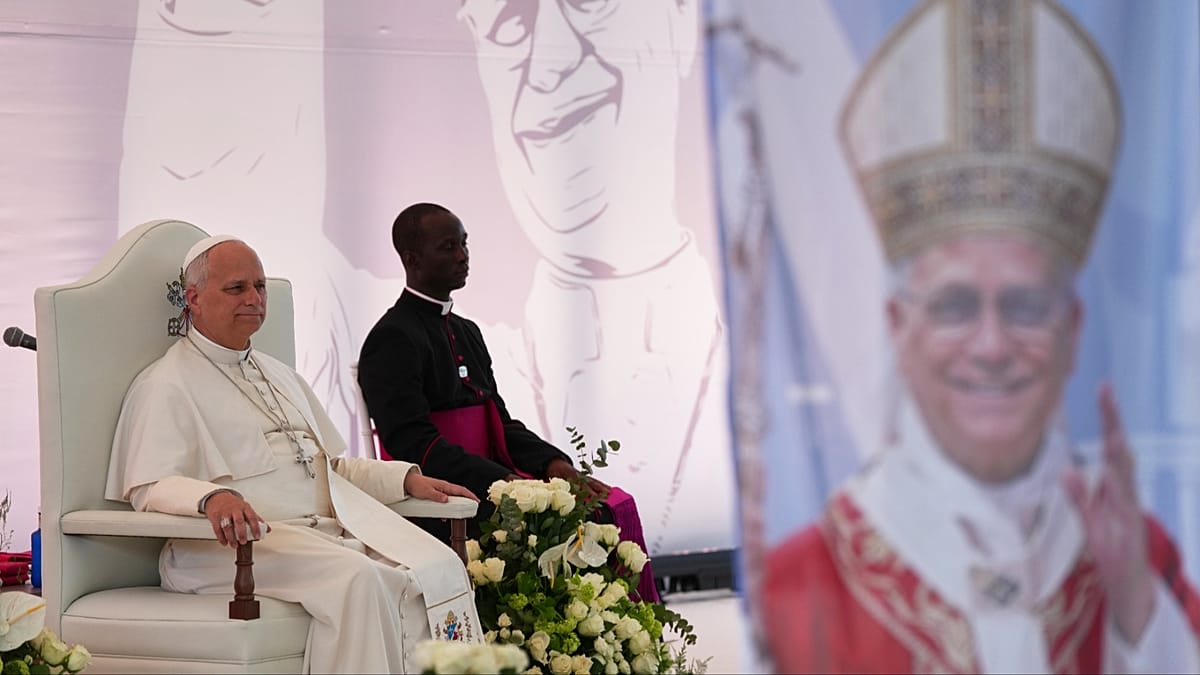
Pope Leo XIV delivered a sharp critique of global resource exploitation and domestic inequality on Tuesday during the final stop of his African tour in Equatorial Guinea. Addressing government officials in the capital, Malabo, the pontiff condemned what he termed the 'colonisation' of the continent's oil and mineral wealth, linking it to armed conflicts and a disregard for international law.
The visit, the first by a pope to this West African nation since John Paul II in 1982, drew large crowds of faithful. Pope Leo XIV arrived at the presidential palace in an open motorcade, greeted by cheering supporters. 'We have waited 44 years for the arrival of the pope. It is a blessing for the country,' said Diosdado Marques, a senior Catholic official in Equatorial Guinea.
A Nation's Contrasts
Equatorial Guinea, a former Spanish colony, presents stark contrasts. Since the discovery of offshore oil in the mid-1990s, its economy has been transformed, with petroleum accounting for nearly half of its GDP and over 90% of exports. Yet, more than half of its nearly two million inhabitants live in poverty.
The nation has been ruled since 1979 by President Teodoro Obiang Nguema Mbasogo, Africa's longest-serving head of state. His government has faced persistent accusations from groups like Human Rights Watch and in European courts of widespread corruption, with oil revenues allegedly enriching the ruling family rather than the population.
Speaking on the first anniversary of Pope Francis's death, Pope Leo XIV quoted his predecessor directly to condemn an economic system that 'kills.' He argued that inequality is exacerbated by a global economy 'that seeks profit at all costs.' 'It is even more evident today... that the outbreak of armed conflicts is often driven by the colonisation of oil and mineral resources, without respect for international law or the self-determination of peoples,' he stated.
Geopolitical Competition and Local Realities
The pontiff's comments on resource competition resonate amid renewed great-power rivalry in Africa. The United States, under the Trump administration, has moved to secure access to critical minerals, challenging China's long-standing dominance. This includes involvement in peace deals in the mineral-rich eastern Democratic Republic of Congo and investments in infrastructure like the Lobito Corridor rail project, intended to export minerals from Zambia and Congo through Angola.
Within Equatorial Guinea, the Catholic Church occupies a complex position. While the state is officially secular, approximately 75% of the population is Catholic, making it one of the continent's most Catholic nations. This gives the Church significant social influence, but its relationship with the government is described as 'closely intertwined.'
'Partly because of the fear the government has of everyone, including the church, and partly because of the financial benefits the church gets from this government,' explained Tutu Alicante, a US-based activist who leads the rights group EG Justice.
Reverend Fortunatus Nwachukwu of the Vatican's Office for Missionary Evangelisation defended the Church's engagement. 'Should the Church go to war against the government? Certainly not,' he said. 'Should the church swallow everything as if it is normal? No. The church should continue to preach justice, always in defence of life, human dignity and the common good.'
The government faces accusations beyond corruption, including the harassment, arrest, and intimidation of political opponents, critics, and journalists.
Migration Policy Condemned
Pope Leo XIV also took aim at the Trump administration's migration policy. Equatorial Guinea is among several nations that have accepted migrants deported from the US under agreements to receive individuals not returned to their home countries. The Associated Press reports that at least 29 such migrants with no ties to Equatorial Guinea have been sent there, with some held in Malabo under restricted access to legal and medical aid.
During a visit to a prison in the port city of Bata, the Pope labeled the overall US deportation strategy as 'extremely disrespectful.' His condemnation adds to a chorus of international criticism of such policies, mirroring controversies that sometimes emerge in Europe's own migration debates.
The Pope's four-nation African tour, concluding in Equatorial Guinea, has consistently highlighted themes of economic justice, peace, and the ethical extraction of resources—issues with clear echoes in Europe's own political and business engagements with the continent.