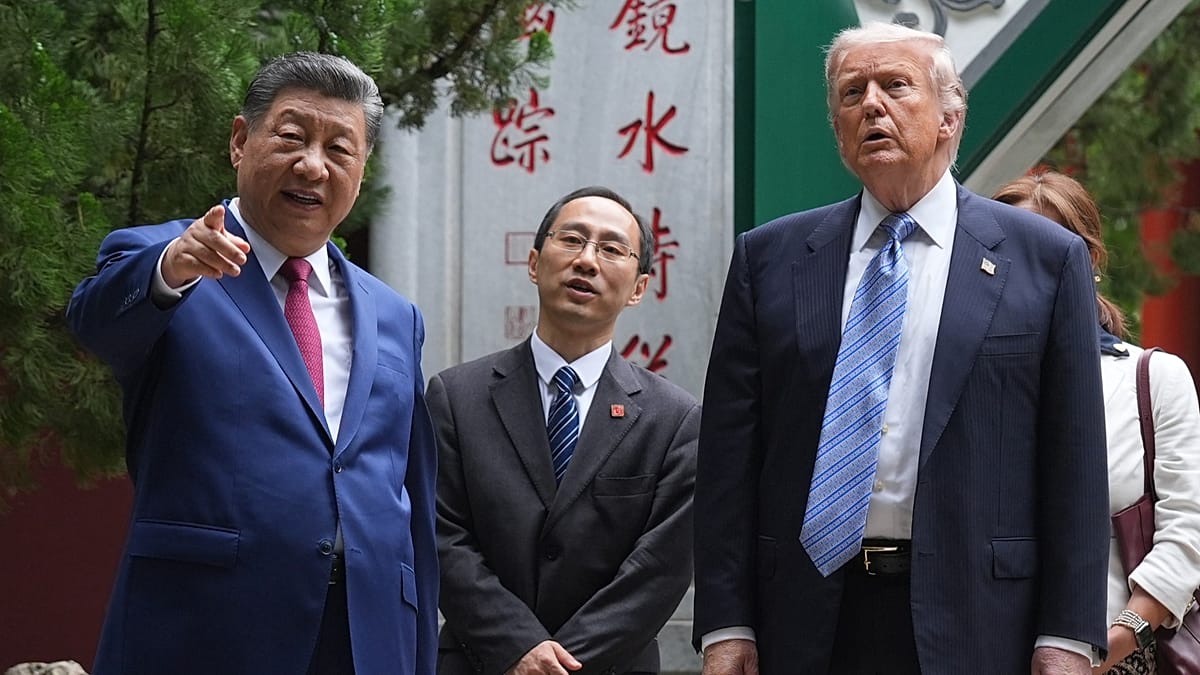
US President Donald Trump concluded his two-day state visit to Beijing on Friday with a final meeting with Chinese leader Xi Jinping at the Zhongnanhai leadership compound, adjacent to the Forbidden City. The talks yielded a Chinese offer to mediate the reopening of the Strait of Hormuz, but also a stark warning from Beijing that disagreements over Taiwan could escalate into open conflict.
Trump, who had lunch and tea with Xi before departing for Washington, wrote on Truth Social that he hoped the US-China relationship would become "stronger and better than ever before," adding that Xi had congratulated him on "so many tremendous successes in such a short period of time."
The summit, however, failed to produce major economic breakthroughs. Trump focused on securing deals in agriculture, aviation, and artificial intelligence, but the talks were primarily aimed at stabilising the bilateral relationship and maintaining a fragile truce reached at the end of last year. In October, Washington agreed to lower tariffs on all Chinese goods, while Beijing paused its restrictions on rare earth exports.
Strait of Hormuz: A Chinese Mediation Offer
On the Iran war, Xi told Trump that Beijing wants to help negotiate an end to the conflict and reopen the Strait of Hormuz, a critical chokepoint for global energy supplies. China's heavy reliance on Iranian oil gives it leverage to influence Tehran, according to analysts. The White House stated that "the two sides agreed that the Strait of Hormuz must remain open to support the free flow of energy." Trump added that China reassured it would not provide Iran with military equipment.
The offer comes amid heightened tensions in the strait. On Thursday, a ship anchored off the United Arab Emirates was seized and taken toward Iranian waters, while an Indian-flagged cargo ship sank near the coast of Oman after an attack. Iranian state media reported that Chinese vessels had begun passing through the strait following an understanding over Iranian management protocols. Iran has largely blocked shipping through the waterway, which normally carries about a fifth of the world's oil and LNG, since the outbreak of war with the United States and Israel on 28 February.
Global markets reacted positively to the prospect of a diplomatic breakthrough, with indices rallying on hopes that the Strait of Hormuz could be reopened. For Europe, which relies heavily on energy imports from the region, any resolution would have significant implications for energy security and prices. The rally in global markets underscores the stakes for European economies.
Taiwan: A Red Line for Beijing
Taiwan emerged as one of the most divisive topics on the agenda. Xi warned Trump that disagreements over the self-governed island—which China claims as its own—could lead to clashes or conflict. In December, Washington approved an $11 billion arms package to Taiwan, which it has not yet delivered. On Thursday, US Secretary of State Marco Rubio warned that it would be a "terrible mistake" for China to take Taiwan by force.
The warning from Beijing is a reminder of the delicate balance the US must maintain between supporting Taiwan and avoiding a direct confrontation with China. For European capitals, the Taiwan issue is a potential flashpoint that could disrupt global trade and security, particularly given the island's central role in semiconductor supply chains. The EU must unite or face irrelevance, as one Greens MEP warned after the talks.
While Trump's visit was largely symbolic, the outcomes—or lack thereof—will be closely watched in Brussels and other European capitals. The summit's focus on stabilising US-China ties, rather than achieving concrete trade deals, suggests that the relationship remains fraught. For Europe, the key question is whether the US and China can manage their differences without dragging the continent into a broader conflict.