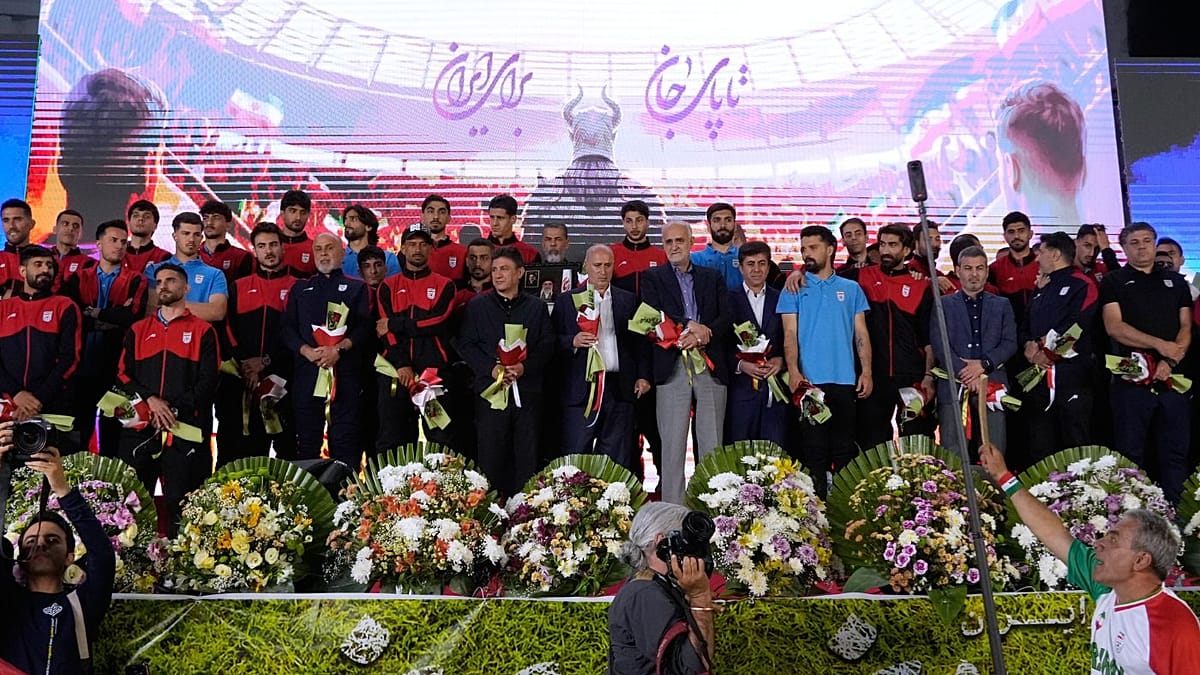
Iran's national football team was given a state-organized send-off in Tehran this week, a ceremony marked by chants of "Death to America" and the presence of Hezbollah flags. The event, held at Islamic Revolution Square, drew large crowds that initially prevented players from leaving their team buses. It also served as the unveiling of Iran's official kit for the 2026 World Cup.
Mehdi Taj, head of the Iranian Football Federation, told state-run television IRIB: "This is the best farewell ceremony in the last four World Cups. The players stand alongside the people, and the people stand alongside the country's dignity, honour and power." He added, "Whatever the result, we hope Iran’s flag will be raised there and defended."
The ceremony underscored the regime's effort to project unity, but it also highlighted the deep political tensions surrounding Iran's participation. The Mehr News Agency, affiliated with the Islamic Development Organisation, censored footage showing Hezbollah flags in its coverage.
Visa Hurdles and Political Complications
All three of Iran's group-stage matches are scheduled to be played in the United States, and no visas have yet been issued for players or coaching staff. The Revolutionary Guards (IRGC) are designated a terrorist organisation in both Canada and the US, and US Secretary of State Marco Rubio has stated that individuals linked to the IRGC would not be permitted entry. Taj himself was denied entry to Canada two weeks ago when he attempted to attend the FIFA Congress in Vancouver.
"We have not yet received anything regarding the visas. We hope the issue will definitely be resolved within this timeframe," said Heydat Mombini, the federation's secretary-general, on the sidelines of the ceremony. "FIFA has given assurances and we hope it will follow through and the players will receive their visas on time."
Reports that the US had rejected visa applications for players in Iraq's national team — later denied by the White House and the Iraqi Football Association — have added to concerns in Tehran. Mombini stressed, "I have heard the same news. I hope FIFA steps in. We have always believed that sport should be separate from politics. FIFA has a duty to intervene and ensure that the entry of all members of teams taking part in the World Cup is facilitated."
The situation echoes broader debates about the intersection of sport and politics, a theme that has also surfaced in European football, as seen in Lamine Yamal's Palestine flag gesture.
Disrupted Preparations and On-Field Struggles
The war with the United States and Israel, which began in late February, has severely disrupted Iran's World Cup preparations. Fixtures and training plans have been cancelled, the national coach's Italian assistant terminated his contract unilaterally, and the team has been reduced to internal practice matches. The national team was already struggling before the conflict, having lost to both Uzbekistan and Russia, with calls from sports media — including outlets close to the Revolutionary Guards — for coach Amir Ghalenoei to be replaced by a foreign manager.
The team will travel to Turkey next week for a training camp and is scheduled to play a warm-up match against Gambia in Antalya on 29 May. The federation is also working to arrange a second friendly during the camp.
Meanwhile, the broader geopolitical context remains tense. The US and Iran are locked in a fragile ceasefire, with Trump rejecting Tehran's counteroffer, and regional dynamics are further complicated by Qatar's warnings to Iran over the Strait of Hormuz.
The relationship between the national team and Iranians both at home and abroad remains complicated. The state-organized farewell, while drawing large crowds, also highlighted the regime's attempt to harness sporting success for political legitimacy — a strategy that has often backfired in the past.