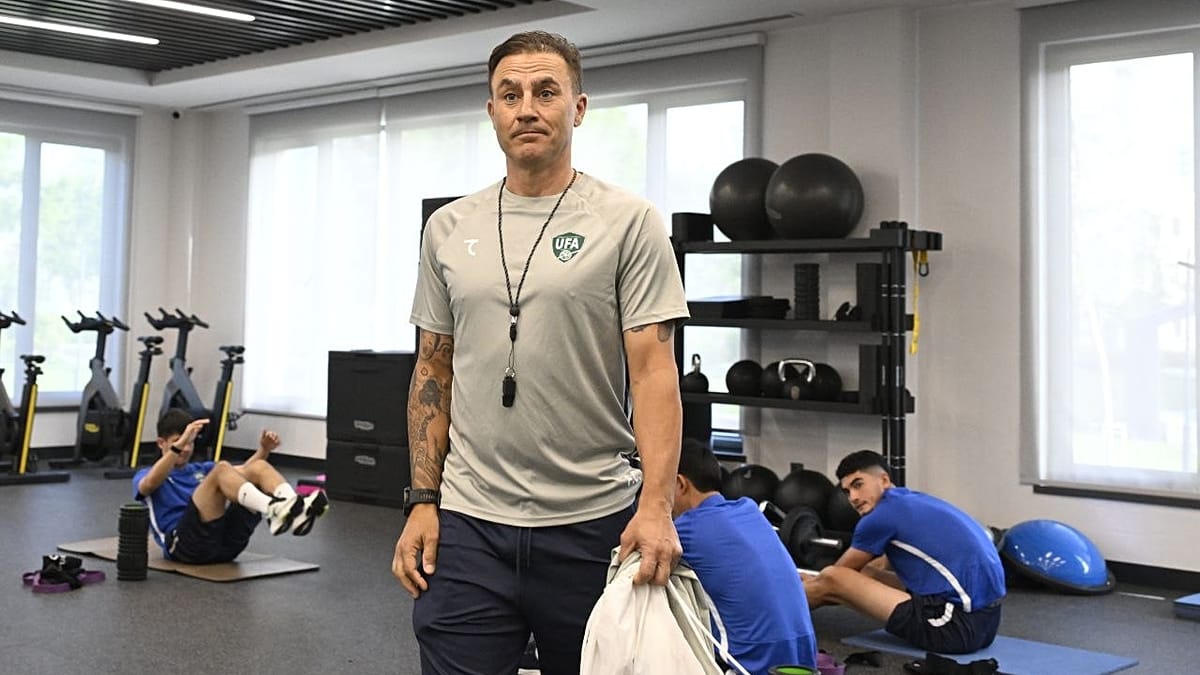
Twenty years after captaining Italy to World Cup glory, Fabio Cannavaro is back on football's biggest stage—this time as head coach of Uzbekistan, a Central Asian nation making its historic debut at the tournament. In an exclusive interview, the former Ballon d'Or winner told European Pulse that his squad approaches the challenge with ambition rather than fear.
“It's the first time we are going to the World Cup, it's the first time I am coaching in this kind of tournament,” Cannavaro said. “I saw many players with great ambition. They want to learn, improve, work hard and of course we have nothing to lose.”
Uzbekistan, a country of roughly 36 million, qualified for the 2026 FIFA World Cup after decades of near misses. The team now faces a daunting group stage: Portugal, led by Cristiano Ronaldo; Colombia, featuring James Rodríguez and Luis Díaz; and DR Congo, whose players ply their trade in Ligue 1 and the Premier League. Cannavaro, however, sees opportunity in unpredictability.
“I think it's a very tough stage, because Colombia and Portugal are among the top 20 teams in the world,” he explained. “Congo, many players play in Liga 1, in Premier League, so it will be tough. During the World Cup, you cannot say one is stronger than another because it's the World Cup.”
From Berlin Wall to Tashkent Dugout
Cannavaro, a native of Naples, earned the nickname “Il Muro di Berlino” (The Berlin Wall) for his imperious defending during Italy's 2006 campaign, when the Azzurri kept five clean sheets and conceded just two goals. He is one of only three defenders—alongside Franz Beckenbauer and Matthias Sammer—to have won the Ballon d'Or. After a storied playing career with Juventus and Real Madrid, he transitioned into coaching, managing clubs in China, Saudi Arabia, and Europe before taking the Uzbekistan job.
Now, instead of marshalling troops on the pitch, Cannavaro guides a new generation from the dugout. “World Cup is something that, as a football player, is a dream,” he said. “As a footballer, it's the most important tournament, and to participate there is a privilege. In the meantime, you need to understand that there will be a very nice atmosphere around. You need to be enjoying, you have to be happy to participate in this tournament.”
Giant-Slayer Mentality
Inside the squad, competition for places has intensified. Midfielder Otabek Shukurov, who plays for Baniyas in the UAE Pro League, told European Pulse that the team is focused on enjoying the moment. “This is our first time participating in the World Cup,” Shukurov said. “We need to put all the pressure aside, go out there, enjoy the game, and show that Uzbekistan is a country with strong football.”
Young midfielder Umarali Rahmonaliyev, who plays in Azerbaijan, noted that internal rivalry has sharpened. “Competition has always existed, but ahead of the World Cup it has become even more intense,” he said.
Uzbekistan's rise on the global stage mirrors broader shifts in the country's international engagement. The nation has recently made strides in economic diversification, as highlighted by its export shift from raw materials to finished goods, and in cultural preservation, such as the digitization of rare folk instruments. Even in football, the team's debut reflects a growing confidence that extends beyond sport.
Cannavaro's own journey—from World Cup winner to coach of a debutant nation—underscores the tournament's power to unite diverse stories. For Uzbekistan, the goal is clear: compete without fear, and let the world see what the team can do.