Uzbekistan is undergoing a structural transformation in its trade model, moving decisively from raw material exports to finished and value-added goods. This shift, driven by industrial diversification and market reforms, is reshaping the Central Asian nation's economic profile and deepening its ties with Europe.
Total exports reached €28.37 billion last year, with shipments to Europe rising 23% to €1.93 billion, according to the Central Bank of Uzbekistan. The country now exports over 4,300 product categories, nearly double the 2,245 in 2017, reflecting a broad industrial upgrade.
Value-Added Goods Take Center Stage
Finished and semi-finished goods now account for €11.28 billion, or 52% of total exports, while raw materials have shrunk to just €1.62 billion, or 7%, according to the Ministry of Investment, Industry and Trade. The country produces nearly 300 finished textile items, processes all domestically grown cotton, and manufactures over 780 types of machinery and equipment, including household appliances. It also produces more than 300 food products, around 400 chemical products, and over 180 metal products.
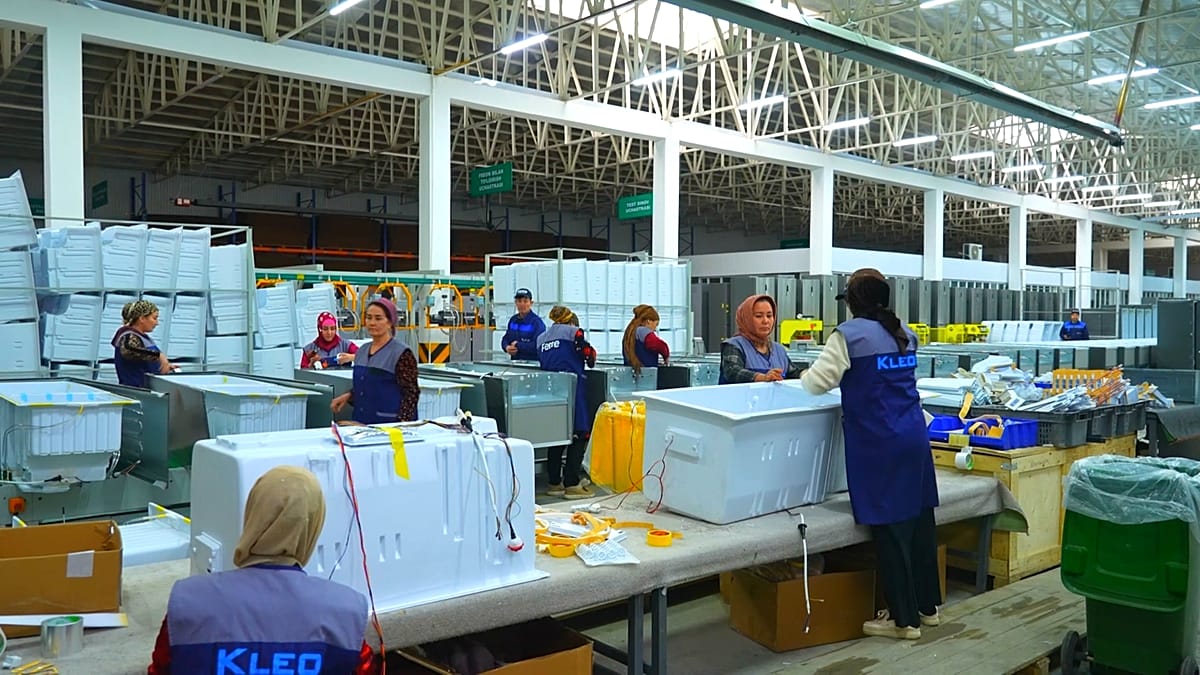
Sam-Ferre, a major home appliance manufacturer, illustrates this trend. “We export to seven neighboring countries, including Kazakhstan, Turkmenistan, Tajikistan, Azerbaijan, Kyrgyzstan, Georgia, and Afghanistan,” explained production director Atajan Nazhmetdinov. In 2025, Sam-Ferre shipped 42,000 units abroad, valued at €6.98 million, with a target of 60,000 units in 2026 projected to generate €11.16 million. “A localisation rate of 60–80% creates jobs, strengthens supply chains, and promotes sustainability through energy-efficient production,” he added.
Expanding Global Reach
Currency liberalisation and government support—including trade fair funding, export subsidies, and overseas promotion—have increased registered exporters to over 9,000. Uzbek companies now trade regularly with 165 countries, reaching a total of 190 markets. Exports to Afghanistan rose from €920 million in 2024 to €1.66 billion in 2025, supported by trade exhibitions and B2B initiatives.
“These measures have allowed companies to enter new markets such as Iraq, Syria, and other developing regions, diversifying revenue streams and increasing export resilience,” explained Yorkin Malikov, Chairman of the Uzbekistan Exporters Association. At the beginning of the year, 200 entrepreneurs participated in a six-day exhibition in Iraq, occupying more than 1,000 square metres of exhibition space. “A charter flight was organized for these entrepreneurs, and attendance was completely free of charge,” Malikov noted. He also highlighted the Uzbekistan Trade House in New York, which markets Uzbek handicrafts—including trays, teapots, traditional floor mats, and cradles—to international buyers.
This diversification is particularly relevant as Europe navigates its own trade challenges, such as the MEP Warns of 'Perfect Storm' for EU Jobs If US Trade Deal Fails and the EU Prepares Defensive Measures as Trade War with China Escalates. Uzbekistan's growing industrial base offers European firms new sourcing opportunities beyond traditional suppliers.
From Raw Materials to Services
The export structure increasingly reflects higher value-added production. “Textiles now include ready-made garments instead of raw cotton, and electronics exports cover cables and transformers rather than just copper. Services such as tourism, IT, and transport accounted for over 41% of total exports in 2025,” said Yunusbek Yusupov, Head of Division at the Ministry of Investment, Industry and Trade.
The IT sector has emerged as a significant driver. By the third quarter of 2024, 936 IT companies were delivering services abroad, a 170% increase year-on-year. “Companies are increasingly adopting AI, digital marketing, and innovation strategies to expand their presence in Europe, the Americas, and Asia,” Yusupov added. The industrial shift is also evident in metals and textiles. “In the past, Uzbekistan exported raw copper. Today, we export finished cables, wiring components, transformers, and other electrical products,” he explained. The textile sector now processes 100% of domestic cotton, supplemented by imports from Kazakhstan, Tajikistan, and the U.S. under the “Made with U.S. Cotton” programme. “This allows Uzbek manufacturers to export finished garments to the U.S. market and work directly with international buyers,” he noted.
Economic Impact and Policy Support
Export expansion is boosting GDP growth, creating jobs, and driving industrial diversification. “By opening new markets, attracting investment, and supporting SMEs, Uzbekistan strengthens its industrial base, reduces production costs, and enhances competitiveness globally,” said economist Bejan Jamolov. “Uzbekistan is improving small and medium enterprises, circulating money within them because every SME needs access to finance,” he added.
Government policies continue to underpin this growth. “We have lower taxation, and small businesses can attract investments with reduced tax burdens, so that after costs decrease, the products remain competitive,” Jamolov explained. Structural reforms and international partnerships have enabled Uzbekistan to shift from raw material dependency to higher-value manufacturing and services, reinforcing its global trade competitiveness and positioning the country as a rising industrial hub. This transformation also aligns with broader European interests, as seen in the Uzbekistan's UzNIF Debuts on London Stock Exchange in Historic Dual Listing, which signals growing financial integration with European markets.