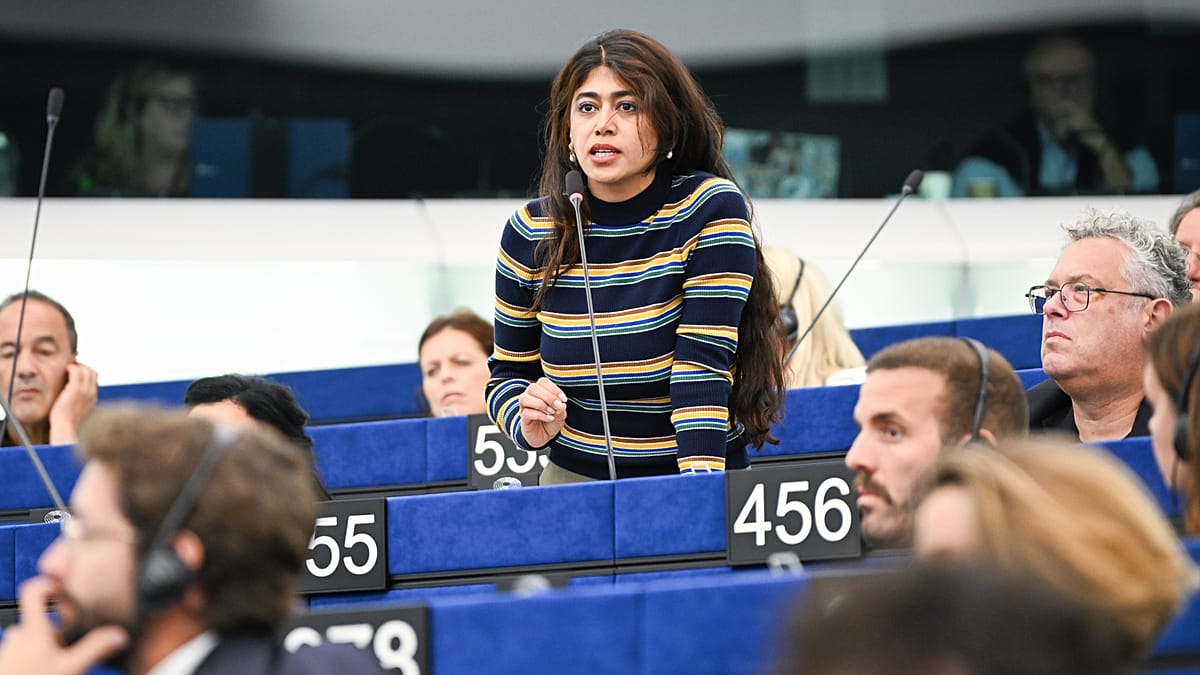
Three years after Hamas's assault on Israel, the European Parliament has become the stage for a bitter political confrontation. On Monday evening, Rima Hassan, a French MEP from the far-left La France Insoumise (France Unbowed), reportedly toppled an Israeli flag displayed at an exhibition commemorating the victims of the October 7 attacks. Photographs circulating on social media show both the Israeli and European Union flags lying on the floor of the parliament's premises in Strasbourg.
The incident has drawn swift condemnation from across the political spectrum. Roberta Metsola, the Parliament's president, told the chamber on Tuesday that she took the matter "extremely seriously" and that "all appropriate measures" were being taken against Hassan, though she did not name her directly. "We cannot have actions that could make people fearful of speaking. We cannot have damage to property. And we cannot have attempts to intimidate rather than to debate," Metsola said.
Hassan has acknowledged removing the Israeli flag but denied intentionally knocking over the EU flag. Her office issued a statement asserting that neither flag was "stepped on or damaged." She framed her actions as a protest against the Israeli state's support for the exhibition, claiming that speeches delivered during the event denied the existence of Palestine.
Outrage and accusations
The episode has provoked widespread indignation, particularly among centre-right and pro-Israeli figures. François-Xavier Bellamy, a French MEP from the centre-right Les Républicains, described the act as "a form of complicity with those who want to reintroduce antisemitic hatred" in Europe. Israeli Foreign Minister Gideon Sa'ar called the scenes "shameful, outrageous, but sadly not surprising."
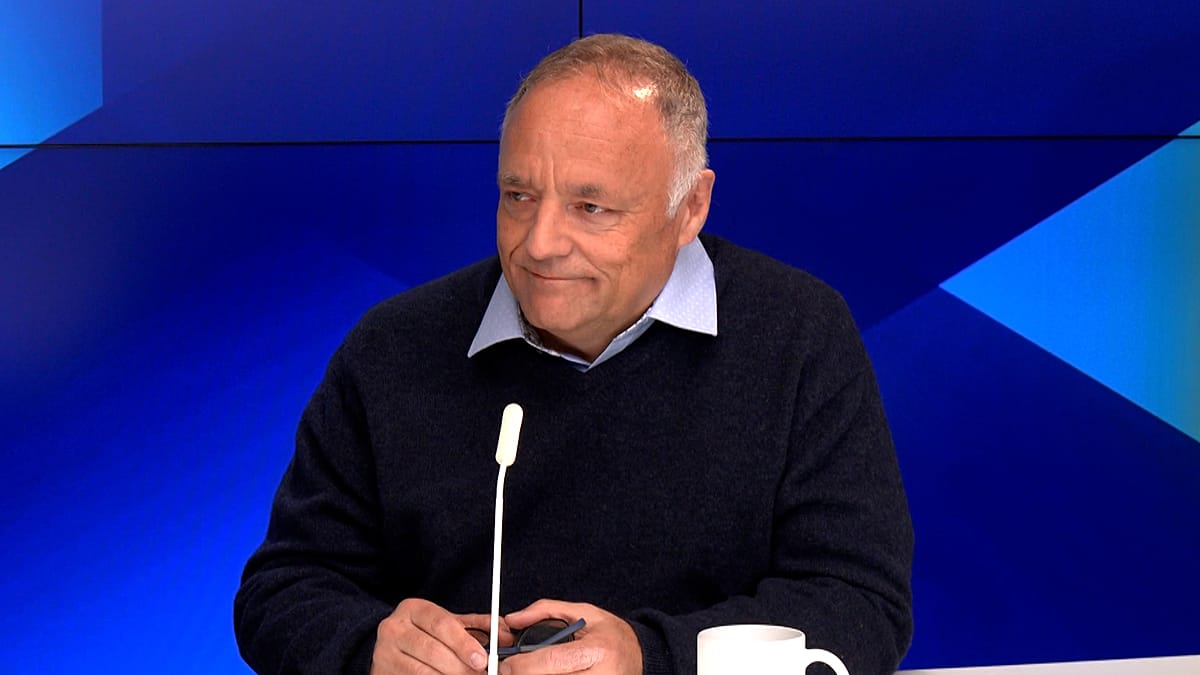
In an interview with our chief editor Maria Tadeo, Israel's ambassador to France, Joshua Zarka, expressed disbelief at Hassan's conduct. "I cannot understand how a person that aims to be a politician, that aims to represent the public, can be so violent and disrespectful of the death of thousands of people that has been caused by the same cause that she's trying to help," he said. Zarka also claimed that the French public was "tired of her behaviour, of what she represents, of her attempt to import the Israeli conflict into France."
Hassan is currently awaiting trial over allegations that she promoted terrorism in a social media post referring to a Japanese man responsible for a 1970s terror attack in Israel. Her legal troubles add another layer to an already fraught political climate in France, where antisemitism has become a central issue ahead of next year's presidential election.
The controversy has also reignited scrutiny of the far-right Rassemblement National (National Rally). French investigative outlet Mediapart recently published antisemitic messages allegedly attributed to the party's leader, Jordan Bardella, who denies the claims. Ambassador Zarka told Maria that Israel is monitoring the allegations closely and "will react once it is clear that these allegations are true." However, he added that there is "one party that is openly antisemitic in France, and that's LFI (France Unbowed)."
The European Parliament's response to Hassan's actions is being closely watched. Metsola's pledge to take measures signals a broader effort to maintain decorum and ensure that the institution remains a space for debate rather than confrontation. Yet the incident underscores the deep divisions that the Israeli-Palestinian conflict continues to provoke within European politics.
Meanwhile, Europe's eastern flank faces its own security challenges. A fatal drone strike off Romania's coast on Monday killed two people and injured dozens more, raising questions about whether such incidents should still be classified as "hybrid warfare." A second incident on Tuesday, 130 kilometres off Bulgaria's coast, saw drones sink one commercial ship and set another on fire, with crews evacuated. Bulgarian Prime Minister Rumen Radev condemned the attack as "absolutely unacceptable" and a "flagrant violation of international law and maritime norms," though he stopped short of assigning blame. Ukrainian President Volodymyr Zelenskyy attributed Monday's strike to Russian forces, calling it a "horrific strike" on a civilian vessel in neutral waters.
These incidents have affected vessels linked to NATO member states, including Turkey, Romania, and Bulgaria, prompting the alliance to refer questions to national authorities. The situation remains tense, with no clear attribution and growing concern about the safety of commercial shipping in the Black Sea.
On the health front, European Commission officials and member state representatives are meeting today to discuss a suspected outbreak of pneumonic plague in Siberia, Russia. The Health Security Committee, which evaluates serious cross-border health threats, had already scheduled a meeting for this morning, but the latest developments have added a new item to the agenda. Russia has denied that a lab worker who died in Siberia succumbed to the plague, but details remain murky. The European Centre for Disease Prevention and Control (ECDC) said the suspicion of an outbreak was "not yet confirmed," noting that there is little travel between Irkutsk and the EU, particularly due to Russia's war against Ukraine. The agency added that there are no reports of secondary cases or sustained human-to-human transmission.
As EU ambassadors work to finalise a list of over 1,600 individuals and companies accused of supporting Russia's invasion of Ukraine, the bloc continues to grapple with a range of pressing issues, from security threats to public health concerns. The flag incident in Strasbourg, however, serves as a stark reminder of the emotional and political weight that the October 7 anniversary carries across Europe.