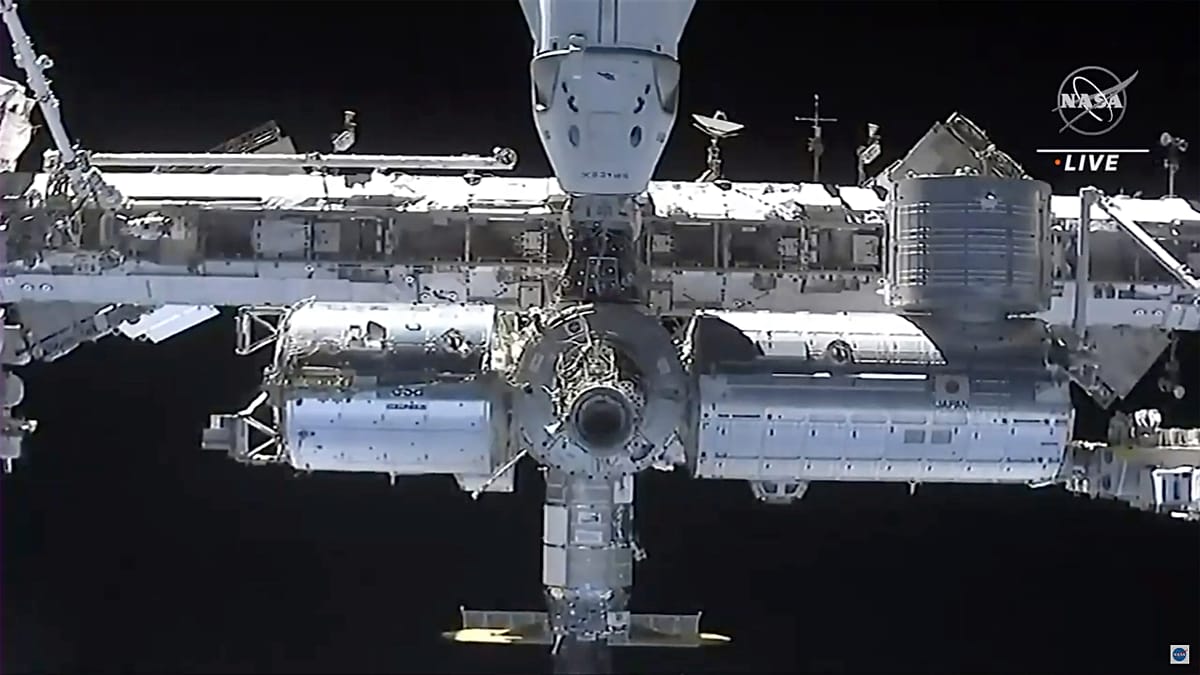
Astronauts aboard the International Space Station (ISS) were placed on evacuation alert this week after a persistent air leak in a Russian module worsened, prompting NASA to order the crew to take shelter in a SpaceX Crew Dragon capsule. The incident, which occurred on Monday, underscores the ongoing technical challenges facing the aging orbital laboratory, a joint venture involving NASA, Roscosmos, and other international partners, including the European Space Agency (ESA).
Leak Intensifies in Zvezda Module
The leak originates from the PrK transfer tunnel of the Zvezda service module, a Russian-built section of the ISS that has been experiencing cracks and minor leaks since 2019. According to Bethany Stevens, a NASA press officer, Roscosmos had previously managed to contain the issue, but a recent increase in the leak rate prompted more urgent action. On Monday, the leak rate doubled from approximately half a kilogram of air per day to one kilogram, a significant escalation for a sealed environment where every molecule of atmosphere is precious.
In response, Roscosmos initiated extensive repair work on Friday, June 5. As a precaution, NASA instructed the four members of the SpaceX Crew-12 mission—two Americans, one French national, and one Russian—along with American astronaut Chris Williams, to board the Crew Dragon spacecraft docked to the station. The order came at 9:04 a.m. US East Coast time, and the crew were asked to don their spacesuits for a potential emergency evacuation.
“The transfer tunnel of the Zvezda service module, known as the PrK, has long had cracks and leaks, which Roscosmos has contained as far as possible up to now,” Stevens said in a statement posted on X. “Following new leaks, Roscosmos decided to carry out more extensive repair work. As a precautionary measure, NASA ordered the four members of the SpaceX Crew-12 mission and American astronaut Chris Williams to adopt maximum safety procedures inside the Dragon spacecraft for the entire duration of the operations.”
Cooperation Amid Geopolitical Tensions
The incident highlights the delicate balance of international cooperation on the ISS, which has continued despite heightened geopolitical tensions between Russia and Western nations, particularly over the war in Ukraine. NASA and Roscosmos have been in discussions for months about the cause and potential solutions to the leaks, which are concentrated in the Zvezda module, a critical structure of the station that is roughly the size of a football pitch.
While the leak rate remains modest—an average adult inhales and exhales between 10 and 15 kilograms of air per day—any loss of atmosphere in space requires immediate attention. The crew’s temporary relocation to the Crew Dragon capsule, which serves as a lifeboat in emergencies, allowed Roscosmos to proceed with repairs without risking the astronauts’ safety. After checks were completed and the repair work progressed, the situation was deemed under control, and the crew returned to their normal activities.
This is not the first time the ISS has faced such challenges. The station, which has been continuously inhabited since 2000, has experienced various technical issues over the years, from cooling system failures to minor leaks. However, the current leak in the Zvezda module has been a persistent concern, and its recent worsening raises questions about the long-term viability of the Russian segment.
The European angle is clear: the ISS is a symbol of international collaboration, with ESA contributing significant resources and astronauts. French astronaut Thomas Pesquet, a veteran of two ISS missions, has previously spoken about the importance of such cooperation. The incident also comes as Europe continues to develop its own space capabilities, including the Cercle Festival 2026, which blends electronic music with space exploration themes.
Meanwhile, the broader context of Russian-European relations remains fraught. Recent events, such as the interception of 11 Russian aircraft by French Rafale jets over the Baltic, underscore the tensions that coexist with space cooperation. The ISS partnership, however, has largely remained insulated from these conflicts, a testament to the shared interest in maintaining the station’s operations.
For now, the crew is safe, and the station continues to function normally. But the incident serves as a reminder that even the most advanced human outpost in space is not immune to the wear and tear of time. As NASA and Roscosmos work toward a permanent solution, the eyes of the global space community remain fixed on the Zvezda module and the cracks that threaten its integrity.