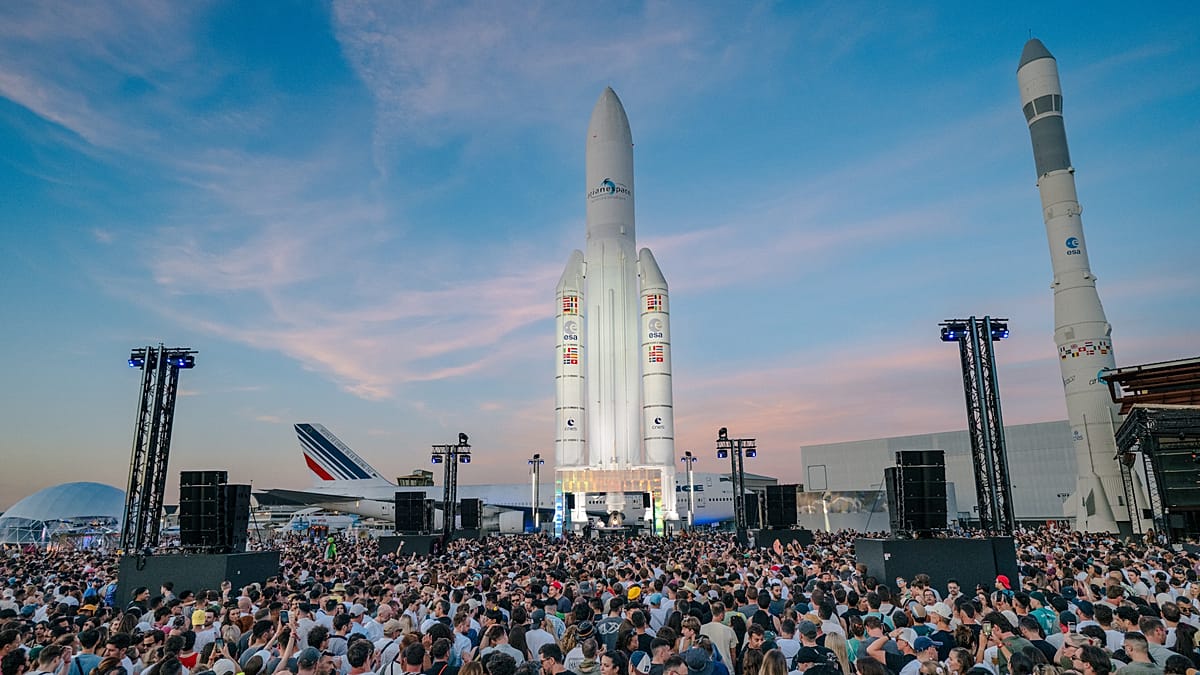
For three days in late May, the grounds of the Musée de l’Air et de l’Espace at Paris-Le Bourget airport became a meeting point for electronic music fans, astronauts, and space scientists. The 2026 edition of the Cercle Festival, marking the collective’s tenth anniversary, drew around 20,000 visitors each day and featured a collaboration with the European Space Agency (ESA) and the French space agency CNES.
This was not merely a music festival with a space-themed backdrop. The organisers emphasised that ESA and CNES were genuine co-creators of the programme, not just sponsors. A dedicated zone called CUPOLA — an immersive dome — hosted lectures by astronauts, hands-on experiments, and discussions on the intersection of art and space exploration.
From YouTube to a Global Phenomenon
Cercle began a decade ago when founder Derek Barbolla decided to film DJ sets in striking locations rather than clubs. The concept quickly grew into an online sensation, with cinematic YouTube performances viewed by millions. Over the years, the collective expanded into a label, immersive Cercle Odyssey concerts, and a biennial festival at the Paris air and space museum.
This year’s lineup included Eric Prydz, Röyksopp, ARTBAT, Ben Böhmer, Monolink, Michael Bibi, and Adriatique, spread across three stages. The museum’s collection — Ariane rockets, a Concorde, and the giant A380 — provided an awe-inspiring setting.
Space and Sound: A New Festival Format
Inside CUPOLA, visitors learned about the physics of sound on Mars, where bass and treble frequencies travel at different speeds, creating a delayed auditory experience unlike anything on Earth. “We still don’t know how the brain would cope with that,” an ESA scientist explained.
The festival’s opening was a first: French ESA astronaut Sophie Adenot sent a recorded message from the International Space Station, marking the first time a space mission has directly addressed an electronic music audience on such a scale.
ESA’s involvement reflects a broader strategy to engage younger audiences through culture rather than traditional press conferences. The agency sees festivals like Cercle as a way to make space science emotionally resonant and accessible.
For comparison, other European cultural events are also drawing large crowds: the Copenhagen Light Festival recently attracted hundreds to a night run through illuminated art, while Vilnius hosted a three-day pink soup festival expecting over 100,000 visitors. Meanwhile, the EU’s push for electrification underscores the continent’s high-stakes bet on a cleaner, competitive future.
Cercle Festival 2026 demonstrated that the future of entertainment can be both immersive and educational. By weaving together music, audiovisual art, and space science, it offered a glimpse of how culture and technology might continue to inspire each other.