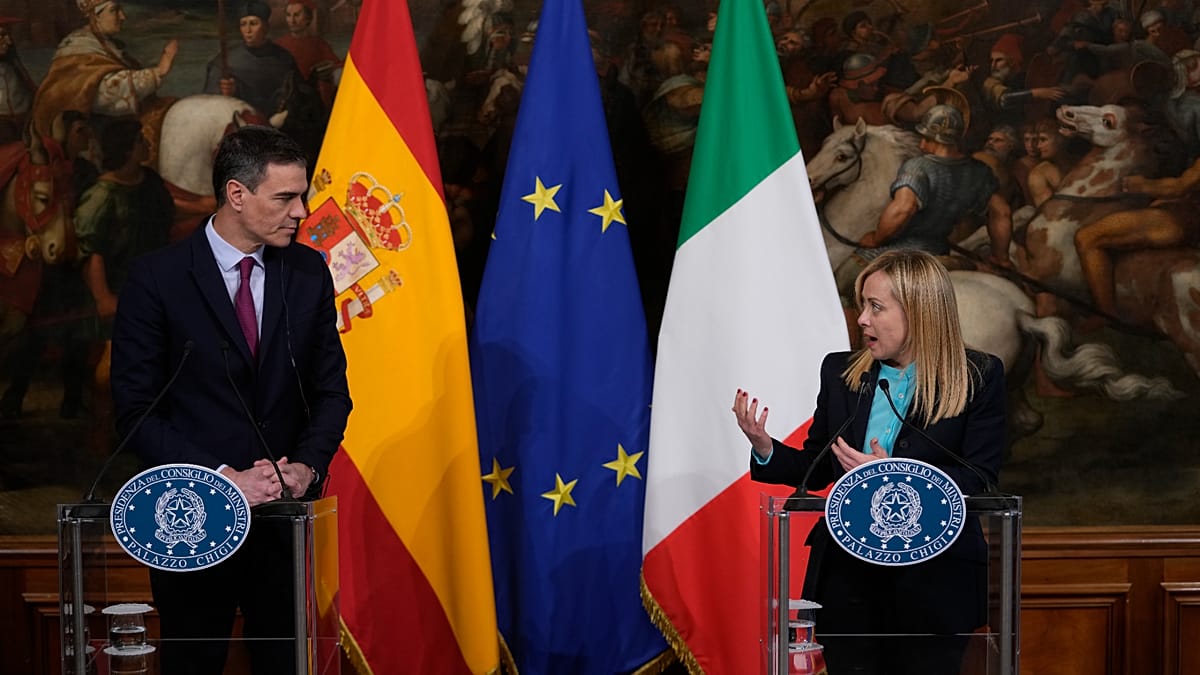
The relationship between Rome and Madrid has soured dramatically in recent weeks, as a dispute over migration has escalated into one of the most serious diplomatic confrontations between the two southern European nations in years. What began with Italy reintroducing border controls on travellers arriving from Spain, following a mass influx of migrants into the Spanish enclave of Ceuta, has now become a tit-for-tat standoff.
Spain has responded by imposing its own checks on arrivals from Italy, while Madrid has demanded that Rome lift its restrictions. The immediate trigger was the migration crisis in Ceuta, but the dispute exposes a deeper political divide between two countries that, on paper, should be natural allies.
Natural allies, divergent paths
“It shouldn't be possible for two natural allies and friends like Spain and Italy not to take full advantage of their joint potential,” Spanish Prime Minister Pedro Sánchez said during a visit to Rome in 2020. Geography and economic interest are the main structural forces drawing Rome and Madrid together. Both are among the EU's most important Mediterranean countries, major frontline states for migration from North Africa, with strong economic and political interests in the southern neighbourhood. Both have long argued that the Mediterranean should occupy a more prominent place in EU policy.
Those interests were reflected in the EU's 2025 Pact for the Mediterranean, which placed stability, economic development, security and migration management in the region among the bloc's strategic priorities. The two countries also share considerable common ground on the EU budget, pushing together for an expansive settlement with significant resources allocated to regional funding and agricultural subsidies. Rome and Madrid were also the two main beneficiaries of NextGenerationEU, the post-pandemic stimulus fund, and both back a gradual repayment schedule and an expansion of the joint borrowing mechanism to finance future investment.
On many European files, then, they remain partners. But migration has increasingly become a dividing line between the two major EU countries, crystallising what some experts consider competing approaches to Africa policy. “Ceuta's fabricated crisis exposed once again how Europe's migration obsession is one of its strongest vulnerabilities: its neighbours can exploit it for political pressure, its far right for political gains,” Claudio Francavilla, an associate director at the NGO Human Rights Watch, told Euronews. “Orderly, safe, rights-respecting migration policies remain a mirage, as do European unity and solidarity on the matter,” he said.
The migration fault line
Ironically, Rome and Madrid start from a similar diagnosis: migration across the Mediterranean is not a problem frontline countries can solve alone, and the EU has a shared responsibility to develop a common framework to manage it. But the approaches, driven by significant political distance, could hardly be more different. Giorgia Meloni's right-wing government has made deterrence, returns, external partnerships and tougher controls central to its migration policy. Rome has been particularly keen on exporting its model of return hubs in third countries — which it is trialling in Albania — to the EU level, and the approach has now been written into a controversial migration law.
Pedro Sánchez's centre-left government has pursued a more mixed approach, combining cooperation with countries such as Morocco with legal migration initiatives and the regularisation of undocumented migrants already in Spain. That approach has come under fire from other EU countries and right-wing figures across Europe since the Ceuta crisis, when tens of thousands of people entered the Spanish enclave from Morocco, and Madrid's regularisation policy was slammed as a “pull factor.” Sánchez, together with French President Emmanuel Macron, has by contrast been sharply critical of return hubs, arguing they waste resources and undermine Europe's reputation in third countries.
The dispute exposes a broader political shift. Migration policy was once framed largely as a confrontation between frontline countries and the rest of the EU. With Ceuta, the divisions now run between the frontline countries themselves. In other words, the two countries that have spent years demanding Europe share the burden of migration are now fighting over what that sharing actually means, with their positions hardened by domestic political pressures.
Domestic politics
Politically, Rome and Madrid could hardly be more distant: Sánchez leads one of the few centre-left governments left in Europe, while Giorgia Meloni is approaching the end of her first term at the head of a far-right coalition. The diplomatic crisis is unfolding as both countries head toward elections next year. In Spain, the centre-right opposition Partido Popular leads national polling, while the hard-right Vox has consolidated its position as the country's third political force. The Ceuta crisis has allowed Sánchez's opponents to portray his migration policy as too permissive, while the government has sought to show that Spain can manage its external borders without adopting the model favoured by Europe's harder right.
Meloni remains Italy's dominant figure on the right, but her government now faces competition from further right still. MEP Roberto Vannacci (Italy/ESN), who left Matteo Salvini's League earlier this year, has launched his own political movement, National Future. With Rome in the process of reforming its electoral law, Vannacci poses a real threat: he could erode support for the right-wing coalition, potentially leaving no clear winner at the next election and producing a hung parliament. “Meloni is not suspending Schengen because of Sánchez, but because of Vannacci, her new far-right rival,” MEP Sandro Gozi (France/Renew) wrote in a Facebook post, calling the introduction of border controls a move aimed at domestic audiences.
The standoff has also reignited broader questions about the future of the Schengen area. While border checks are permitted under EU rules in exceptional circumstances, their prolonged use by member states has become a contentious issue. The European Commission has urged both countries to resolve their differences, but so far neither side has shown willingness to back down. As the dispute continues, it underscores how migration remains one of the most divisive issues in the EU, capable of straining even the closest of alliances.