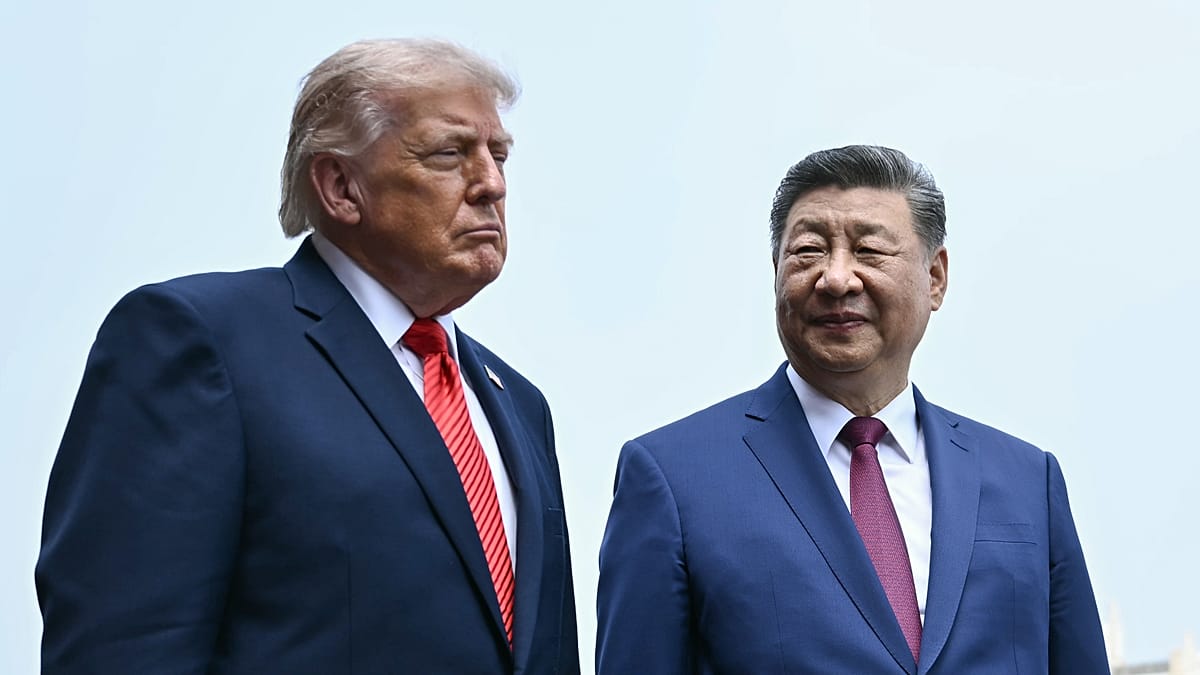
US President Donald Trump has signalled that he could hold a trilateral meeting with Russian President Vladimir Putin and Chinese President Xi Jinping on the sidelines of the Asia-Pacific Economic Cooperation (APEC) summit in Shenzhen, scheduled for November 18-19. Speaking to reporters on Sunday, Trump said: "Well, I'm going to be going to China, and one of the meetings I think will be with President Putin and President Xi, and that'll be interesting." He added that the talks would cover "a lot of things, including denuclearisation," and that the US is "trying to end the war in Iran."
If the meeting takes place, it would be a rare three-way summit among the leaders of the world's largest nuclear powers. The Kremlin confirmed on October 21 that preparations for such a meeting are "being prepared," following a report in the Wall Street Journal that Putin had pushed for the trilateral format to broker a peace deal in Ukraine that would be favourable to Moscow, which launched its full-scale invasion in 2022.
A diplomatic coup for Putin
Analysts are cautious about the prospects for substantive outcomes, given the divergent interests of the three leaders. "China wants the image but not the costs," said Sun Yun, director of the China program at the Stimson Center, noting that Beijing is keen to project itself as a global mediator but wary of taking on commitments.
For Putin, the meeting would be a significant diplomatic victory, breaking his international isolation and placing him on equal footing with the US and Chinese leaders. "Putin has the most to gain from a leaders' trilateral, and the Russians are clearly behind the push for a meeting, which would be a diplomatic coup," said Danny Russel, a former senior State Department official in the Obama administration. Russel also remarked that Trump, with his "crush on authoritarian strongmen," would relish the encounter, though he has reportedly been advised by his aides to avoid discussing Ukraine in detail.
Trump's willingness to meet Putin also signals a desire to end Russia's isolation, which has been a cornerstone of Western policy since the invasion. European capitals, particularly Berlin and Paris, will be watching closely. Any move to ease pressure on Moscow without concrete concessions on Ukraine could strain transatlantic relations, especially as the EU has been coordinating sanctions and military aid to Kyiv.
The meeting would also come amid a fragile trade truce between Washington and Beijing, which is set to expire in January. Trump is expected to travel to Shenzhen for his third meeting with Xi this year, with trade tensions and the Iran conflict likely to dominate the agenda.
However, some observers downplay the significance of the encounter. "The meeting may amount to no more than a photo opportunity that would allow Putin to be seen next to US and Chinese leaders," said Craig Singleton, senior director of the China program at the Foundation for Defence of Democracies. Such a visual would still be valuable for the Kremlin, projecting an image of normalcy and global relevance.
The trilateral format is unprecedented in recent history, and even if it occurs, the three leaders are unlikely to reach any binding agreements. Their interests are fundamentally at odds: Washington seeks to contain Iran's nuclear program and counter Chinese influence, Moscow wants to secure a favourable settlement in Ukraine and ease sanctions, and Beijing aims to stabilise its economy and project itself as a responsible global power.
For Europe, the implications are significant. Any US-Russia rapprochement could undermine the EU's unified stance on Ukraine, while a US-China deal on Iran might reshape the Middle East dynamics that European nations are deeply invested in. The EU has been a key player in the Iran nuclear deal (JCPOA) and has sought to preserve it, even as the US withdrew in 2018. A trilateral summit that sidelines European interests would be a worrying sign for Brussels.
As the summit approaches, European diplomats will be parsing every statement from Washington, Moscow, and Beijing. The meeting, if confirmed, would be a stark reminder that the continent's security architecture is increasingly shaped by great-power politics beyond its borders.