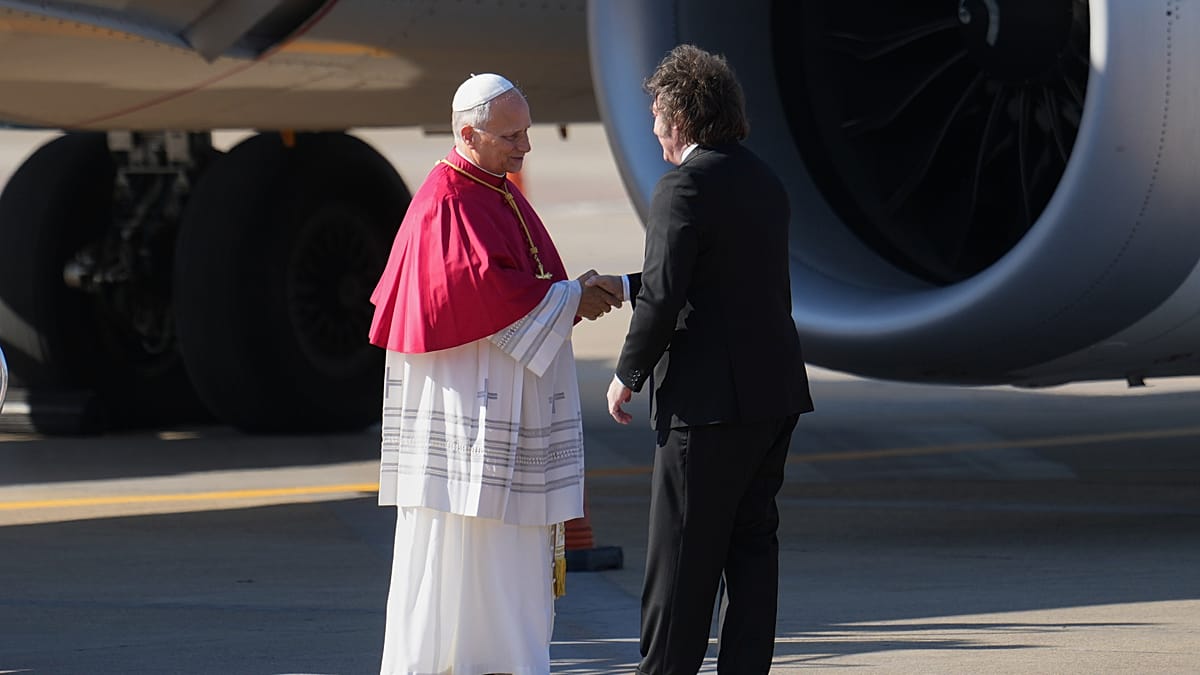
Pope Leo XIV arrived in Argentina on Sunday, 8 November, for a historic visit that marks the first papal trip to the country in nearly 40 years. The pontiff's plane landed at Buenos Aires' Ezeiza International Airport, where he was received by President Javier Milei, a leader known for his unorthodox style and often tense relations with the Vatican.
The Argentine capital pulled out all the stops for the occasion. The iconic Obelisco, a symbol of Buenos Aires, was illuminated in the colors of the Vatican, while crowds of faithful gathered along the route to catch a glimpse of the Pope. The visit is seen as a significant moment for a nation that has deep Catholic roots but has also seen a rise in secularism and political polarization in recent years.
Milei, who has previously clashed with the Church over social issues and economic policy, struck a conciliatory tone at the airport. In a brief statement, he called the visit "a blessing for all Argentines" and expressed hope that it would foster unity and dialogue. The two leaders are expected to hold private talks later in the week, with discussions likely to touch on poverty, social justice, and the country's ongoing economic challenges.
The visit comes as part of a broader South American tour that has already taken the Pope to Uruguay, where he began his journey with a focus on regional issues. In Montevideo, he paid tribute to women and issued a stark warning about femicides, a problem that plagues many Latin American countries. The Pope's itinerary in Argentina includes meetings with clergy, civil society groups, and indigenous communities, as well as a mass expected to draw hundreds of thousands of worshippers.
A delicate diplomatic balancing act
For Milei, the papal visit is a delicate diplomatic balancing act. The Argentine president has built his political brand on radical economic reforms and a confrontational style, often targeting the political establishment and the Church's social teachings. Yet, he has also sought to project an image of statesmanship on the international stage. The visit offers him a chance to showcase Argentina as a key player in regional and global affairs, even as he navigates domestic controversies.
Milei's recent frosty exchange with Spanish Prime Minister Pedro Sánchez at a Madrid summit highlighted his combative approach, but the Pope's presence may provide a softer backdrop. Analysts suggest that the meeting between Milei and the Pope could signal a thaw in relations, or at least a temporary truce, as both sides seek to emphasize common ground on issues like poverty and inequality.
The Pope's visit also carries symbolic weight for the wider region. Argentina is the birthplace of Pope Francis, the previous pontiff, and the first Latin American pope in history. Leo XIV, who is of Italian and Argentine descent, has often spoken of his affection for the country and its people. His trip is being watched closely across the continent, where the Catholic Church remains a powerful social and political force.
Security is tight, with thousands of police and military personnel deployed across Buenos Aires. The government has declared a public holiday on the day of the main mass, and many businesses have closed to allow employees to participate. The Pope is scheduled to visit several landmarks, including the Metropolitan Cathedral and the Sanctuary of Our Lady of Luján, a popular pilgrimage site.
Beyond the ceremonial aspects, the visit is expected to address pressing issues such as the economic crisis that has driven millions of Argentines into poverty. The Pope has consistently called for greater social justice and an end to austerity measures that hurt the most vulnerable. His message is likely to resonate with many Argentines who are struggling with inflation and unemployment, even as Milei pushes forward with his controversial austerity program.
The Pope's tour has also drawn attention to Argentina's growing role in technology and data centers, a sector that Milei has championed as a driver of future growth. However, the Pope has urged caution, emphasizing the need for ethical considerations in technological development. This tension between economic modernization and social welfare is a recurring theme in the region, and the Pope's visit is likely to bring it to the forefront.
As the Pope continues his journey, the eyes of the world are on Argentina. The visit is not just a religious event but a political and cultural milestone, reflecting the complex relationship between faith, power, and society in Latin America. For many Argentines, it is a moment of pride and reflection, a chance to reconnect with their spiritual heritage and to look forward to a future of hope and reconciliation.