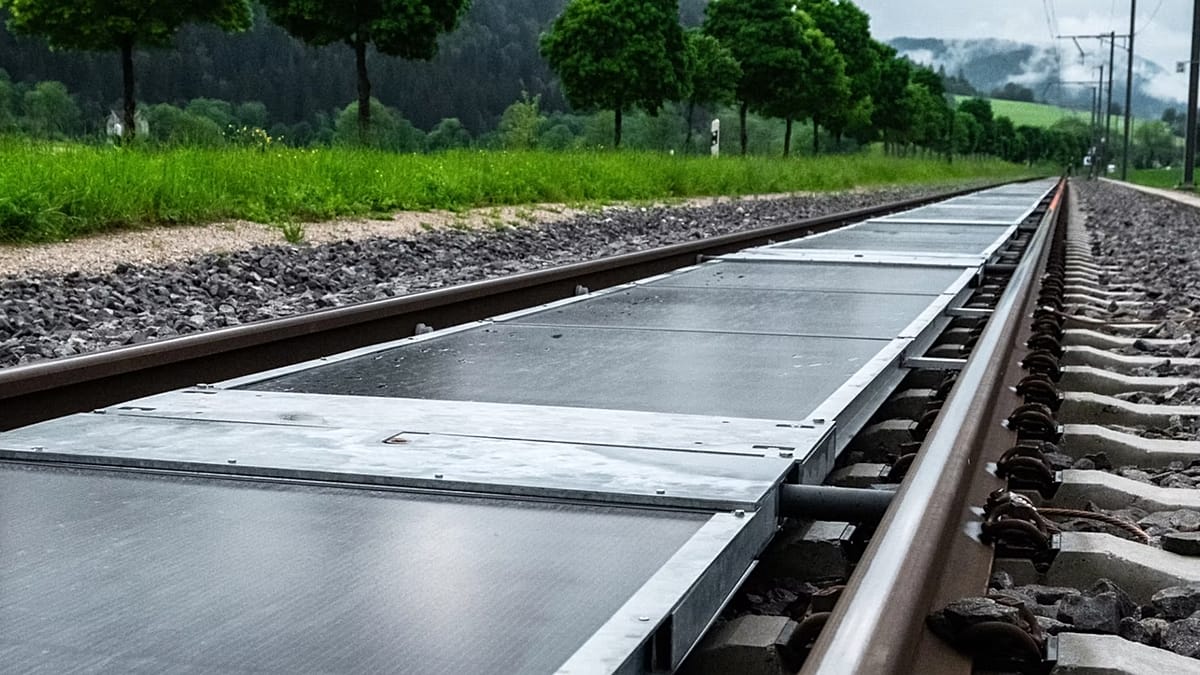
A Swiss start-up has demonstrated that railway tracks can double as solar energy generators, and Italy is now preparing to follow suit. Sun-Ways, based in the canton of Vaud, installed 48 photovoltaic panels along a 100-metre stretch of active track in the village of Buttes, in the Val-de-Travers district, last year. Originally conceived as a three-year experiment, the project has performed so well that a permanent installation is now likely, the company told Euronews Earth.
The panels, specially designed for railway use, have a combined capacity of 18 kWp. In their first year, they generated approximately 16,000 kWh—roughly the annual electricity consumption of a fully electrified UK household, including heating, hot water, lighting, and appliances. Sun-Ways estimates that deploying similar panels across Switzerland’s entire 5,317-kilometre rail network could cover an area equivalent to 760 football fields and produce around one terawatt-hour (TWh) per year, or about two percent of the country’s total energy use.
Addressing Safety and Efficiency Concerns
Solar panels are typically tilted to maximise sunlight absorption—in Spain, for instance, an optimal angle of 30° to 35° yields annual production losses below one percent. Railway panels, by contrast, lie flat between the rails. Sun-Ways acknowledges a production loss of roughly ten percent due to this lack of inclination, but the trial results suggest the trade-off is acceptable.
Safety was a key concern raised by the International Union of Railways, which warned of potential micro-cracks, fire risks, and glare that could distract train drivers. Sun-Ways responded by using more robust panels than standard rooftop models, fitted with anti-reflection filters. Built-in sensors monitor performance, and brushes attached to the ends of trains clean the panel surfaces. After one year of operation, the company reported no special maintenance was needed and that the system “worked perfectly.” Currently, the electricity is fed into the grid, but Sun-Ways is developing methods to route it directly into railway substations or traction lines.
Italy’s national railway infrastructure manager, Rete Ferroviaria Italiana (RFI), is now in discussions with a local business partner of Sun-Ways. A pilot project is expected to be announced in the coming months. If successful, it could pave the way for broader adoption across the continent, turning Europe’s extensive rail networks into distributed solar farms.
The development comes as European countries accelerate renewable energy deployment. Solar power continues to surge globally, and integrating generation into existing infrastructure—like railways—offers a way to use land efficiently without competing with agriculture or natural habitats. Sun-Ways’ approach is particularly suited to the dense rail networks of Western and Central Europe, where space for ground-mounted solar farms is limited.
Switzerland’s successful trial also highlights the potential for other nations. The country’s mountainous terrain and extensive rail system make it an ideal testbed, but the technology is adaptable. Italy’s interest suggests that Mediterranean countries, with higher solar irradiation, could achieve even better yields. The partnership with RFI may also accelerate regulatory approvals, as rail infrastructure is often subject to strict safety and operational standards.
While Sun-Ways has not disclosed the cost of the Buttes installation, the company is scaling up production to reduce per-panel expenses. If Italy’s pilot proves viable, solar railways could become a familiar sight across Europe within a decade, contributing to the EU’s goal of carbon neutrality by 2050.