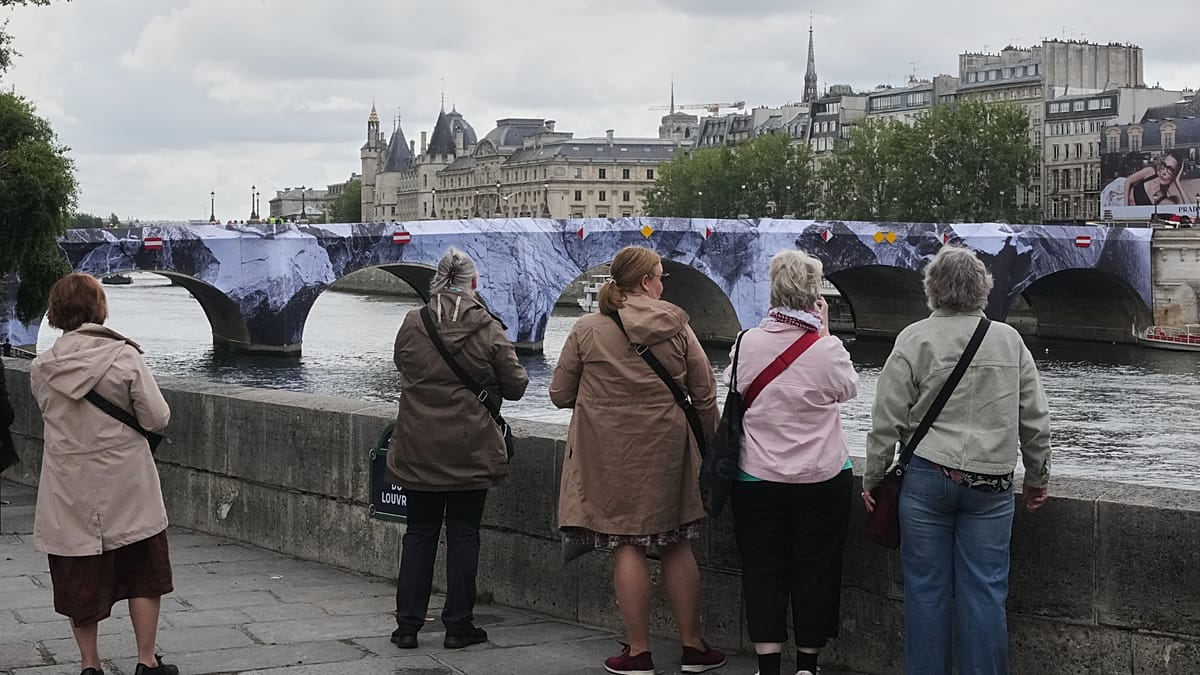
Paris's oldest bridge, the Pont Neuf, is undergoing a dramatic transformation. By 6 June, the French artist JR will have turned it into a monumental cavern, a work titled La Caverne du Pont Neuf. The installation spans 120 metres in length, 20 metres in width, and reaches up to 18 metres in height, enveloping the bridge's stone arches and quays in a vast, immersive environment.
JR, known for his large-scale photographic interventions across the globe, describes the project as an attempt to “juxtapose the raw and the wild” and to create “a dialogue between past and present.” The work invites visitors to experience the bridge not as a thoroughfare but as a space of contemplation, where the ancient structure meets contemporary art.
A Soundscape by Daft Punk's Thomas Bangalter
Adding to the sensory experience, JR has commissioned Thomas Bangalter, formerly of the electronic duo Daft Punk, to compose the sound world that will pervade the cavern. The audio component is designed to deepen the immersion, echoing the cavern's visual drama with a carefully crafted sonic environment.
The installation will be open to everyone, 24 hours a day, for three weeks, from 6 to 28 June. It is a fully accessible public artwork, free of charge, allowing Parisians and visitors alike to wander through the transformed space at any hour.
Forty Years After Christo and Jeanne-Claude
JR's project arrives exactly forty years after the artist duo Christo and Jeanne-Claude famously wrapped the Pont Neuf in fabric in 1985. That earlier work, which shrouded the bridge in beige cloth, became a landmark in public art. JR's cavern, by contrast, does not wrap the bridge but hollows it out, creating a negative space that invites exploration.
Like Christo and Jeanne-Claude's project, La Caverne du Pont Neuf is funded entirely by private sponsorship. The artist has long relied on corporate and philanthropic support for his large-scale works, which often engage with social and historical themes. This approach keeps the art independent of public budgets, though it also raises questions about commercial influence in public spaces.
Reactions among Parisians are mixed. “I like it when Paris is alive, and this is clearly going to be a really beautiful event,” said a thirty-something man near the bridge, which is currently under renovation. Another woman expressed disappointment: “I'm a bit disappointed, in that it doesn't really move me for the moment.” The contrast reflects the perennial tension between novelty and tradition in a city that treasures its architectural heritage.
JR's work is part of a broader trend in European public art that seeks to reimagine urban landmarks. In Vienna, for instance, a massive mural on an office tower recently celebrated the city's hosting of the Eurovision Song Contest, as Vienna Unveils Austria's Largest Mural on Office Tower for Eurovision. Similarly, JR himself transformed a hotel facade in Venice with a socially engaged installation, as JR Transforms Venice Hotel Facade with Socially Engaged Art Installation. These projects underscore how contemporary artists are using the built environment to spark dialogue about history, identity, and community.
The Pont Neuf, despite its name meaning “New Bridge,” is the oldest standing bridge in Paris, completed in 1607. Its stone arches and distinctive half-moon-shaped bastions have survived centuries of change. JR's cavern, by temporarily altering its appearance, invites a fresh look at a familiar monument. Whether it will be remembered as a triumph or a curiosity remains to be seen, but for three weeks in June, Paris will have a new, subterranean-like space at the heart of the city.