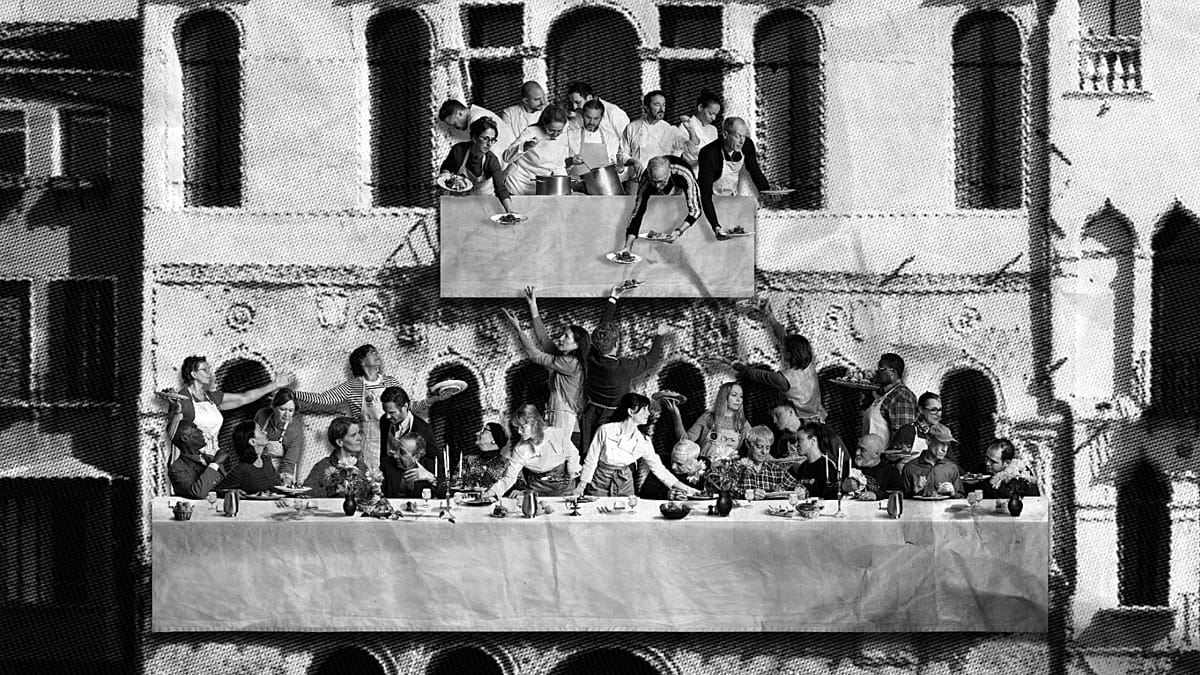
The French street artist and photographer JR has unveiled his latest large-scale installation, Il Gesto, at the Palazzo Ca' da Mosto in Venice, the building that houses the Venice Venice Hotel. The work, created for the 61st International Art Exhibition of the Venice Biennale 2026, transforms the 13th-century Venetian-Byzantine palace into an open-air stage visible from the Grand Canal and the banks of the Rialto.
Inspired by Paolo Veronese's 1563 masterpiece The Wedding at Cana, JR's installation reimagines the biblical banquet scene as a metaphor for contemporary social transformation. Where Veronese depicted abundance and choreographed opulence, JR presents a table populated by 176 real individuals—volunteers, chefs, and guests from the Refettorio Paris community, an anti-waste culinary and cultural project that turns surplus food into elegant meals while fostering social inclusion.
From Renaissance Feast to Modern Encounter
Il Gesto does not simply replicate Veronese's composition; it subverts it. The original painting's miracle of water turned into wine becomes, in JR's hands, a symbol of the work done by Refettorio Paris to reduce food waste and strengthen human connections. The table in Il Gesto highlights the real and often complicated lives of people today, serving as a metaphor for equality rather than hierarchy.
Each portrait in the installation is accompanied by a recording, creating a living archive that chronicles the voices and lives of individuals often at the edges of society. Visitors can read, listen, and explore the installation simultaneously, while a digital platform offers deeper insight into the stories behind the faces. JR has also created a portal that allows the public to learn more about the creative process behind the work.
Inside the Palazzo Ca' da Mosto, the installation begins on the Second Piano Nobile, in the grand salon, and extends into an adjoining room. The space features grand chandeliers, a mirrored table, and a giant tapestry made from yarns of virgin wool, recycled plastic, washi paper, and organic cotton—a nod to Venice's textile heritage and artisan traditions.
Art as Social Intervention
JR's work has long blurred the line between art and social activism. His previous projects include Portrait d'une Génération, which challenged stereotypes about young people from Parisian suburbs; Kikito, a giant child peering over the US-Mexico border; and the anamorphosis installations at the Louvre Pyramid. Il Gesto continues this tradition, using the Venice Biennale as a platform to ask fundamental questions about community and visibility.
“By bringing together people of different origins in a single composition, I ask: what idea of community are we building today? Who is truly visible? Who is invited to sit at the table? What does it mean, at the deepest level, to share a meal?” JR said. “In this work, the banquet becomes a necessary space of encounter, where beauty ceases to be a privilege and becomes a shared human experience.”
The Venice Venice Hotel itself is a study in contrasts: a 13th-century palace with a 20th-century avant-garde interior, embodying the so-called “postvenezianità” style. The hotel's facade, covered in ultra-lightweight panels, now merges the gestures and faces of the Refettorio community with ancient stone, peeking through windows and inviting passersby to participate in the shared experience.
The installation is part of a broader trend of Europe's art hotels blending contemporary art with hospitality, a movement that has gained momentum in cities like Venice, Berlin, and London. JR's project also coincides with the Venice Biennale's broader cultural program, which this year includes performances by Marina Abramović and the band Broken Social Scene.
By turning a historic palazzo into a living archive of human dignity, JR reminds us that art can be both a mirror and a catalyst. Il Gesto will remain on display throughout the Biennale, offering a quiet but insistent counterpoint to the spectacle of the art world's most prestigious gathering.