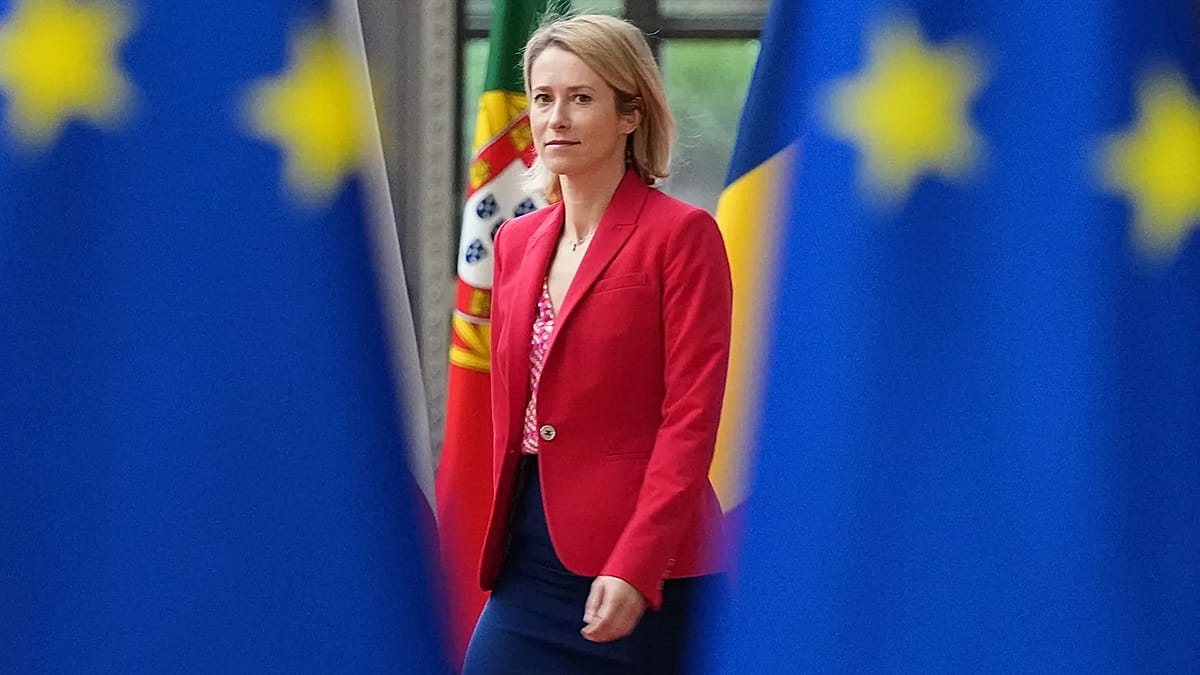
EU foreign policy chief Kaja Kallas has firmly rejected the possibility of former German Chancellor Gerhard Schröder acting as a European mediator in potential peace negotiations between Ukraine and Russia. Speaking to journalists ahead of an EU foreign affairs ministers’ meeting in Brussels on Monday, Kallas dismissed the suggestion, which had been floated by Russian President Vladimir Putin over the weekend.
Putin proposed on Saturday that Schröder, who served as German chancellor from 1998 to 2005, could represent European interests in future talks, claiming the conflict was “heading towards an end”. However, Kallas was unequivocal in her response. “First, if we give Russia the right to appoint a negotiator on our behalf, that would not be very wise. Second, I think Gerhard Schröder has effectively been a high-level lobbyist for Russian state-owned companies,” she said.
Kallas added that Putin’s preference for Schröder meant “he would effectively be sitting on both sides of the table”. The EU foreign policy chief’s remarks came as ministers gathered to discuss a range of issues, including sanctions on Russia and the ongoing war in Ukraine, as reported in EU Foreign Ministers Tackle Sanctions on Russia, Israeli Settlers, and Syria Talks.
Schröder’s Controversial Ties to Russia
Schröder has maintained close personal and professional links with Putin since leaving office. He served on the board of Russian oil giant Rosneft until 2022 and held roles with other Russian state-owned energy firms, including Nord Stream AG and Gazprom. These connections have long drawn criticism across Europe, particularly after Russia’s full-scale invasion of Ukraine in February 2022.
Putin’s proposal was also swiftly rejected by Ukraine. Speaking on Monday, Ukrainian Foreign Minister Andrii Sybiha was asked whether Kyiv supported Schröder as a possible mediator. “No, we do not,” he replied bluntly. The rejection underscores the deep mistrust between Ukraine and figures perceived as too close to the Kremlin.
The idea of Schröder as a mediator received a mixed response across Europe, with many EU member states viewing it as an attempt by Moscow to influence the negotiation process. The episode comes amid broader discussions about the trajectory of the war, as Putin has recently signaled that the conflict could be nearing an end, a topic explored in Putin Signals Ukraine War Could End Soon as EU Ministers Convene in Brussels.
EU’s Unified Stance on Ukraine
Kallas’s firm rejection of Schröder reflects the EU’s broader strategy of maintaining a unified front against Russian aggression. The bloc has imposed multiple rounds of sanctions on Russia and continues to provide military, economic, and humanitarian aid to Ukraine. The foreign ministers’ meeting in Brussels also addressed other pressing issues, including sanctions on Israeli settlers and developments in Syria.
The EU’s position is that any peace negotiations must be led by Ukraine, with the bloc playing a supporting role rather than allowing external actors to dictate terms. Kallas’s comments highlight the importance of avoiding conflicts of interest in mediation efforts, particularly when the proposed mediator has deep financial ties to the aggressor state.
As the war grinds on, the question of who might mediate future talks remains contentious. While Putin has floated Schröder as a candidate, the EU and Ukraine have made it clear that such a proposal is unacceptable. The episode serves as a reminder of the complex diplomatic landscape surrounding the conflict, where even the suggestion of a mediator can spark controversy.