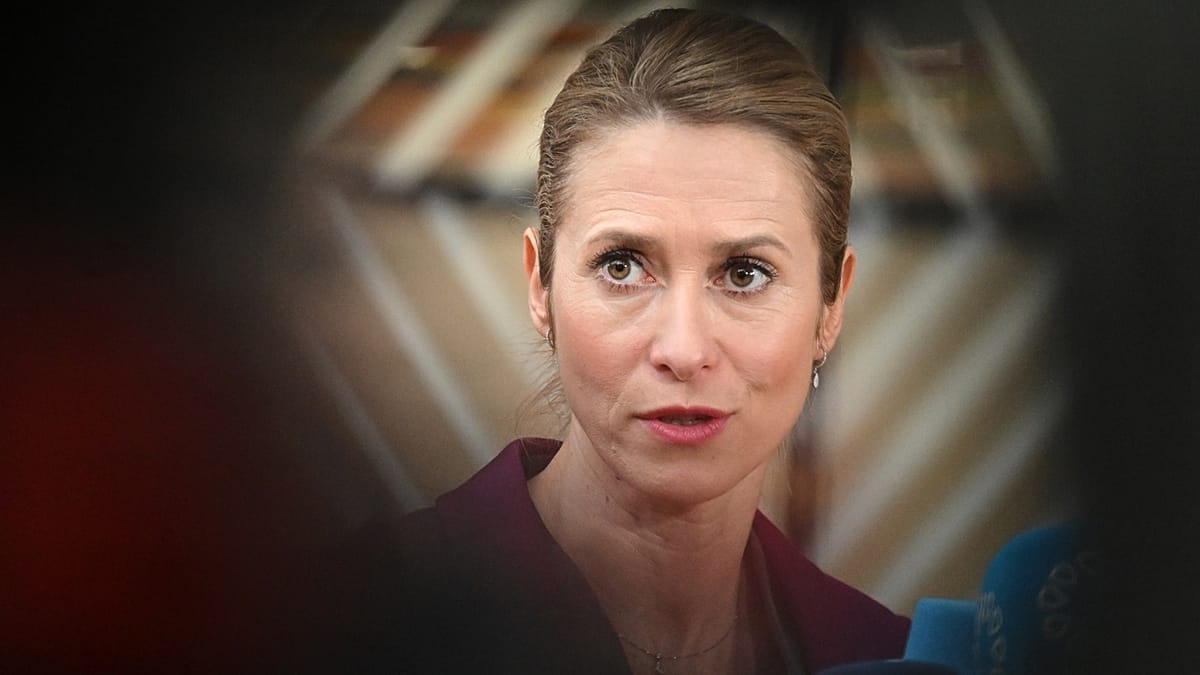
The position of High Representative for Foreign Affairs and Security Policy has always been a balancing act. But for Kaja Kallas, the current officeholder, the tightrope has become nearly unmanageable. An informal document circulated by the French government, proposing three options to reshape her role, has triggered a political storm that reveals far more than personal dissatisfaction with the former Estonian prime minister.
The French paper suggests either strengthening Kallas's portfolio by adding trade and economic development, or weakening it by shifting powers to the European Commission under Ursula von der Leyen, or back to the member states. Kallas responded by defending the treaty-based framework that defines her mandate, stating in an internal email that "the roles and responsibilities of the EU institutions are clearly defined in the treaties. That framework remains unchanged."
The timing is no coincidence. Kallas has faced mounting criticism for her outspoken positions on China, her insistence on using frozen Russian assets to support Ukraine, strained relations with the US administration, and a tendency to table ambitious plans without consulting national capitals. Critics argue she still behaves like the prime minister of a small Baltic state, advancing positions that exceed the consensus of the 27 member states. Slovak Prime Minister Robert Fico has repeatedly called for her dismissal.
Structural Dysfunction, Not Just Personality
Diplomats speaking on condition of anonymity acknowledge that the backlash has intensified, but many disagree with the French approach. "She does, unfortunately, a lot to lose support. She is not very good at building alliances in the Council," one senior diplomat said. "But France is currently in all-attack mode against all institutions."
The deeper issue, diplomats say, is institutional. The High Representative sits awkwardly between the European Commission, where she serves as a vice president, and the European External Action Service (EEAS), which she leads. Foreign policy decisions require unanimity among member states, meaning a single veto can derail any initiative. "The EEAS and the position of High Representative were created in a different time and age," another diplomat noted. "If you were to create the system from scratch, you wouldn't do it now the way it was done then."
A third diplomat was blunter: "Structurally, the High Representative cannot succeed, regardless of who it is. She/he doesn't have tools. All previous High Representatives failed, and so will those in the future."
Kallas's Eastern European background also fuels the backlash. Her hardline stance on Russia, shared by Poland, the Baltics, and the Nordics, clashes with the more cautious approach of Western and Southern European capitals. French and German leaders continue to explore direct engagement with Moscow over Ukraine, a path Kallas has publicly opposed.
Meanwhile, tensions between Kallas and von der Leyen's Commission have grown. The Commission has increasingly styled itself as a "geopolitical" actor, taking the lead on responses to Russia's invasion, the energy crisis, and Chinese overcapacity. This institutional overreach has at times backfired, but leaders have largely allowed von der Leyen's remit to expand, further marginalizing the High Representative's role.
France has since downplayed the document, calling it an exploratory note not validated by the government. But the debate it ignited is unlikely to fade. As one diplomat put it: "It's important that the EU has a strong High Representative. That's in our interest." Whether the current structure allows for one remains an open question.