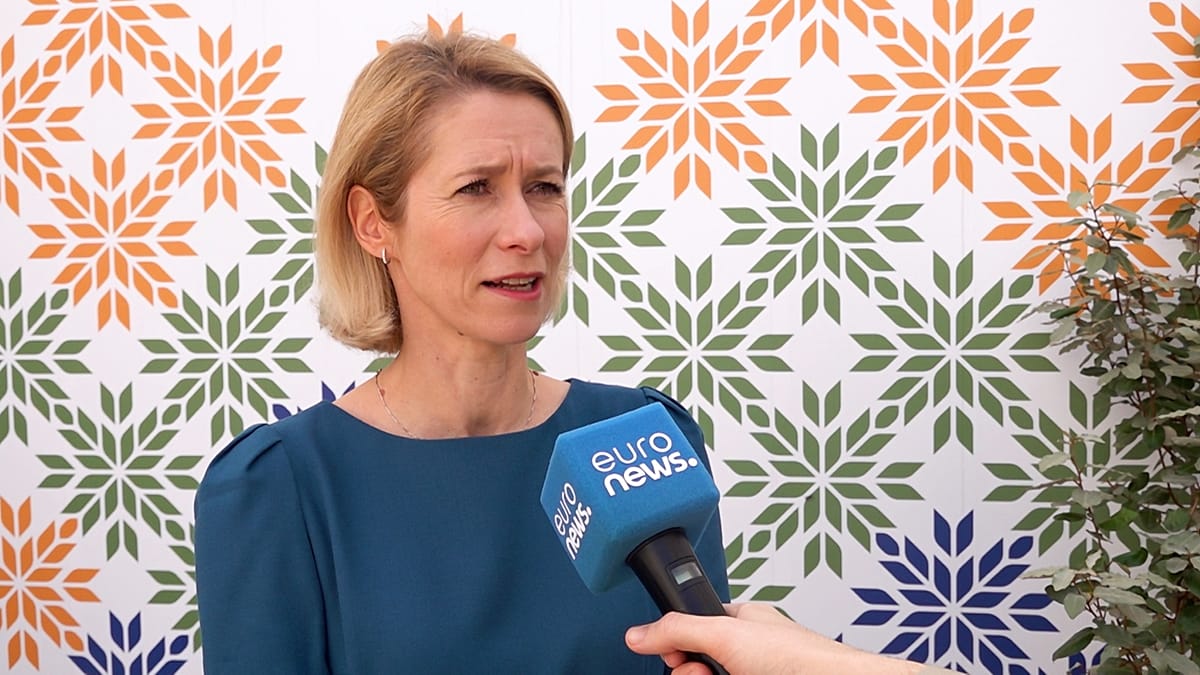
In an exclusive interview with Euronews, the European Union's High Representative for Foreign Affairs, Kaja Kallas, argued that the systematic use of vetoes by individual member states undermines the bloc's democratic foundations. Speaking on the sidelines of an informal summit of EU leaders in Cyprus, Kallas reflected on the end of Viktor Orbán's 16-year tenure as Hungary's prime minister, during which Budapest frequently blocked decisions supported by the other 26 member states.
“We have seen recently that when 26 countries want something, and one does not, then we end up doing what that one country wants, not what the 26 want. So it is not really democracy,” Kallas said. She stressed that the EU treaties are based on unanimity, not a formal veto, but that in practice, a single holdout can hijack the collective will.
Reforming EU Decision-Making
The EU treaties do provide a legal pathway to move from unanimity to qualified majority voting, but such a shift itself requires unanimous consent—a Catch-22 that has long frustrated reformers. Kallas acknowledged the need to examine working methods to become more effective. “In this geopolitical world, we need to be credible—and for that we need to be united and able to take decisions,” she added.
As the EU's foreign policy chief, Kallas has dealt first-hand with Orbán's vetoes, which have blocked joint statements on issues ranging from Ukraine to Russia sanctions. At times, she had to issue statements in her own name after joint communiqués proved impossible. The situation has prompted broader debate within the bloc about ending unanimity to prevent future vetoes, a topic explored in depth in our analysis After Orbán's Exit, EU Debates Ending Unanimity to Prevent Future Vetoes.
Hope for a Reset with Budapest
Kallas expressed cautious optimism about the incoming government of Péter Magyar, who won Hungary's elections on a pledge to restore ties between Budapest and Brussels, currently at an all-time low. “I am very hopeful that we will have good cooperation,” she said. However, Magyar has indicated that the veto remains a “valid option” if used constructively. “We cannot run ahead of events. First, we need to have the new Hungarian government in place, which will probably happen in mid-May,” Kallas noted. “Then we will see whether we can revisit the decisions that have been blocked before.”
This week saw the lifting of two Hungarian vetoes: one on the €90 billion loan to Ukraine and another on the 20th package of sanctions against Russia. However, Orbán appears intent on leaving his veto on Ukraine's accession process—in place for almost two years—as an inheritance for Magyar. As a result, Kyiv has yet to open a single cluster of negotiations. The incoming prime minister has expressed opposition to fast-tracking talks with Kyiv, a view shared by other member states who worry that shortcuts could undermine the credibility of enlargement policy.
Ukraine's Membership Ambitions
Ukrainian President Volodymyr Zelenskyy, meanwhile, continues to push for a clear date for his country's admission under an accelerated timetable. He has rejected overtures for half-baked membership as an alternative to full rights. “Ukraine does not need symbolic membership in the EU. Ukraine is defending itself—and it is also defending Europe. And it is not doing so symbolically—people are really dying,” Zelenskyy said this week before joining EU leaders in Cyprus. “We are defending shared European values. I believe we deserve full membership.”
Kallas, a strong supporter of Kyiv's ambitions, said it was important to work on both sides—public opinion in member states and legal reforms in Ukraine—and to shift the narrative around candidate countries to highlight their potential contributions. “We need to talk about what we gain from these countries joining,” she said. “A bigger Europe, a stronger Europe in terms of defence, and also a larger single market that benefits our companies—all of this makes us a more credible geopolitical power in the world. It is always a geopolitical choice.”
The debate over EU enlargement and decision-making comes at a time when the bloc's credibility is under scrutiny on multiple fronts. As Spanish Prime Minister Pedro Sánchez recently warned, the EU's inaction on Israel undermines its credibility on Ukraine, a point explored in Sánchez Warns EU's Israel Inaction Undermines Ukraine Credibility. For now, all eyes are on Budapest as the transition of power unfolds, with the hope that a new government in Hungary will herald a more cooperative era in EU affairs.