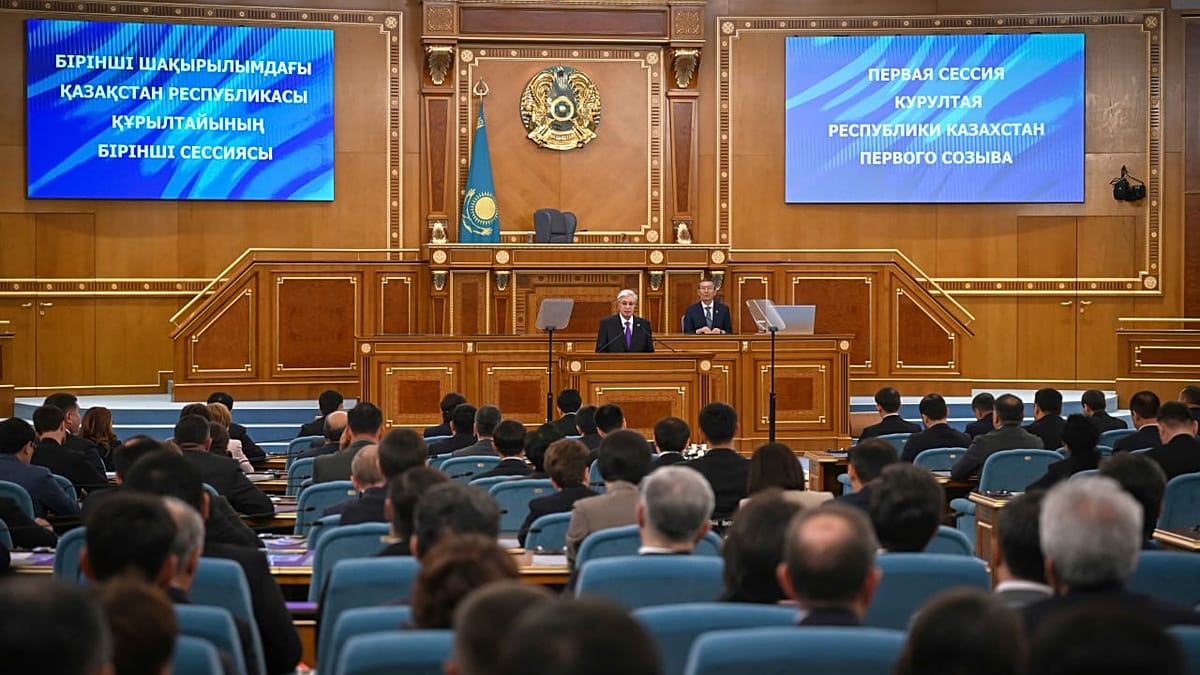
Kazakhstan has entered a new political era as its freshly elected unicameral parliament, the Kurultai, held its inaugural session on Friday in Astana. The gathering follows a landmark constitutional reform that has fundamentally reshaped the country's governance, and it came just days after the pro-government Adilet party secured a commanding victory in the parliamentary elections.
President Kassym-Jomart Tokayev opened the session, addressing all 145 newly elected lawmakers. He described the moment as the start of a significant new chapter in Kazakhstan's development, emphasizing that the Kurultai would modernize the state apparatus and strengthen the legal framework. "From this day, the process of renewing the country's political system begins," Tokayev said. "The Kurultai will fundamentally modernise the system of government and give a powerful impetus to the work of the entire state apparatus."
A new political system takes shape
The new constitution, which came into force on 1 July 2026, replaced the previous bicameral parliament—comprising the Mazhilis and the Senate—with a single-chamber Kurultai. The term "kurultai" has deep historical roots, referring to assemblies among the peoples of the Great Steppe. The constitutional overhaul was approved in a nationwide referendum held on 15 March 2026.
Under the new rules, the government is required to step down before a newly elected Kurultai convenes. Accordingly, the cabinet relinquished its powers on Friday, but President Tokayev signed a decree instructing the outgoing ministers to continue their duties until a new government is formed, ensuring a smooth transition.
Tokayev praised the speed and scope of the reforms, noting that the referendum demonstrated national unity. "By coming together, our people accomplished a great deal in a very short period of time," he said. "Thanks to the nationwide referendum, the country successfully implemented a sweeping constitutional reform."
Adilet's dominance and new leadership
The Kurultai comprises 145 lawmakers elected for five-year terms, representing five political parties. Adilet, which absorbed the former ruling party Amanat (successor to Nur Otan), holds a commanding majority with 110 seats. The Auyl party follows with 10 seats, Respublica with nine, and both the Nationwide Social Democratic Party (OSDP) and Ak Zhol with eight each.
During the session, President Tokayev nominated Aibek Dadebai for the position of chairman of the Kurultai. Dadebai, who has led Adilet since May 2026, previously served as head of the Presidential Administration from February 2024 to May 2026. Tokayev praised his experience and integrity, saying, "I consider him worthy of this position and ask the members of the Kurultai to support his candidacy." Lawmakers subsequently elected Dadebai in a secret ballot.
The Kurultai also elected three deputy speakers: former senator Nurlan Beknazarov, former Mazhilis deputy speaker Dania Espaeva, and Children's Rights Commissioner Dinara Zakiyeva. Eight standing committees will be established, with seven chaired by Adilet members and one by an Auyl representative.
What happens next
Kazakhstan's political transformation will continue over the coming weeks. Once the Kurultai is fully organized, President Tokayev will put forward candidates for vice-president and prime minister, followed by the appointment of a new government after consultations with lawmakers. A deputy chairman of the Security Council will also be appointed to a newly created post.
Tokayev indicated that he would deliver his annual address to the nation once the new parliament and government are fully in place. Institutional changes are set to continue into September, with the establishment of the Kazakhstan People's Council, a new constitutional body representing the country's ethnic, regional, social, and political diversity, which will have the right to initiate legislation.
This political overhaul comes as Kazakhstan seeks to modernize its governance and strengthen its international standing. The country's strategic position in Central Asia and its role in European energy markets make these developments of interest beyond its borders. For more on regional political shifts, see our coverage of Adilet's electoral landslide.
As Kazakhstan navigates this transition, observers will watch how the new Kurultai balances its legislative role with the executive branch, and whether the reforms deliver the promised efficiency and accountability. The coming months will be crucial in determining the effectiveness of the new system.