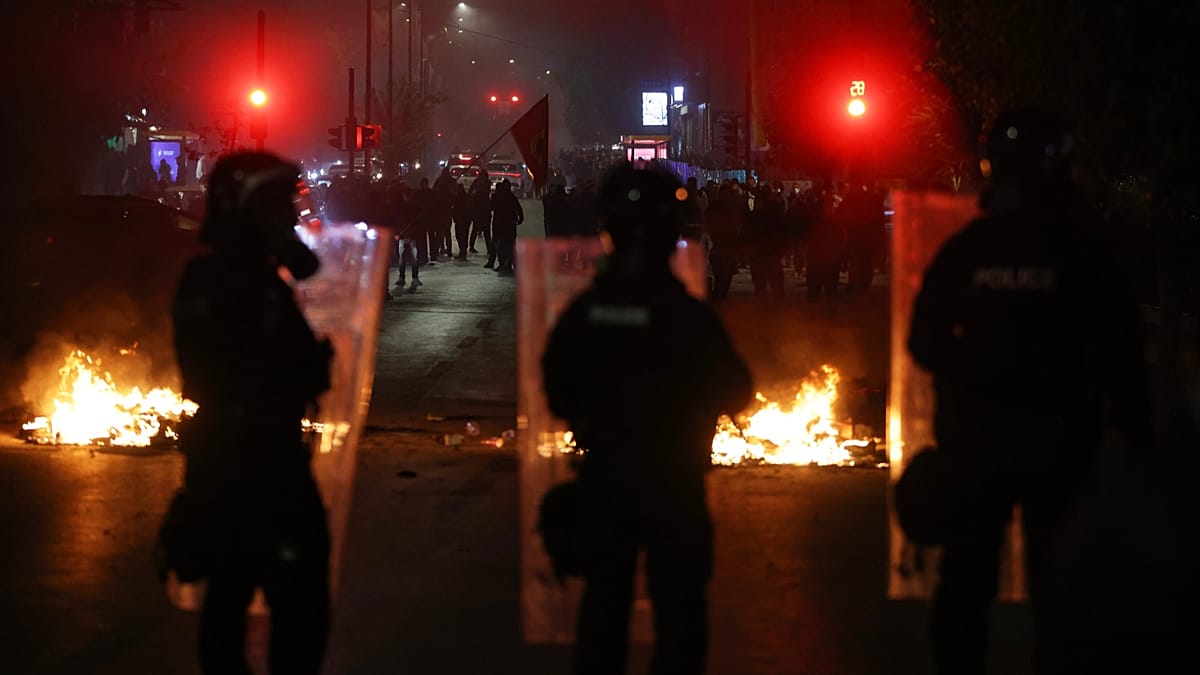
Riot police in Pristina deployed tear gas and a water cannon on Monday night to disperse several hundred demonstrators who had gathered outside Kosovo's parliament, demanding that lawmakers pass a bill to restrict the authority of the country's war crimes court. The protest, which began in the afternoon, turned tense after the parliamentary session ended without approving the legislation.
The crowd, many of whom had vowed to blockade the building until the bill was passed, moved toward police lines in an attempt to prevent lawmakers from leaving. Officers responded with tear gas, while some protesters threw firecrackers and other projectiles. Nearby, rubbish bins were set alight, and police used armoured vehicles to push back the crowd.
Anger over Thaci verdict
The demonstration was fueled by the recent sentencing of former president Hashim Thaci, who was convicted last month by the Kosovo Specialist Chambers (KSC) for crimes committed during the 1990s war of independence against Serbia. Thaci, along with three other former senior guerrilla leaders, received heavy prison terms after being found criminally responsible for murders, illegal arrests, torture, and cruel treatment carried out by Kosovo Liberation Army (KLA) fighters.
For many in Kosovo, these men are seen as heroes of the independence struggle, and the verdict has sparked widespread anger and rallies across the Balkan country. The protesters outside parliament on Monday echoed that sentiment, denouncing the court as biased and unjust.
The bill in question, which cleared its first reading on Monday but was not passed into law, would strip the KSC of its jurisdiction over war crimes and crimes against humanity committed during the conflict between ethnic Albanian guerrillas and Serb armed forces. Instead, its mandate would be limited to crimes committed within Kosovo in the immediate aftermath of the war.
The KSC, based in The Hague, was established to try cases related to allegations of KLA abuses, and its proceedings have been a sensitive issue in Kosovo, where many view the court as an imposition by the international community. The failure to pass the bill is likely to deepen the political divide in the country, with opposition parties and veterans' groups calling for more decisive action.
The European Union and other international partners have urged Kosovo to respect the court's independence, warning that any attempt to undermine it could have consequences for the country's European integration path. Meanwhile, the situation on the streets of Pristina remains tense, with the possibility of further protests in the coming days.
This unrest comes amid broader regional tensions, as similar scenes have played out elsewhere in Europe. In France, students have clashed with police over funding cuts, while in Spain, housing protesters have dug in ahead of new rental legislation. The use of tear gas and water cannons against demonstrators is a recurring image across the continent, raising questions about the balance between public order and the right to protest.
For Kosovo, the challenge is to navigate the delicate path between honoring the legacy of its liberation struggle and meeting the demands of international justice. The coming weeks will be crucial in determining whether the government can find a way to address the concerns of its citizens without further inflaming tensions.