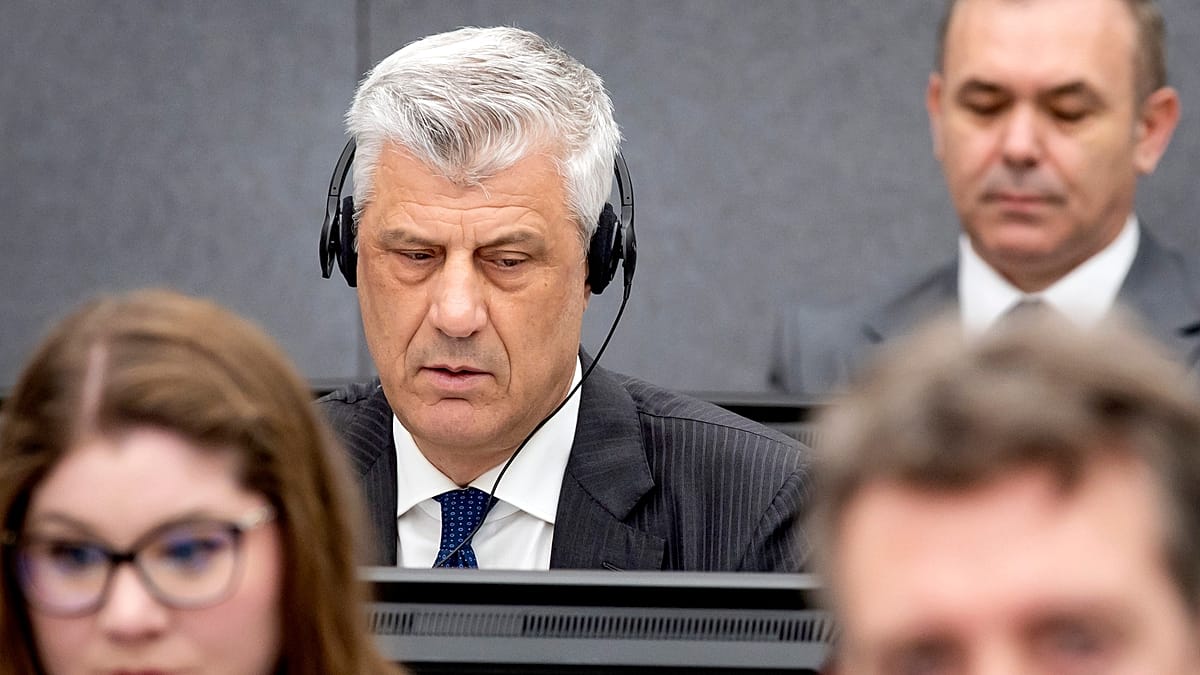
The Kosovo Specialist Chambers in The Hague on Wednesday convicted Hashim Thaçi, the former president of Kosovo, of war crimes committed during the country's 1998-99 independence war against Serbia. The tribunal sentenced him to 25 years in prison.
Thaçi, who also served as prime minister and foreign minister, was found guilty on four counts: murder, torture, cruel treatment and arbitrary detention. The verdict was delivered by a panel of international judges, with Presiding Judge Charles Smith reading the sentence. Thaçi, dressed in a suit and tie, stood silently as the judgment was announced.
The trial, which lasted three years, involved four former senior figures of the Kosovo Liberation Army (KLA): Thaçi, Jakup Krasniqi, Rexhep Selimi and Kadri Veseli. Prosecutors had requested 45-year prison terms for each, but the court imposed sentences ranging from 15 to 26 years. All four had pleaded not guilty.
A hero's fall
Thaçi, now 58, was once celebrated as a founding father of the independent Kosovo. He helped oversee the declaration of independence in 2008, and during a White House visit, then US Vice President Joe Biden called him the "George Washington of Kosovo." His popularity, however, was later overshadowed by a 2010 Council of Europe report that alleged links to organised crime and serious abuses during and after the war.
Critics also accused him of corruption and of concentrating power among political allies. But it was the wartime allegations that abruptly ended his presidency and led to his detention in The Hague.
Throughout the trial, Thaçi's image appeared on billboards across Kosovo, and supporters held regular rallies in Prishtina. On Saturday, tens of thousands gathered in the capital to demand acquittal, with countdown clocks set up in city squares ticking down to the verdict. Many had expected him to be released, and preparations for a possible return were already under way.
Kosovo's Prime Minister Albin Kurti, who had voiced support for the KLA leaders before the verdict, said: "Our war was just, a war of liberation." He added, "We believe and hope that the KLA leaders will return free to their country and to their families."
Controversial court
The Kosovo Specialist Chambers, although based in the Netherlands and staffed by international judges, was established under Kosovo law specifically to prosecute crimes committed by KLA members. The court has been deeply unpopular since its creation, and its use of evidence supplied by Belgrade—which still refuses to recognise Kosovo's independence—has fuelled accusations of political bias.
The defendants were tried for crimes against prisoners held at KLA detention facilities in Kosovo and neighbouring Albania, as well as the politically motivated murders of Serb, Albanian and Roma civilians. The indictment covered crimes committed during and just after the war, which claimed some 13,000 lives and ended with a NATO intervention that pushed Serbian forces out in 1999.
Prosecutors throughout the trial sought to distinguish between the country's independence struggle and the actions of the men on trial. Defence lawyers argued that the KLA lacked a strict command structure, and that senior figures could not control or be held responsible for fighters who committed crimes.
The verdict comes at a sensitive time for the region, with tensions still simmering between Kosovo and Serbia. The court's decision is likely to be met with mixed reactions across the Balkans. In Serbia, the conviction may be seen as validation of its long-standing claims about KLA atrocities, while in Kosovo, many will view it as a betrayal of the liberation struggle.
Thaçi still faces a second trial on charges of obstruction of justice. The case has drawn international attention, highlighting the challenges of post-conflict justice in the Western Balkans. As the region continues to grapple with its past, the ruling serves as a reminder of the complex legacy of the Kosovo war.