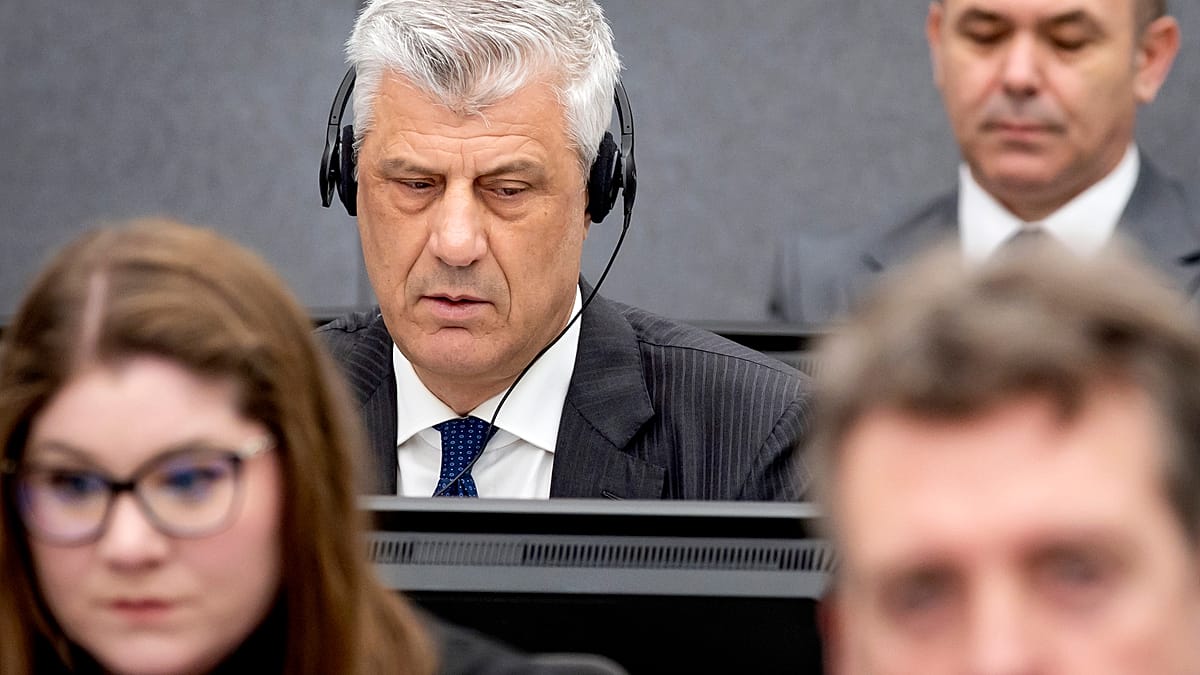
In a landmark ruling, the Kosovo Specialist Chambers in The Hague sentenced former president Hashim Thaçi to 25 years in prison for war crimes committed during the 1998-99 conflict with Serbia. The verdict, delivered on Wednesday, marks the first conviction of a senior Kosovo Liberation Army (KLA) leader by the court, which was established to address allegations of atrocities committed by KLA fighters.
Thaçi, who served as Kosovo's president from 2016 to 2020 and was a key figure in the country's independence movement, was found guilty on charges including murder, torture, and illegal detention. The court determined that he bore criminal responsibility for a campaign of violence against Serbs, Roma, and ethnic Albanian political opponents during and after the war.
The presiding judge, Ekaterina Trendafilova, stated that Thaçi's actions "undermined the very foundations of the rule of law" and that his role in the KLA's leadership did not grant him immunity from accountability. The sentence was met with a mix of relief and outrage, reflecting the deep divisions that persist in the region.
Protests erupt in Pristina
Within hours of the verdict, thousands of Thaçi's supporters gathered in Pristina, the capital of Kosovo, to denounce the ruling. Many waved Albanian flags and chanted slogans in his defense, while some clashed with police who attempted to disperse the crowd. Riot police used tear gas and water cannons to control the situation, and several arrests were reported.
The protests underscore the enduring sensitivity of the war crimes issue in Kosovo, where many view the KLA as liberators who fought against Serbian oppression. For them, the Hague tribunal is seen as biased, focusing disproportionately on KLA actions while ignoring Serbian atrocities. "This is a betrayal of our history," said one protester, who asked not to be named. "Thaçi is a hero, not a criminal."
However, human rights organizations and victims' families welcomed the verdict. "This is a historic step for justice in the Balkans," said a representative from the Humanitarian Law Center in Belgrade. "It sends a message that no one is above the law, regardless of their role in the conflict."
The trial, which began in 2021, heard testimony from dozens of witnesses and examined evidence of a coordinated campaign by KLA forces to eliminate perceived enemies. The court found that Thaçi, as a senior commander, had both direct and indirect responsibility for the crimes, which occurred in detention centers across Kosovo and in neighboring Albania.
Thaçi's defense team has announced plans to appeal the verdict, arguing that the prosecution failed to prove his direct involvement in the alleged crimes. His lawyers have also criticized the court's procedures, claiming that the trial was politically motivated.
The ruling has broader implications for the region. It comes at a time when relations between Kosovo and Serbia remain tense, with EU-facilitated dialogue on normalization stalled. The verdict could complicate efforts to reconcile the two countries, as nationalist voices on both sides seize on the ruling to reinforce their narratives.
European leaders have called for calm and respect for the judicial process. A spokesperson for the European External Action Service said, "The EU respects the independence of the Kosovo Specialist Chambers and urges all parties to accept the court's decision peacefully." The United States, a key ally of Kosovo, also expressed support for the tribunal's work.
For many in Kosovo, the verdict is a painful reminder of the war's legacy. The country, which declared independence in 2008, has struggled to confront its past while building a modern state. The trial of Thaçi, once a symbol of the independence struggle, has forced a reckoning with the darker chapters of that fight.
As the protests subside, the focus now shifts to the appeals process and the potential impact on Kosovo's political landscape. Thaçi remains a polarizing figure, and his conviction is unlikely to heal the deep wounds left by the conflict. Yet, as the court's ruling makes clear, the pursuit of justice, however painful, is an essential step toward lasting peace in the Balkans.