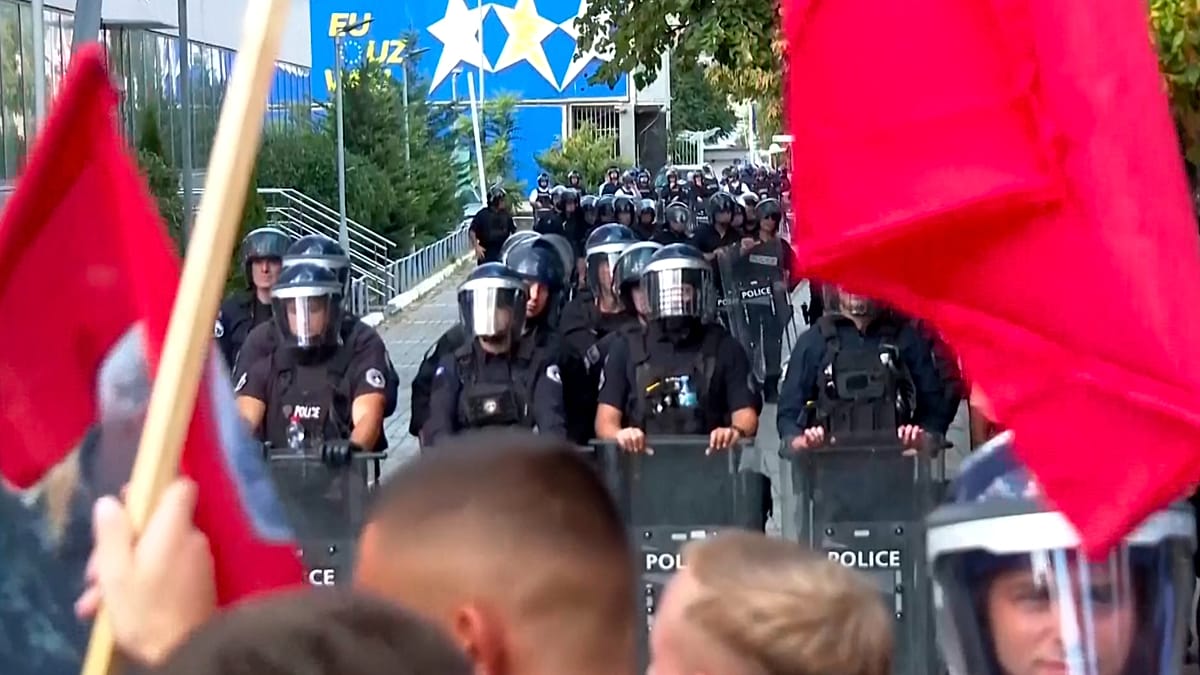
The conviction of Kosovo's former president Hashim Thaçi on war crimes charges has ignited a wave of anger across the country, with demonstrators clashing with police outside the European Union's rule-of-law mission in Pristina. The verdict, delivered by the Kosovo Specialist Chambers in The Hague, sentenced Thaçi to 25 years in prison for his role in crimes committed during the 1998-1999 independence war against Serbia.
Thousands of Kosovars had gathered in the capital on Wednesday, many expecting an acquittal after weeks of rallies organized by Thaçi's supporters. As the sentence was read out, a stunned silence fell over the crowd. Soon after, groups of young men marched toward the EULEX headquarters, waving flags of the Kosovo Liberation Army (KLA) and chanting its name. Some threw stones at the building and scuffled with riot police, who eventually cleared the area. A small group remained until late evening, blocking traffic before heading to Pristina airport to welcome Thaçi's son and that of co-defendant Kadri Veseli.
In The Hague, demonstrators near the court also clashed with police, with some climbing onto a police van. Officers used water cannon to disperse the crowd.
Mixed reactions across the political spectrum
The verdict has deepened divisions in Kosovo, a nation of about 1.6 million people. Prime Minister Albin Kurti called the ruling "a great and harmful punishment" and urged that it be "corrected" on appeal. In a Facebook post, he wrote: "These are unjust findings, but they are not final and will be subject to review on appeal. The reason the KLA was born was not, and cannot, be punished or tarnished."
Pensioner Tahir Bytyqi, who watched the verdict on a large screen in Pristina, expressed the sentiment of many: "This process was not about justice, but politics."
Thaçi, who served as president, prime minister, and foreign minister, was found guilty alongside three other former KLA leaders: Jakup Krasniqi (25 years), Rexhep Selimi (13 years), and Kadri Veseli (18 years). The court ruled that they had "contributed significantly" to a common criminal purpose targeting perceived opponents of the KLA's political and military goals. They were acquitted of charges of crimes against humanity but can appeal the sentences.
Judge Charles Smith, reading the verdict, described the crimes as "very serious," including 96 murders of ethnic Albanians, Serbs, and Roma, some of whom were political opponents. "Murder victims in this case were shot to death, and others died because of the severe beatings," he said, adding that many bodies were found in conditions that amounted to an outrage upon their dignity.
The crimes occurred between April 1998 and June 1999, during and just after the war that claimed some 13,000 lives and ended with a NATO intervention that pushed out Serbian forces.
A court deeply unpopular at home
The Kosovo Specialist Chambers, though based in The Hague and staffed by international judges, was established under Kosovo law to prosecute crimes committed by KLA members. It has been deeply unpopular since its inception, and its reliance on evidence supplied by Belgrade has fueled accusations of political bias. Nevertheless, the court's mandate is strongly backed by Kosovo's international allies, and it has previously convicted several individuals for wartime crimes.
Thaçi, 58, resigned as president and surrendered to the court in 2020 after his indictment. He has been detained in The Hague since, with time served counting toward his sentence. He also faces a second trial on charges of obstruction of justice, for which prosecutors have requested a six-year sentence.
In Serbia, President Aleksandar Vučić expressed dissatisfaction with the verdict, but for different reasons. He criticized the court for allegedly ignoring crimes against ethnic Serb civilians and claimed an anti-Serb bias. "There can be binding judgements, or non-binding ones, it's all the same, Serbs will always be (war) criminals and all the others will be liberators and heroes," Vučić told the press.
The verdict has also reignited debates about the legacy of the KLA and the nature of the independence struggle. For many Kosovo Albanians, Thaçi and his co-defendants remain heroes of the liberation movement, and the court's ruling is seen as an affront to their history. The protests, though largely peaceful, underscore the deep emotional and political fault lines that persist in the Western Balkans.
As the appeals process begins, the region watches closely. The case has broader implications for international justice and the delicate balance between accountability and reconciliation in post-conflict societies. For now, the streets of Pristina and The Hague reflect a nation grappling with a painful past and an uncertain future.